Living page, updated in place every week. Current update: 24 July 2026, as of the AMIS Market News Summary for Week 30. Monthly baseline: AMIS Market Monitor No. 140 (3 July 2026).
AMIS website
Market Monitor No. 140
AMIS weekly email (free)
Every figure on this board is as reported by AMIS.
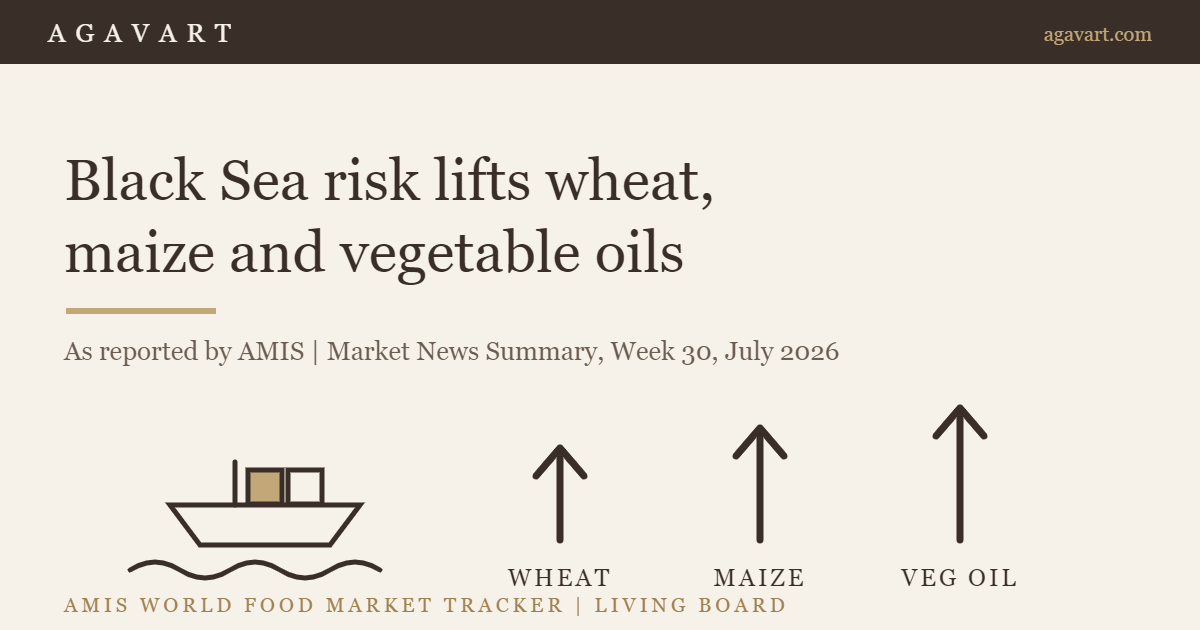
Wheat prices extended their gains in week 30 of 2026 on escalating concerns over Black Sea export flows and weather risks to crops in France, the Russian Federation and the United States. Maize and soybeans drew support from the same Black Sea disruptions and firm Chinese demand, rice firmed on weather concerns in India, and vegetable oils rose with higher crude oil and stronger Indian import demand, according to the AMIS Market News Summary for Week 30 (July 2026).
This week at a glance: Week 30, 2026
| Segment | This week, per AMIS | Direction |
|---|---|---|
| Wheat | Prices extended gains on escalating Black Sea export concerns and weather uncertainty in France, the Russian Federation and the United States. | ▲ Firmer |
| Maize and soybean | Black Sea disruptions and firm Chinese demand supported prices; favourable United States crop ratings and tariff uncertainty tempered the rise. | ▲ Firmer |
| Rice | Supported by weather concerns in India and freight disruptions linked to the Near East; ample global stocks capped gains. | ▲ Firmer |
| Fertilizers | Price trends unchanged on subdued trading; sentiment shaped by Near East export flows and trade policy. | ■ Steady |
| Trade logistics | Pressure building: Black Sea and Red Sea security risks, low water on major European waterways, Panama Canal draft reductions announced for July and August. | ▼ Tightening |
| Vegetable oil and biofuel | Futures rose on higher crude oil and Black Sea disruptions; Indian import demand ahead of festivals further underpinned sentiment. | ▲ Firmer |
| Policy | The United States announced a 25 percent tariff on selected Brazilian goods and proposed 10 to 12.5 percent tariffs on 60 partners (food and fertilizer exempt); Indonesia targets nationwide B50 biodiesel by October; Indian industry seeks review of duty-free edible oil imports from Nepal. | ■ Active |
Directions summarise the price tone described in the AMIS Market News Summary for Week 30 (July 2026).
Week-by-week tracker
| Week (2026) | Wheat | Maize and soybean | Rice | Vegetable oils | Defining theme, per AMIS |
|---|---|---|---|---|---|
| W30 24 Jul | ▲ Black Sea risk, weather | ▲ Black Sea, Chinese demand | ▲ India weather; stocks cap | ▲ Crude oil, Indian imports | Black Sea escalation spreads across the complex |
| W29 17 Jul | ▲ Two-year high | ▲ Maize firm; soybean steady | ▲ Indian reserve price, Philippine buying | ▲ Palm up on crude | Black Sea logistics choke; EU and US heat |
| W28 10 Jul | ▼ Harvest pressure | ▲ Weather risks, China hopes | ■ Policy-driven, mixed | ▲ Soyoil multi-week high | Policy wave: India reserve price, Philippine import ban, Russian export tax back |
| W26 26 Jun | ■ EU heat vs US harvest | ▼ Near lows, ample supply | ■ Mixed; Viet Nam up | ▼ Crude retreat | Hormuz de-escalation eases the complex |
One row is added every week from the AMIS Market News Summary. No weekly summary circulated for week 27; the Market Monitor No. 140 was released that week (3 July 2026).
The monthly baseline: AMIS Market Monitor No. 140 (July 2026)
In its July assessment, AMIS describes agricultural markets as moving through a generally steady period, supported by favourable conditions across the four AMIS crops, with harvest pressure in the northern hemisphere and ample supply prospects balancing localized tightness. Two watch points stand out in the report: El Nino conditions are present and likely to be a high-impact event, and fertilizer markets have eased as flows through the Strait of Hormuz improve.
World supply and demand, 2026/27 forecasts (FAO-AMIS, 3 July 2026)
| Crop | Production | Utilization | Trade | Stocks | Vs previous season |
|---|---|---|---|---|---|
| Wheat | 806.5 | 802.5 | 199.2 | 348.4 | ▼ Tightening |
| Maize | 1316.8 | 1295.5 | 205.0 | 326.8 | ■ Neutral |
| Rice | 552.5 | 558.2 | 60.5 | 214.1 | ▼ Tightening |
| Soybean | 443.9 | 444.8 | 189.9 | 73.4 | ■ Neutral |
All figures in million tonnes. Stocks are carry-overs at the close of national marketing years. The tightening and easing labels are AMIS’s own “Markets at a glance” assessment against the previous season.
International prices, end-June 2026
IGC Grains and Oilseeds Index (GOI) and daily export quotations of 30 June 2026, as published in the Market Monitor. Rice was the only GOI sub-index to rise in June (plus 3.3 percent m/m, a more than one-year high).
Fertilizers and ocean freight, June 2026
| Indicator | June 2026 | Change m/m | Change y/y |
|---|---|---|---|
| Urea (USD per tonne nitrogen) | 1054.9 | minus 34.4% | plus 16.5% |
| Ammonia (USD per tonne) | 828.8 | minus 3.4% | plus 95.2% |
| Phosphate (USD per tonne P2O5) | 1878.3 | plus 0.1% | plus 17.3% |
| Potash (USD per tonne K2O) | 634.7 | plus 2.1% | plus 10.5% |
| Baltic Dry Index (end-June) | 2524.0 | minus 21.7% | plus 69.5% |
| IGC Grains and Oilseeds Freight Index | 177.5 | minus 0.2% | plus 23.8% |
Fertilizer prices are monthly averages based on CRU price data, as published by AMIS. Urea prices fell sharply after an Indian tender attracted offers exceeding 6 million tonnes against a requested 1.7 million tonnes.
The weather watch: El Nino is present
The Monitor’s crop monitor flags El Nino conditions as present, with an early onset in June 2026 and an 84 percent chance of strong or very strong conditions from September through November 2026, per the June 2026 NOAA CPC outlook cited by AMIS. The event is expected to remain active at least through March 2027, with a positive Indian Ocean Dipole also forecast for October to December 2026. A dry start to the kharif season in India and the wet season in Thailand are already noted as rice watch points.
Questions and answers
What is AMIS?
AMIS, the Agricultural Market Information System, is a G20 inter-agency platform created in 2011 to improve transparency in world food markets. Its secretariat is hosted at FAO in Rome, and its assessments are a collective product of ten international organizations, including FAO, IFPRI, IGC, OECD, UN Trade and Development, the World Bank Group, WFP and WTO. It covers wheat, maize, rice and soybeans.
What does this tracker show and how often is it updated?
It restructures AMIS’s two regular outputs onto one permanent page: the weekly Market News Summary (a new tracker row every Friday) and the monthly Market Monitor (world supply and demand, prices, fertilizers and freight, refreshed ten times a year).
What moved world food markets in week 30 of 2026?
Per AMIS, the dominant driver was escalating disruption to Black Sea export flows, which supported wheat, maize, soybeans and vegetable oils, alongside weather risks in France, the Russian Federation, the United States and India, and firm Indian vegetable oil import demand ahead of festivals.
When is the next AMIS Market Monitor due?
The next issue is due on 4 September 2026, followed by 2 October, 6 November and 4 December 2026. There is no August issue.
Sources: AMIS Market News Summary, Week 30, July 2026 (AMIS Secretariat email publication, 24 July 2026); AMIS Market Monitor No. 140, July 2026, amis-outlook.org/market-monitor.