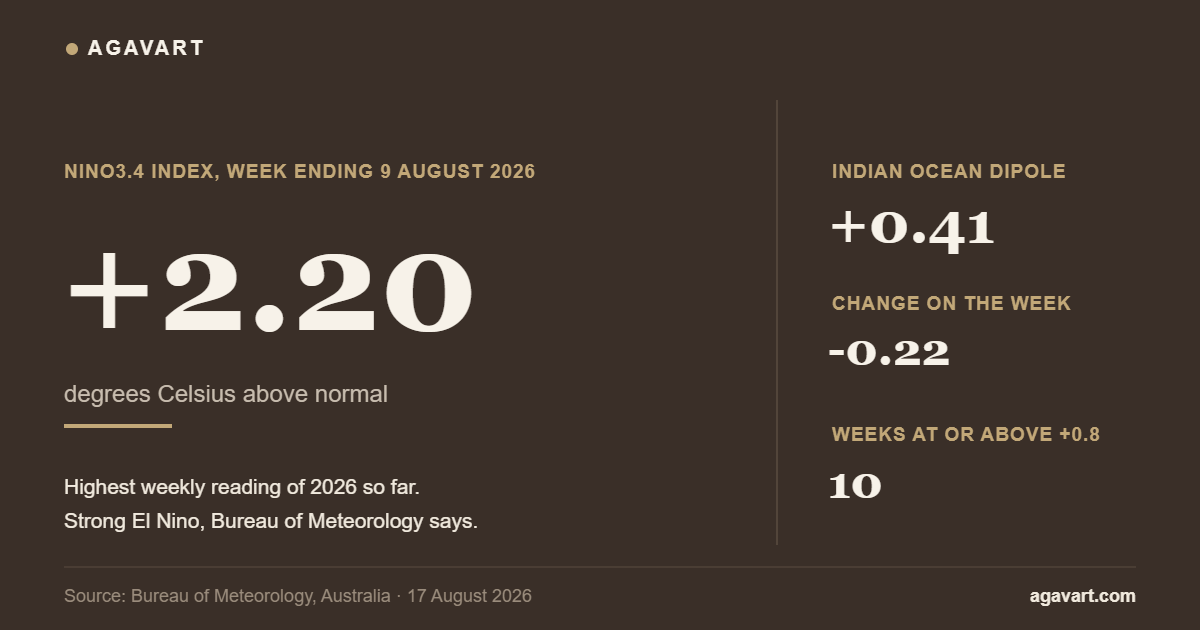
MELBOURNE: The Pacific Nino3.4 index reached +2.20 degrees Celsius for the week ending 9 August 2026 and is indicative of a strong El Nino, Australia’s Bureau of Meteorology said in its Southern Hemisphere Monitoring update issued 11 August 2026. The United States Climate Prediction Center, in its ENSO Diagnostic Discussion issued 13 August 2026, put the chance of a very strong event during the Northern Hemisphere fall and winter above 90 per cent.
Ocean and atmosphere both point the same way
The Bureau said equatorial upper ocean heat anomalies during July 2026 were the highest on record for any month since 1979, and that trade winds, pressure and cloud patterns were all consistent with a strong El Nino. The Southern Oscillation Index, the atmospheric measure of ENSO, was strongly negative, at minus 25.6 over the 30 days to 8 August, well below the Bureau’s minus 7 threshold. The July average of minus 29.1 was the most negative July value on record.
A historic event is now on the table
NOAA’s Climate Prediction Center said its July Nino index readings stood at +1.4 degrees Celsius in Nino-3.4, +1.7 in Nino-3 and +2.9 in Nino-1+2, on its own monthly measurement basis, which is not directly comparable to the Bureau’s weekly figure above. The agency put the chance of a historic event, one that would exceed every El Nino since 1950, at 69 per cent for October to December 2026. Both agencies expect the event to keep strengthening through the rest of the year, with the Bureau saying it is likely to persist into autumn 2027.
Indian Ocean Dipole still neutral
The Indian Ocean Dipole is currently neutral, the Bureau of Meteorology said. The weekly index stood at +0.41 as of 9 August 2026, the third consecutive week it has reached the positive dipole threshold of +0.4, but the Bureau requires sustained values above that level before an event is considered established. Models suggest a positive dipole will develop during the southern hemisphere winter and persist into spring, though the Bureau noted uncertainty in its timing and strength.
What to watch: The Bureau of Meteorology publishes a new weekly Nino3.4 and Indian Ocean Dipole reading every Tuesday. NOAA’s Climate Prediction Center will issue its next ENSO Diagnostic Discussion on 10 September 2026.
Source: Southern Hemisphere Monitoring, Bureau of Meteorology, Australia (bom.gov.au/climate/enso). ENSO Diagnostic Discussion, Climate Prediction Center, NOAA (cpc.ncep.noaa.gov).
Curated and Reviewed by Deepak Chavan.