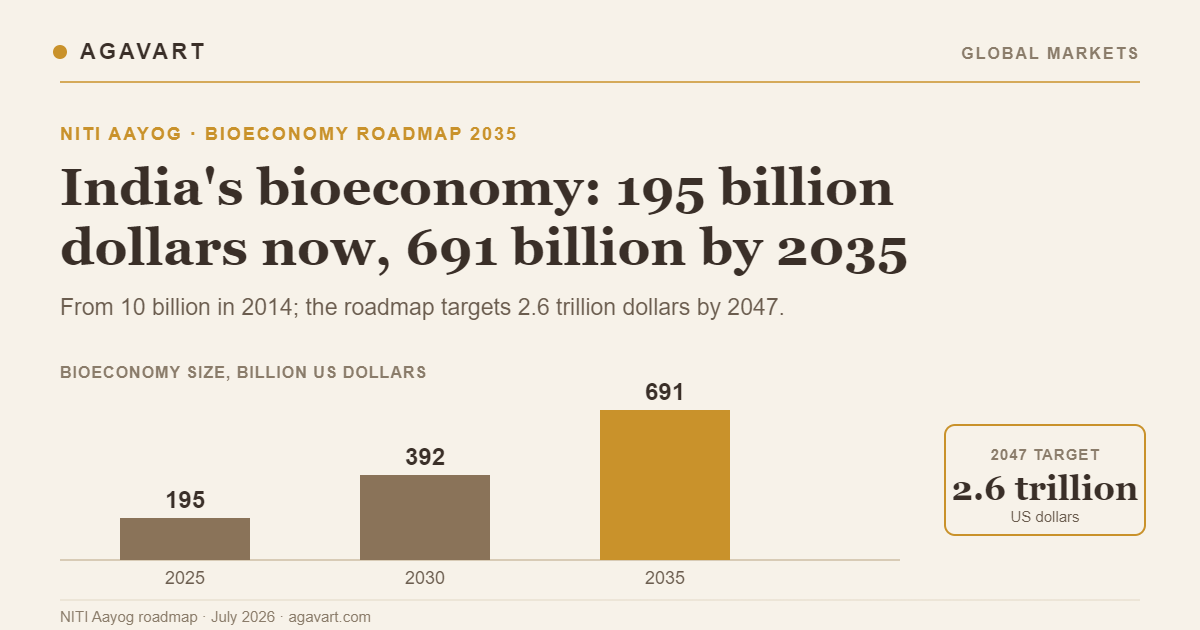
India’s bioeconomy has grown sixteen-fold in a decade, from 10 billion dollars in 2014 to 195.30 billion dollars in 2025, now contributing 4.8 percent of national GDP. A new NITI Aayog roadmap sets a bolder path: 691 billion dollars by 2035 and 2.6 trillion dollars by 2047, creating more than 30 million high-value jobs and placing India among the world’s top three biotechnology powers.
The roadmap argues that incremental growth is no longer enough. It proposes a shift to mission-mode execution through six National BioMissions, a dedicated 50,000 crore rupee growth fund, and deep integration of artificial intelligence with biology. The stated ambition is for India to move from being the world’s trusted supplier of affordable medicines to shaping the rules, markets and platforms of the biological age.
The India bioeconomy in numbers
The growth path: 2025 to 2047
GDP contribution rises from 4.8 percent now to 4 to 4.5 percent of an 8 trillion dollar economy by 2030, 5 to 6 percent of an 11 trillion dollar economy by 2035, and 8 to 10 percent of a 30 trillion dollar economy by 2047. By 2035 the roadmap also targets 100 billion dollars of biotech exports and 15 globally competitive biotech companies.
If you have a moment, read on for the full breakdown, the six BioMissions, the global comparison and the sources.
Where the growth comes from: segment projections
| Segment | 2030 | 2035 | 2047 | Key drivers |
|---|---|---|---|---|
| BioIndustrial | 180.40 | 318 | 1,195 | Biofuels, biogas, bio-based chemicals, smart proteins, enzymes, biopolymers, bioplastics |
| BioPharma | 129.40 | 228 | 857 | Vaccines, biosimilars, monoclonals, mRNA therapies, cell and gene therapies, APIs |
| BioIT / Research | 31.30 | 55 | 208 | Bio-AI, multi-omics, genomics, proteomics and metabolomics as services, bioinformatics |
| BioAgri | 51 | 90 | 338 | Gene-edited crops, biopesticides, biochar, biofertilizers, precision farming, biostimulants |
| Total | 392 | 691 | 2,598 |
The six National BioMissions
| Mission | Focus area | Lead agency | Outcome by 2035 |
|---|---|---|---|
| GeneIndia | Cell and gene therapies | DBT and ICMR | Affordable gene cures |
| AgriBio 2.0 | CRISPR crops, bioinputs | DBT, ICAR and MoA&FW | Climate-resilient crops |
| BioX Foundry | Design-build-test-learn platforms | CSIR and DBT | 100 synthetic biology startups |
| One Health Grid | Zoonosis and biosecurity surveillance | ICMR and MoHFW | Early detection and outbreak preparedness |
| Marine Biotechnology | Marine biotech and algae | MoES and DBT | Exports and blue economy |
| BioPharmaNext | Vaccines, biologics, AI drug discovery | DBT, DoP and CDSCO | Global hub for affordable, next-generation biologics |
How India compares globally
| Country | Current size | Share of GDP | 2040 target | Focus sectors |
|---|---|---|---|---|
| United States | 950 bn | ~5% | 3.5 tn | Synthetic biology, AI biology |
| European Union | 2.6 tn | ~7.5% | 6 tn | Circular bioeconomy |
| China | 500 to 600 bn | ~4% | 2 tn | Gene editing, industrial enzymes |
| Brazil | 300 bn | ~10% | 600 bn | Bio-ethanol, biodiversity |
| India | 195.30 bn | 4.8% | 1.36 tn | BioIndustrial, BioPharma, BioAgri |
| Australia | 65 to 80 bn | ~3 to 4% | 150 to 200 bn | Biopharma, medtech, agri-biotech, synbio |
The global bioeconomy is projected to expand from about 4 trillion dollars in 2025 to more than 30 trillion dollars by 2050. Emerging markets, India among them, are expected to be major growth drivers.
What it means, why it matters, what comes next
India enters the biological decade from a position of real strength. It runs the world’s largest vaccine manufacturing base, a globally trusted generics and biosimilars industry, deep public research institutions, and a startup ecosystem that has grown from around 50 firms a decade ago to more than 10,000 today. The pandemic response, when India developed and deployed indigenous vaccines at population scale, was not a one-off but the payoff from four decades of institutional investment that began with the Department of Biotechnology in the 1980s.
Why the urgency now. The roadmap frames biotechnology as the next mega-disruption, comparable in scale to what computing did to information. Leading economies are already moving with intent: the United States has adopted a whole-of-government approach to biomanufacturing, the European Union is tying biotechnology to industrial competitiveness and climate goals, and China is using its five-year plans to industrialise at scale. The lesson the document draws is blunt. Leadership in the biological age will not flow from scientific excellence alone. It comes from integrated systems that align capital, regulation, skills, data and manufacturing, and it accrues disproportionately to those who move early.
The gaps are equally clear. India has only about 259 researchers per million people, thin mid-to-late stage capital, limited good-manufacturing-practice infrastructure, and regulatory timelines that average close to 900 days against 500 days in peer countries. High dependence on imported raw material and low-cost competition from Chinese biotech add to the pressure.
What comes next is a delivery agenda rather than another vision statement. The plan rests on six National BioMissions, a 50,000 crore rupee (about 5.8 billion dollar) BioEconomy Growth Fund for 2026 to 2035 to bridge the gap between proof-of-concept and plant-scale manufacturing, differentiated and time-bound regulatory pathways including sandboxes for cell and gene therapies and AI-designed drugs, and a decisive push on the talent pipeline. For agriculture, the AgriBio 2.0 mission aims to put commercially deployable, climate-resilient crop varieties and quality-assured bioinputs into farmers’ hands by 2035, cutting chemical dependence while protecting soil health and farm profitability. The roadmap is candid that the cost of hesitation is high: 30 to 35 million jobs, first-mover advantage, and a share of the fastest-growing deep-tech industrial domain are all on the line.
Frequently asked questions
How big is India’s bioeconomy right now?
It reached 195.30 billion US dollars in 2025, contributing 4.8 percent of national GDP. That is sixteen times its size of 10 billion dollars in 2014.
What are the 2035 and 2047 targets?
The roadmap targets 691 billion dollars by 2035 (5 to 6 percent of GDP) and 2.6 trillion dollars by 2047 (8 to 10 percent of GDP), along with more than 30 million high-value jobs.
What are the six National BioMissions?
GeneIndia for cell and gene therapies, AgriBio 2.0 for climate-resilient crops and bioinputs, BioX Foundry for synthetic biology, One Health Grid for disease surveillance, Marine Biotechnology for the blue economy, and BioPharmaNext for next-generation biologics.
What does the plan mean for agriculture?
AgriBio 2.0 aims to deliver CRISPR-based, climate-resilient crop varieties and quality-assured bioinputs such as biofertilizers and biopesticides by 2035, improving farm profitability while reducing chemical dependence. BioAgri is projected to grow from 51 billion dollars in 2030 to 338 billion dollars by 2047.
Who prepared the roadmap?
It was prepared by the NITI Frontier Tech Hub at NITI Aayog, in consultation with an expert council and industry, and published in July 2026.
Sources
NITI Aayog and NITI Frontier Tech Hub, Roadmap for Building India as a Leading BioEconomy Powerhouse by 2035, July 2026. All figures in this factsheet are drawn from that report, which cites the India BioEconomy Report and ABLE projections.
Newer on Agavart
India Biofuels Annual 2026: ethanol blending reaches 23.4 per cent as the petrol pool shrinks
USDA Foreign Agricultural Service, GAIN report IN2026-0039, published 25 July 2026. The biofuels segment of that bioeconomy, set out with feedstock, capacity, blending and trade tables.