Korea Economic Survey 2026: OECD Sees 2.6% Growth, Urges Tax and Regional Reform

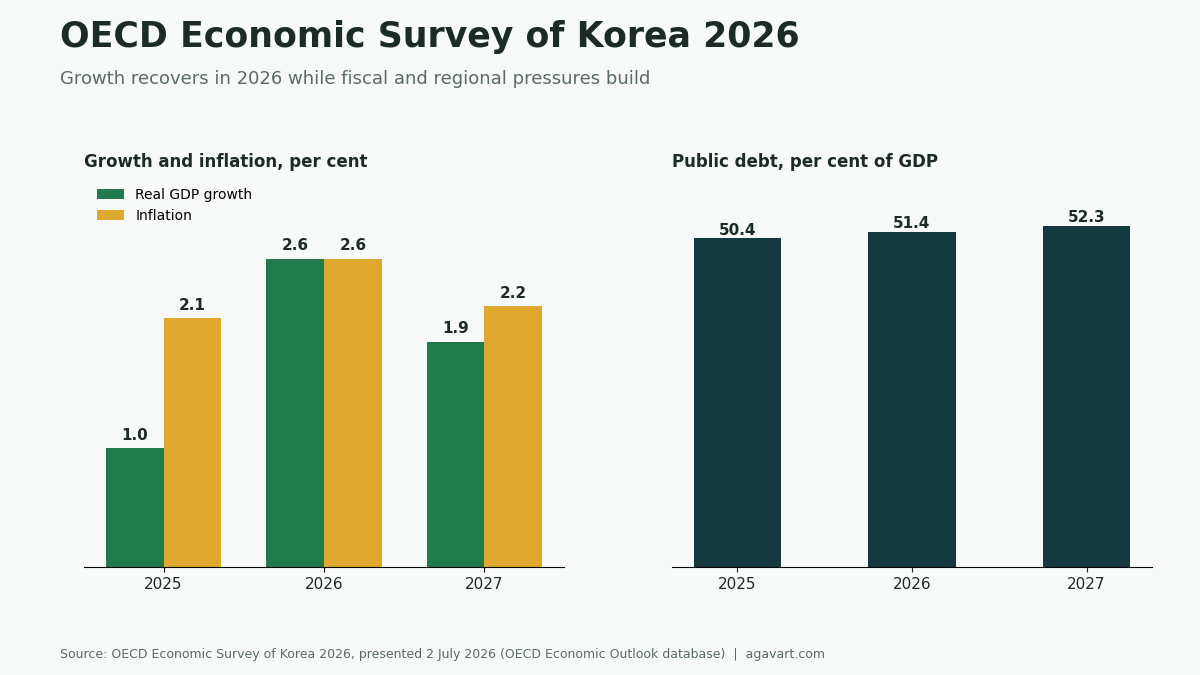
Infographic of the Korea Economic Survey 2026 by the OECD: real GDP growth of 2.6 per cent and inflation of 2.6 per cent forecast for 2026, public debt rising to 52.3 per cent of GDP by 2027

Korea’s economy is set to grow 2.6 per cent in 2026, recovering from 1.0 per cent in 2025 on the strength of exports, according to the OECD Economic Survey of Korea 2026 presented at Sejong on July 2. The Korea Economic Survey pairs the upgraded outlook with a warning: public debt is rising, the energy shock is pressuring inflation, and the gap between the Seoul metropolitan area and the rest of the country keeps widening.

Titled Reshaping the Geography of Opportunity, the survey sets out four priorities: stronger fiscal institutions, a growth-friendly tax rebalance, better adult skills, and targeted investment to revive Korea’s regions.
Read more

World Bank Income Classification 2026: Six Countries Move Up

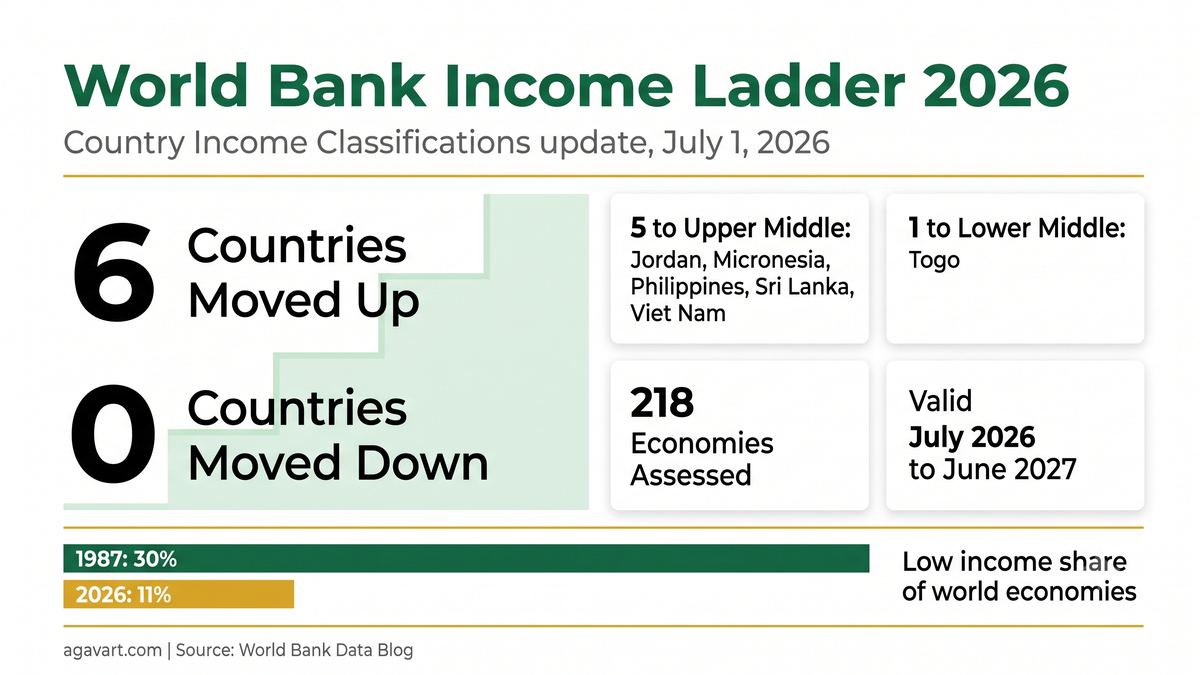
World Bank Income Classification 2026 Six Countries Move Up Infographic by Agavart

Six countries moved to a higher income group in the World Bank income classification update of July 1, 2026. Jordan, Micronesia, the Philippines, Sri Lanka and Viet Nam rose to upper-middle income, and Togo left the low-income group. None of the 218 economies assessed moved down, per the World Bank data blog.

The classification is more than a statistical exercise. It informs which countries can access concessional loans and development assistance, the funding behind schools, hospitals and jobs. The long trend is the bigger story: low-income economies were 30 per cent of the world list in 1987 and are 11 per cent today.

Read more

India’s Oil Intensity Halves to 0.7% of GDP as EV Shift Gathers Pace: SBI Research

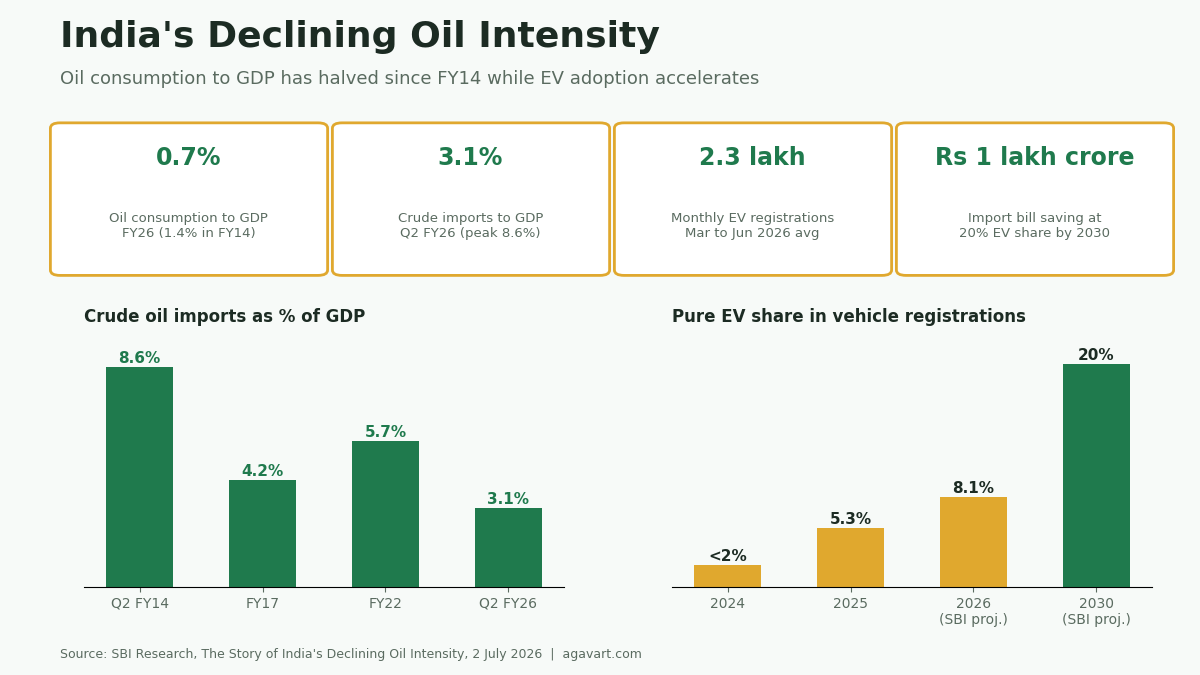
Infographic showing India's declining oil intensity: oil consumption to GDP at 0.7 per cent in FY26, crude imports at 3.1 per cent of GDP and EV registrations averaging 2.3 lakh a month

India’s oil intensity, defined as oil consumption as a share of GDP, has halved from 1.4 per cent in FY14 to 0.7 per cent in FY26, according to SBI Research. Crude oil imports have fallen from a peak of 8.6 per cent of GDP in Q2 FY14 to 3.1 per cent in Q2 FY26. The report, released on July 2, 2026, says this structural decline explains India’s economic resilience through the West Asia crisis.

Electric vehicle registrations have averaged 2.3 lakh a month since the conflict began in February 2026, against 1.3 lakh in 2025. SBI Research argues that a comprehensive EV policy could hasten the fall in oil intensity and save Rs 1 lakh crore on the import bill by 2030.

Read more

India Moves to Put a Monetary Value on Coal Assets Under New Accounting Framework

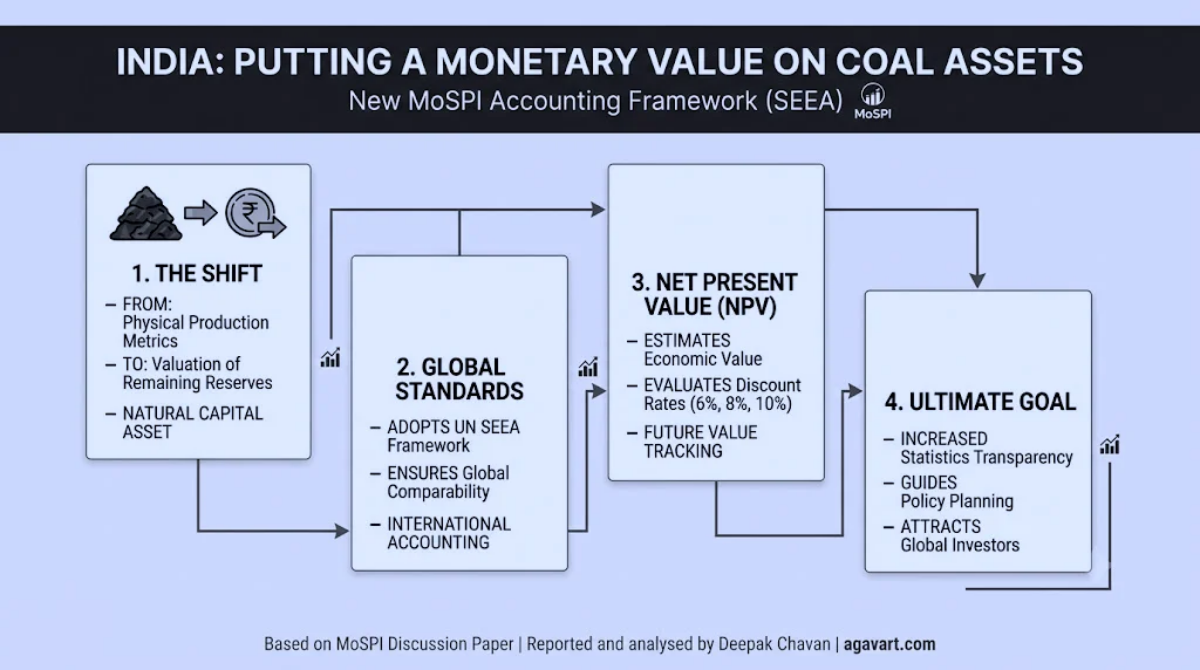
India coal asset valuation framework MoSPI SEEA 2026

India coal asset valuation is moving to the centre of national policy as the Ministry of Statistics and Programme Implementation (MoSPI) proposes a new accounting framework that assigns a monetary worth to the country’s underground coal reserves. Rather than tracking coal purely through production and consumption volumes, the proposed methodology would treat coal deposits as natural capital assets, estimating their present economic value using the Net Present Value (NPV) method and internationally recognised environmental accounting standards.

Read more

China Builds New Growth Model Around Data and Industrial Clusters, Says WEF Report

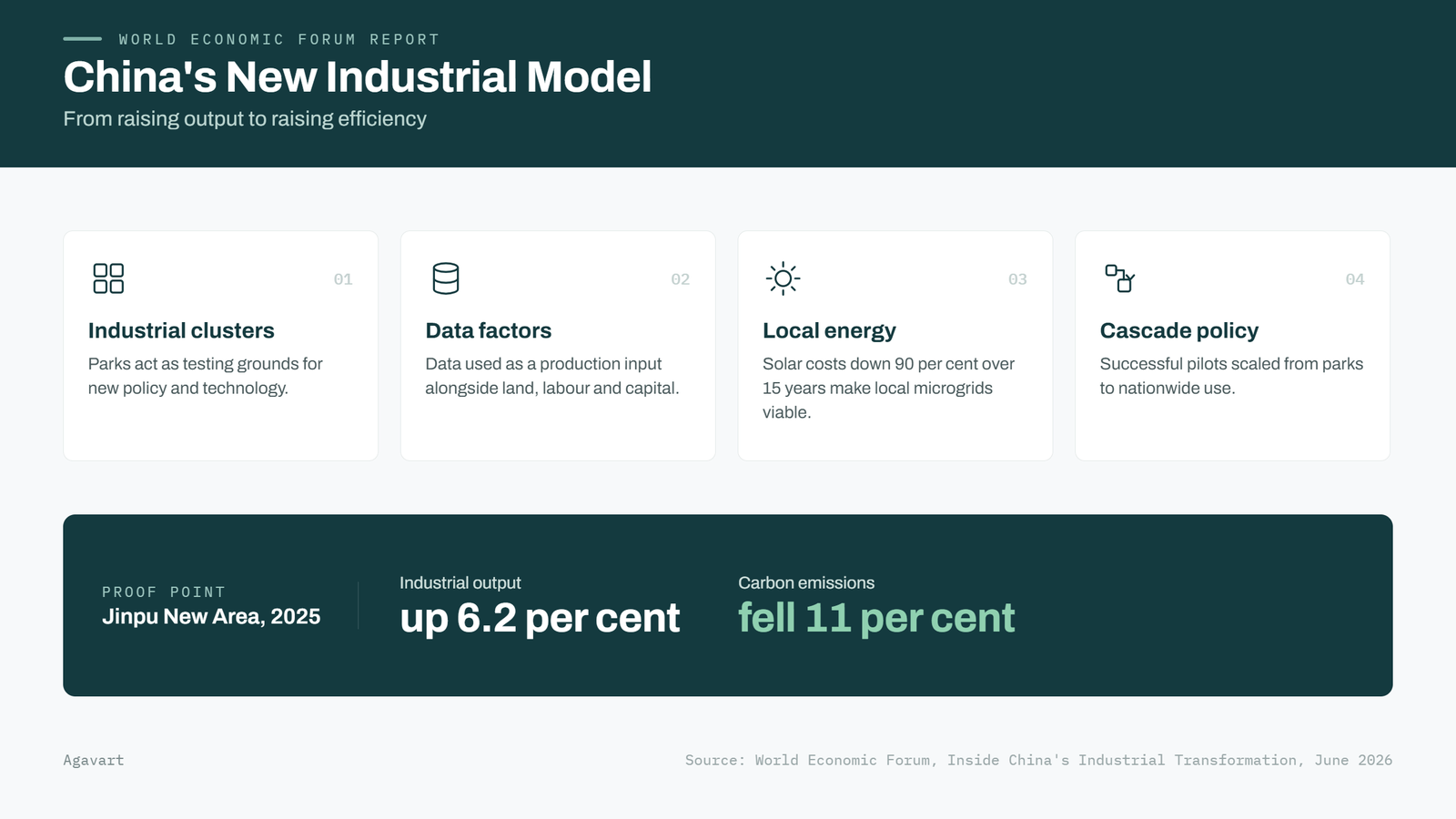
China industrial transformation 2026 WEF report featured image Agavart

China industrial transformation 2026 is taking a new direction, with growth built around digital infrastructure, local energy systems and industrial clusters rather than traditional manufacturing expansion alone, according to the World Economic Forum’s report, Inside China’s Industrial Transformation (June 2026). The report argues that China is shifting to an efficiency-led model combining data, clean energy and cluster-based industrial policy.

Read more