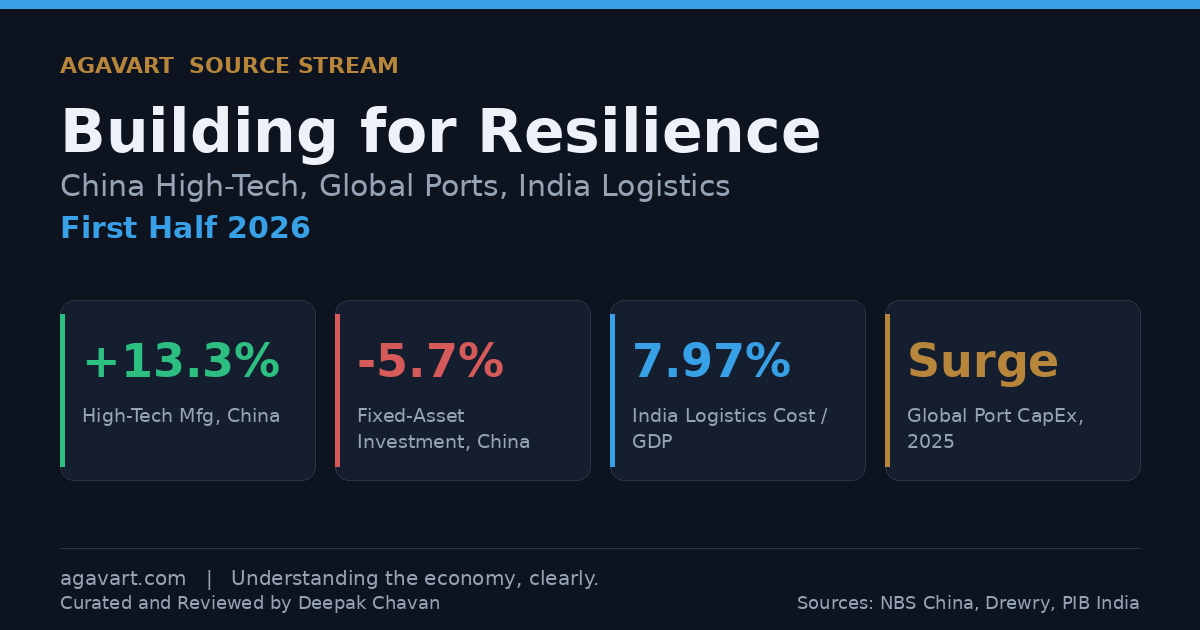
The first-half 2026 data tells one story across three economies: the world is building for resilience, not just growth. China’s factory output held firm and its high-tech manufacturing jumped 13.3 per cent, yet overall fixed-asset investment fell 5.7 per cent. Global port operators poured record earnings into new capacity, and India pushed its logistics cost down to 7.97 per cent of GDP through multimodal rail.
Report SnapshotH1 2026 in one screen
Executive Data FactsheetIndustrial and logistics metrics, H1 2026
| Strategic Category | Key Metric (H1 2026) | Strategic Impact |
|---|---|---|
| China GDP | +4.7% YoY (CNY 69.57 trillion) | Growth held within the government’s target band. |
| China Industrial Output | +5.4% (H1) / +5.3% (June) | Above-designated-size industry stayed resilient. |
| High-Tech Manufacturing (CN) | +13.3% value added | Fastest-growing segment; a decisive move up the value chain. |
| Equipment Manufacturing (CN) | +9.3% value added | Advanced manufacturing outpacing broad industry. |
| Fixed-Asset Investment (CN) | -5.7% (H1) | Overall investment contracted, a notable drag on demand. |
| High-Tech Investment (CN) | +4.6% (H1) | Capital still flowing to high-tech despite the wider fall. |
| Retail Sales (CN) | +1.3% (H1) | Consumption soft; the weak link in the recovery. |
| Global Terminal Operators | Strong earnings, CapEx surge (2025) | Drewry: capacity investment to buffer supply-chain shocks. |
| India Gati Shakti Terminals | 306 approved, 118 commissioned | 192 MTPA capacity; Rs 8,600 crore in private investment. |
| India Logistics Cost | 7.97% of GDP | Rail freight revenue at Rs 12,608 crore, up fourfold since 2022-23. |
China figures: National Bureau of Statistics of China, H1 2026. India figures: Ministry of Railways (Gati Shakti Multi-Modal Cargo Terminals). Maritime: Drewry Maritime Research.
Strategic TakeawaysThe resilience economy
- High-tech dominance: China’s high-tech manufacturing grew 13.3 per cent, far above the 5.4 per cent for industry as a whole, signalling a permanent shift up the value chain.
- Investment polarisation: Overall fixed-asset investment fell 5.7 per cent, yet high-tech investment still rose 4.6 per cent, showing exactly where capital is being concentrated.
- Soft consumption: Retail sales rose just 1.3 per cent, leaving domestic demand as the weak point behind the steady production numbers.
- Maritime resilience: Drewry reports terminal operators recycling strong earnings into a surge in capital investment, shifting from lean to just-in-case logistics.
- India’s logistics leap: Gati Shakti multimodal terminals have helped cut logistics cost to 7.97 per cent of GDP, creating a competitive alternative for South Asian cargo.
ExplainerWhat the H1 2026 numbers reveal
China’s first-half data describes an economy that is producing well but investing cautiously. Value added of industry above designated size rose 5.4 per cent over January to June and 5.3 per cent in June alone, a steady core. The standout is high-tech manufacturing, up 13.3 per cent, with equipment manufacturing up 9.3 per cent. Beijing’s push towards what it calls new quality productive forces is visibly working at the factory floor, moving output away from low-end assembly and towards advanced electronics and machinery.
Beneath that, however, the demand side is soft. Overall fixed-asset investment fell 5.7 per cent in the first half, a genuine contraction, even as investment in high-tech industries grew 4.6 per cent. That gap is the story of the year: capital is being rationed, and what remains is flowing into technology rather than the broad economy. Retail sales grew just 1.3 per cent, confirming that consumption is not yet carrying the recovery. The result is a lopsided expansion, strong where it is advanced, weak where it is broad.
The same instinct to de-risk is visible at sea and on land. Drewry Maritime Research reports that global terminal operators, buoyed by strong earnings, have surged their capital investment through 2025, expanding container-handling capacity less for raw volume than as a buffer against repeated supply-chain shocks. India is pursuing the land-side version of the same goal. Under the PM Gati Shakti master plan, the Ministry of Railways has approved 306 Gati Shakti Multi-Modal Cargo Terminals, of which 118 are commissioned, adding 192 million tonnes a year of capacity and drawing Rs 8,600 crore in private investment. Logistics cost has fallen to 7.97 per cent of GDP, rail freight revenue has grown fourfold since 2022-23 to Rs 12,608 crore, and 2,672 million tonnes of freight have moved from road to rail since 2014. Taken together, the three data sets point one way: physical infrastructure and advanced production are being built to match the speed and fragility of modern trade.
FAQCommon questions
What was China’s industrial output growth in H1 2026?
Value added of industry above designated size grew 5.4 per cent year on year in the first half of 2026, and 5.3 per cent in June. High-tech manufacturing grew far faster, at 13.3 per cent.
Why is China’s overall investment falling while high-tech grows?
Total fixed-asset investment contracted 5.7 per cent in the first half, but investment in high-tech industries still rose 4.6 per cent. Capital is being concentrated in advanced sectors while the broader investment base weakens.
How is India lowering its logistics costs?
Through the PM Gati Shakti master plan and its Multi-Modal Cargo Terminals, India has shifted freight from road to rail and cut logistics cost to 7.97 per cent of GDP, with 306 terminals approved and 118 commissioned.