All readings as of Friday 17 July close; published Monday 20 July 2026.
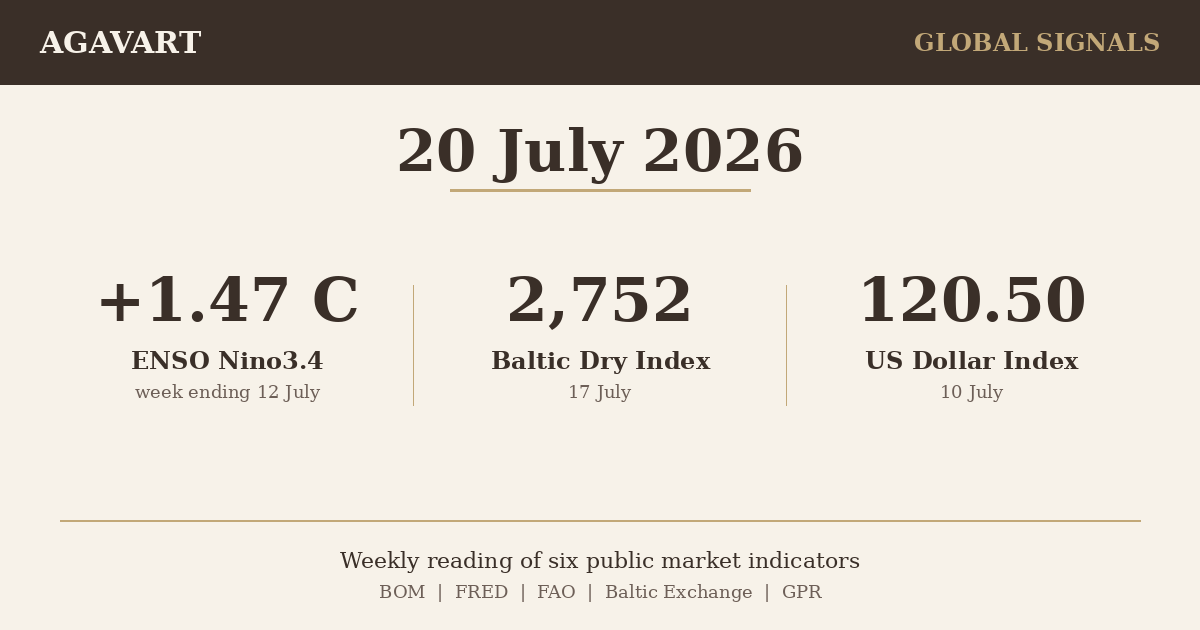
El Nino firmed again last week. The Bureau of Meteorology’s Nino3.4 index reached +1.47 degrees Celsius for the week ending 12 July, up 0.23 from the +1.24 carried in our last issue and now well above the +0.8 El Nino threshold. Dry bulk freight went the other way: the Baltic Dry Index eased to 2,752 on 17 July, down 192 points from 2,944, as Capesize demand softened. The broad US dollar slipped to 120.50, the FAO Food Price Index held at its June reading of 130.3, and the Indian Ocean Dipole stayed neutral near zero. Geopolitical risk was little changed at its June level. In short, the week’s signal was climatic rather than financial: a strengthening El Nino against a calm macro backdrop. Here are the six readings in full.
Climate and weather
ENSO Nino3.4 index: +1.47 degrees Celsius (week ending 12 July, up 0.23 week on week). Central Pacific warmth is strengthening, warming about 0.2 degrees over the preceding two weeks. A firmer El Nino raises the risk to the South West monsoon’s late-season distribution and to kharif output in rain-fed belts. Source: Bureau of Meteorology, Australia.
Indian Ocean Dipole: -0.06 degrees Celsius (as of 12 July, down 0.04 week on week). The IOD remains neutral, but the Bureau notes a positive IOD may develop through the Southern Hemisphere winter and spring. A positive IOD alongside El Nino would tend to suppress monsoon rainfall. Source: Bureau of Meteorology, Australia.
Macro economy
US Dollar Index, broad: 120.50 (as of 10 July, down 0.19 from 120.69). A softer dollar eases the import cost of dollar-priced commodities such as edible oils and pulses for buyers in India and other importing economies. Source: St. Louis Fed, FRED.
FAO Food Price Index: 130.3 (June, unchanged from our last issue). The index slipped 0.3 percent from May as sugar, cereals and dairy eased while vegetable oils and meat firmed. The July reading is due in early August. Source: FAO of the United Nations.
Risk and shipping
Baltic Dry Index: 2,752 (17 July, down 192 points week on week). The fall was led by weaker Capesize rates, the segment that carries iron ore and coal. A lower Baltic Dry points to easing bulk freight costs for grain, fertiliser and coal cargoes. Source: Baltic Exchange.
Geopolitical Risk Index: 173.64 (June, little changed). The monthly index stays elevated against its 1985 to 2019 base of 100, keeping a risk premium under energy and freight. The July figure is due at the start of August. Source: Matteo Iacoviello, GPR Index.
Next readings to watch
The Bureau of Meteorology updates its weekly Nino3.4 and IOD values in the next day or two, and a fresh El Nino outlook will show whether the central Pacific keeps warming. The FRED broad dollar index refreshes through the week. The July FAO Food Price Index is due in early August, and the July Geopolitical Risk Index prints at the start of the month. The Baltic Dry Index updates every business day, so next week’s issue will confirm whether the current softening in dry bulk freight extends or steadies.
Read last week’s readings in Global Signals, 11 July 2026.
Curated and Reviewed by Deepak Chavan | Founder and Market Expert