India is the world’s largest cotton grower by area and the second largest producer and consumer. It planted 114.84 lakh hectares (about 38% of the world’s cotton area), produced 290.91 lakh bales (4.95 million tonnes) in 2025-26 (provisional), consumed 328 lakh bales (5.58 million tonnes), and earned US$ 11.49 billion from cotton exports in FY25. This data board organises India cotton production, consumption, trade and policy figures from the Government of India’s official backgrounder into one reference page.
Updated 20 July 2026, from the PIB Backgrounder “White Gold: India’s Cotton Story” released 20 July 2026. Units: one bale = 170 kg; one lakh = 100,000; Rs one crore = 10 million rupees. All figures as stated in the source.
India in the world cotton economy
| Metric | India | Global context |
|---|---|---|
| Cotton area | 114.84 lakh hectares (rank 1) | About 38% of the global cotton area of 304.08 lakh hectares |
| Cotton production | Rank 2 | 297.24 lakh bales in 2024-25, nearly 20% of global output |
| Cotton consumption | Rank 2 | 328 lakh bales in 2025-26 including MSME, non MSME and non textile use |
| Share of global fibre production | 19% to 23% | The backgrounder cites nearly 19% in its summary and around 23% in the main text |
| Share of world cotton exports | 3.37% | World exports were 541.69 lakh bales (9.21 million tonnes) in 2024-25 |
| Species cultivated | All 4 | India is the only country growing all four recognised cotton species |
India cotton production, consumption and trade
| Metric | Lakh bales | Million tonnes | Period |
|---|---|---|---|
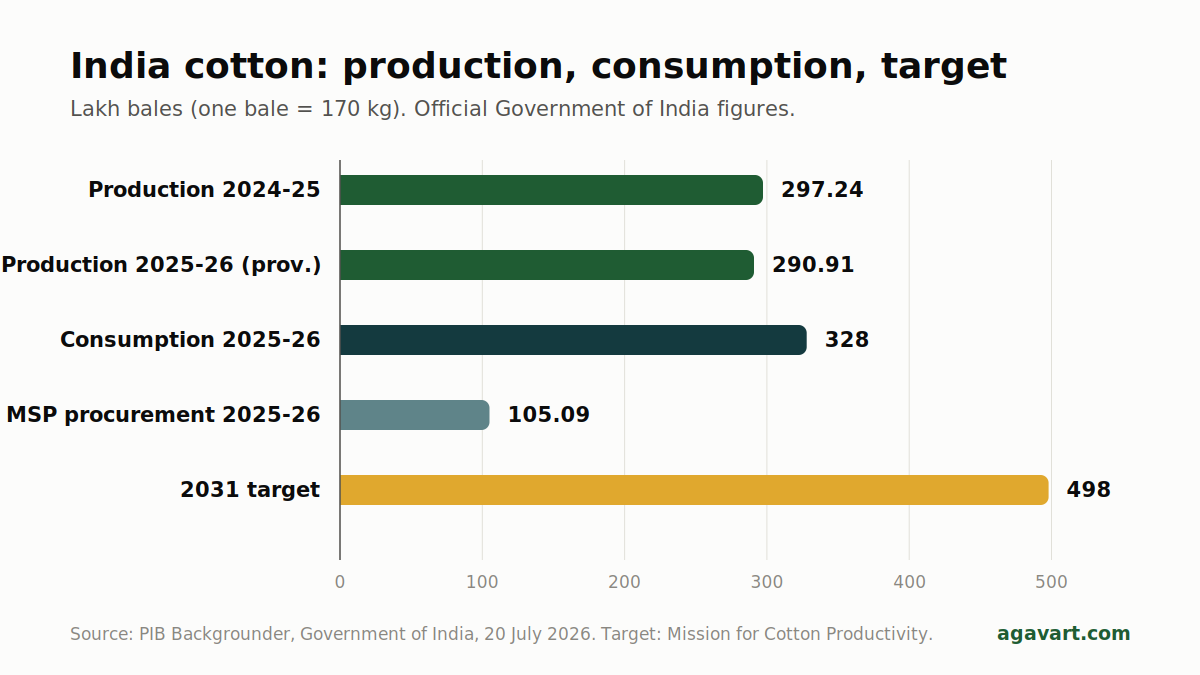
| Production | 297.24 | 5.06 | 2024-25 cotton season |
| Production (provisional) | 290.91 | 4.95 | 2025-26 |
| Domestic consumption | 328 | 5.58 | 2025-26 |
| Exports (volume) | 18 | 0.31 | 2024-25 |
| World exports | 541.69 | 9.21 | 2024-25 |
Cotton year runs October to September. Export value: US$ 11.49 billion in FY25. One bale = 170 kg.
Where Indian cotton goes
| Rank | Destination | Share |
|---|---|---|
| 1 | United States (largest buyer of Indian cotton fabrics and made ups) | 26.35% |
| 2 | Bangladesh | 19.81% |
| 3 | Sri Lanka | 5.11% |
| 4 | United Kingdom | 2.38% |
| 5 | United Arab Emirates | 2.32% |
The crop base
| Metric | Value | Detail |
|---|---|---|
| Area under cotton | 114.84 lakh hectares | Largest in the world |
| Rain fed share | 62% | Remaining 38% is irrigated |
| Major growing states | 9 states, 3 zones | North: Punjab, Haryana, Rajasthan. Central: Gujarat, Maharashtra, Madhya Pradesh. South: Telangana, Andhra Pradesh, Karnataka. Also grown in Odisha and Tamil Nadu |
| Dominant species | G. hirsutum | About 90% of hybrid cotton production; all Bt hybrids belong to this species. Bt cotton was introduced commercially in 2002 |
| Staple categories grown | All 5 | Short (20 mm and below), Medium (20.5 to 24.5), Medium Long (25.0 to 27.0), Long (27.5 to 32.0), Extra Long Staple (32.5 and above) |
People behind the fibre
| Metric | Value |
|---|---|
| Cotton farmers | About 6 million |
| Employment in processing and trade | 40 to 50 million more people |
Price support and procurement
| Metric | 2025-26 | 2026-27 |
|---|---|---|
| MSP, medium staple seed cotton | Rs 7,710 per quintal | Rs 8,267 per quintal |
| MSP, long staple seed cotton | Rs 8,110 per quintal | Rs 8,667 per quintal |
| Year on year increase | Rs 557 per quintal for both varieties | |
MSP is recommended by the Commission for Agricultural Costs and Prices to ensure at least a 50% return over production cost. In 2025-26 the Cotton Corporation of India procured 105.09 lakh bales worth Rs 41,530 crore through 24 lakh transactions, operating 571 procurement centres (up from 508) across 152 districts in 11 states.
Missions, technology and traceability
| Programme | Outlay | Key numbers |
|---|---|---|
| Mission for Cotton Productivity (5 years, from 2025-26) | Rs 5,659.22 crore | Covers about 24 lakh hectares in 140 districts of 14 states, around 32 lakh farmers; targets production of 498 lakh bales by 2031, with special emphasis on Extra Long Staple cotton |
| Special Project on Cotton under NFSM (since 2023-24, 8 states) | Rs 41.87 cr (2023-24), Rs 50.98 cr (2024-25), Rs 60.32 cr (2025-26) | Field demonstrations on 9,175 ha, then about 14,740 ha; yield gains of about 40% under High Density Planting and above 32% under closer spacing |
| Kapas Kisan App (digital MSP procurement) | Not stated | Over 41 lakh farmers registered; slot booking on a four week rolling basis, Aadhaar linked payments, SMS updates |
| Kasturi Cotton Bharat (branding and traceability) | Rs 30 crore (half from industry) | 3,29,550 bales certified as of 30 June 2026 (3,22,400 from CCI); 116 registered units including 41 ginners; covers long staple 28 mm and above and ELS 35 mm and above; QR based certification with blockchain traceability |
Beyond fibre: the by-product economy
Raw cottonseed is roughly one third lint and two thirds seed. The seed carries about 18% edible oil; cottonseed oil contains nearly 50% polyunsaturated fatty acids against about 30% in many traditional oils, which is why it is called heart oil. The residual meal becomes deoiled cake for cattle, poultry and fish feed, linters and hulls go to industry, dried stalks serve as rural biomass fuel, and short staple fibre unsuitable for spinning becomes absorbent surgical cotton.
What this board tells the world
Three things stand out once the official numbers sit side by side. First, India’s cotton economy is built on breadth rather than yield: the country holds 38% of the world’s cotton area but about 20% of its production, largely because 62% of the crop is rain fed. That gap between area and output is exactly what the new Mission for Cotton Productivity is funded to close, with a target of 498 lakh bales by 2031 against 297 lakh bales today, a rise of two thirds within six seasons.
Second, India consumes more cotton than it currently produces. Domestic use of 328 lakh bales in 2025-26 ran ahead of provisional production of 290.91 lakh bales, and exports were a modest 3.37% of world trade. The growth strategy is therefore aimed first at feeding India’s own textile industry, the world’s second largest consumer, and only then at the export market. For global buyers, the more consequential shift is qualitative: certified, traceable Kasturi cotton and a policy push into Extra Long Staple varieties, the premium segment India currently imports.
Third, the state’s footprint in the market is now substantial. In the 2025-26 season the Cotton Corporation of India procured 105.09 lakh bales at the Minimum Support Price, roughly a third of the national crop, worth Rs 41,530 crore. With MSP already raised by Rs 557 per quintal for 2026-27 and procurement digitised through an app used by over 41 lakh farmers, the floor under Indian cotton prices is firmer than it has ever been. Readers tracking world fibre markets should watch three dates: monsoon driven kharif sowing through July and August, the October start of the new cotton year with the higher MSP, and the annual progress of the 2031 production target.
Frequently asked questions
How much cotton does India produce?
290.91 lakh bales (4.95 million tonnes) in 2025-26 (provisional), after 297.24 lakh bales (5.06 million tonnes) in 2024-25, according to the Government of India. One bale is 170 kg.
Is India the largest cotton producer in the world?
No. India ranks first in cotton area, with about 38% of the global area, and second in both production and consumption. Its 2024-25 output was nearly 20% of the world total.
Who buys India’s cotton exports?
The United States is the largest destination with 26.35% of cotton exports, followed by Bangladesh (19.81%), Sri Lanka (5.11%), the United Kingdom (2.38%) and the UAE (2.32%). Total cotton export value was US$ 11.49 billion in FY25.
What is the MSP for cotton in 2026-27?
Rs 8,267 per quintal for medium staple and Rs 8,667 per quintal for long staple seed cotton, both Rs 557 higher than in 2025-26.
What is Kasturi Cotton Bharat?
India’s branding and traceability programme for premium cotton. As of 30 June 2026 it had certified 3,29,550 bales of long staple (28 mm and above) and extra long staple (35 mm and above) cotton, using QR based certification and blockchain traceability.
Source
Press Information Bureau, Government of India, PIB Backgrounder “White Gold: India’s Cotton Story”, released 20 July 2026. Original release. Underlying data: Ministry of Agriculture and Farmers Welfare, Ministry of Textiles, Cotton Corporation of India. All figures reproduced as stated in the source; the source itself cites both 19% and 23% for India’s share of global fibre production, noted in Board 1.
Cite this page as: Agavart, India Cotton Data Board, updated 20 July 2026, based on Government of India (PIB) data. This is a living page; the boards are refreshed as new official releases arrive.