The FAO food outlook June 2026 report shows a sharply divided global food commodity market, with some countries on course for record harvests while others face worsening supply risks driven by weather, conflict and structural vulnerabilities. The biannual report from the Food and Agriculture Organization covers grains, oilseeds, fish and sugar, tracking production shifts that will influence food prices and trade flows through 2026 and into 2027.
What did the FAO June 2026 Food Outlook find?
It found a records-and-lows picture, with several oilseeds and coarse grains hitting record highs while several other crops fell to multi-year lows in the 2025/26 marketing year.
Which crops hit record highs in the FAO 2026 outlook?
Global oilseeds reached 721.7 million tonnes, soybeans 432.3 million tonnes and coarse grains 1,639.1 million tonnes, each a record or all-time high.
Which crops fell to multi-year lows?
United States wheat fell to 42.5 million tonnes, Ukraine sunflower seed to its lowest in a decade, and the Barents Sea cod quota to 285,000 tonnes, its lowest since 1991.
Table of Contents
- Global oilseeds 2025/26 at 721.7 million tonnes, a fourth consecutive record high
- Global soybeans 2025/26 at 432.3 million tonnes, a fresh record
- Global coarse grains 2025/26 at 1,639.1 million tonnes, an all-time high
- Global wheat 2026/27 at 810.9 million tonnes, a sharp contraction from the 2025 record
- Global rapeseed 2025/26 at 97.0 million tonnes, a historical high
- India wheat at 120.2 million tonnes on historically high sowings
- Argentina maize at 76.0 million tonnes, a 2026 record
- South Africa maize at 17.5 million tonnes, a new record
- Meals and cakes global ending stocks forecast at record highs
- United States wheat at 42.5 million tonnes, a multi-year low, down 21.3 per cent year on year
- Ukraine sunflower seed at its lowest in a decade
- Australia rice the smallest crop in six years on water shortage
- Barents Sea cod quota at 285,000 tonnes, the lowest since 1991
- North America wheat exports, Canada and the United States, the lowest in three years
The 2026/27 wheat outlook, with global wheat contracting to 810.9 million tonnes from the 2025 record even as oilseed and coarse grain supplies stay at record highs.
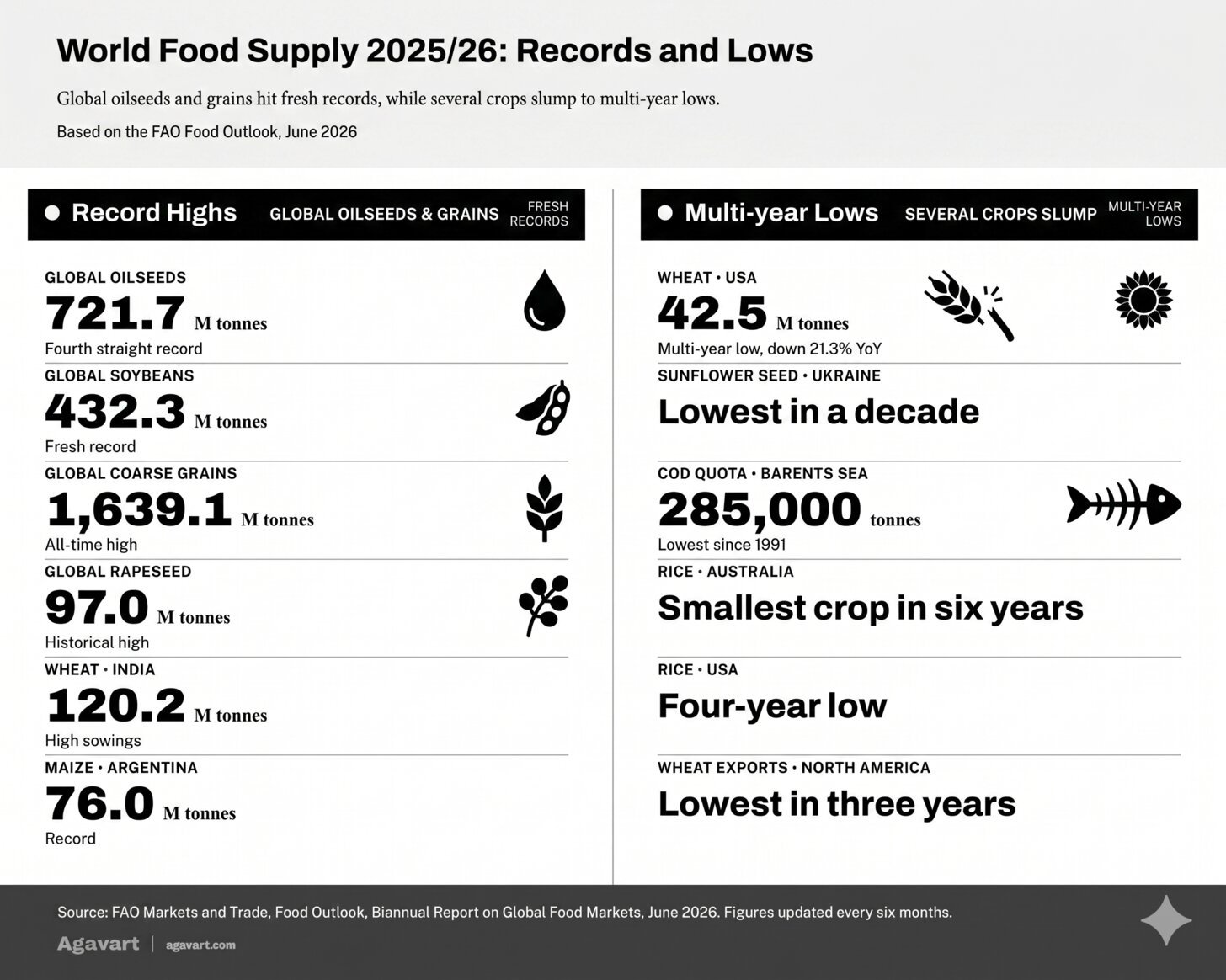
FAO Food Outlook June 2026: Major Production Beneficiaries
India and Argentina emerge as leading beneficiaries in the current outlook. India is on course to harvest a record wheat crop of 120.2 million tonnes, underpinned by historically high sowings and government incentives. This robust output allows India to re-emerge in the global export market with a forecast of 2.5 million tonnes, effectively ending an export ban introduced in May 2022.
In South America, Argentina is forecast to reach a record maize harvest of 76.0 million tonnes in 2026, driven by improved rainfall and expanded sowings. Argentina is also seeing a recovery in sunflower seed production. Similarly, South Africa is expecting a new record maize output of more than 17.5 million tonnes due to favourable growing conditions and above-average yields.
Brazil continues its role as a production powerhouse, with global soybean production forecast at a fresh record of 432.3 million tonnes, primarily underpinned by continued growth in Brazil. Additionally, Brazil is rapidly scaling up its poultry meat output, now accounting for nearly one-fifth of global production.
The Russian Federation also recorded strong soybean production in 2025/26. Despite a smaller wheat crop, the Russian Federation remains a major global wheat exporter. The FAO food outlook June 2026 notes the Federation’s continued presence as a key trade supplier despite ongoing geopolitical pressures affecting logistics.
Other production recoveries are noted in North Africa, where Algeria and Morocco are seeing robust wheat recoveries after two consecutive years of drought-affected harvests. Thailand is also expected to benefit from favourable rainfall, leading to a strong increase in sugar output.
Countries and Regions Facing Supply Risk in 2026
In contrast, several major producers face sharp declines that increase future supply risks. The United States of America is facing a multi-year low in wheat production, forecast at 42.5 million tonnes, a 21.3 per cent year-on-year decrease. The U.S. is also expecting a 6.0 per cent drop in maize production and its lowest rice output in four years.
Supply risks are also rising in Australia, where wheat production is forecast at levels below the previous five-year average. Due to reduced and costlier water supplies for irrigation, Australia is expected to harvest its smallest rice crop in six years.
In Europe, the European Union’s wheat output is forecast to decline by 5.6 per cent to 136.2 million tonnes due to weaker crop margins and rainfall deficits in central and eastern regions. The EU also faces a sharp decline in sugarbeet area, leading to lower sugar production.
Ukraine faces severe production constraints, with its sunflower output estimated to drop to the lowest level in a decade. While its wheat production is forecast to remain stable relative to 2025, it remains well below pre-war levels.
Geopolitical and Environmental Risks in FAO Food Outlook 2026
The FAO food outlook June 2026 report highlights specific systemic risks for certain regions. Small Island Developing States (SIDS) are identified as particularly vulnerable, with 78 per cent of SIDS assessed as at high or critical food insecurity risk, driven by import dependence and exposure to climate events.
In the fisheries sector, Peru faces a 67.0 per cent chance of a “strong or very strong” El Nino event between November 2026 and January 2027. This phenomenon typically suppresses Peruvian anchoveta catches, the world’s largest fishery by volume, posing a significant risk to fishmeal and fish oil supplies.
Finally, logistical disruptions in the Near East have created a “marine blockade”, leaving over 1 million tonnes of urea fertilizer loaded on vessels unable to sail from the Gulf region. This conflict has also disrupted regional sugar flows through the Strait of Hormuz, affecting the United Arab Emirates and Saudi Arabia, which together account for 6 per cent of global sugar imports and 3 per cent of exports.
The FAO food outlook June 2026 underscores a food system facing divergent pressures. Record outputs in India, Argentina and Brazil provide some buffer, but supply risks in the US, EU and Ukraine, combined with El Nino threats and conflict disruptions, point to continued volatility in global food trade through the remainder of 2026.
Source
Source: Food and Agriculture Organization of the United Nations (FAO), Food Outlook: Biannual Report on Global Food Markets, June 2026. 📥 Download Full Report PDF
The FAO food outlook June 2026 highlights a food system under divergent pressure. Record outputs in India, Argentina and Brazil provide some buffer, but supply risks in the US, EU and Ukraine, combined with El Nino threats and conflict-driven disruptions, point to continued volatility in global food trade through the remainder of 2026.
The FAO food outlook June 2026 underscores a food system facing divergent pressures. Record outputs in India, Argentina and Brazil provide some buffer, but supply risks in the US, EU and Ukraine, combined with El Nino threats and conflict-driven disruptions, point to continued food trade volatility. For context on how commodity accounting is evolving, see our analysis of India’s new natural resource valuation framework.
Curated and Reviewed by Deepak Chavan | Founder & Market Expert