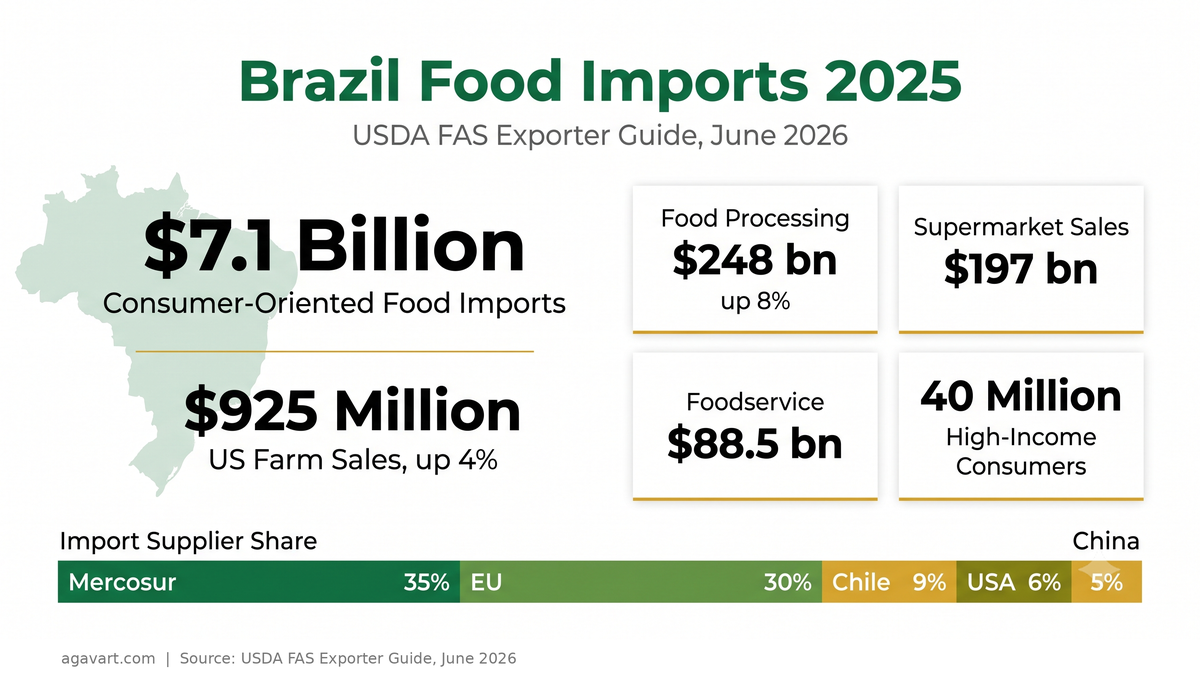
Brazil food imports of consumer-oriented products reached $7.1 billion in 2025, according to the USDA Foreign Agricultural Service Exporter Guide released on June 30, 2026. Brazilian purchases of US agricultural products grew 4 per cent to $925 million. The report identifies 40 million high-income Brazilian consumers as the core market for premium imported food and beverages.
For exporters, food companies and market watchers, the guide sets out the size of each demand channel, the rules that govern market entry, and the trends shaping Brazil food imports over the coming years.
Table of Contents
| Indicator | 2025 value | Note |
|---|---|---|
| Consumer-oriented food imports | $7.1 billion | up from $6.7 billion in 2024 |
| Total agricultural imports | $17 billion | largest importer in South America |
| Imports from the United States | $925 million | up 4 per cent |
| Food processing revenue | $248 billion | up 8 per cent |
| Supermarket sales (2024) | $197 billion | up 9.3 per cent |
| Foodservice revenue | $88.5 billion | up 0.9 per cent |
What the USDA Report Says About Brazil Food Imports
Brazil’s economy grew 2.3 per cent in 2025, taking GDP to about $2.27 trillion, the report states. The country is largely self-sufficient in food. Its processors now make substitutes for many products that were once imported. Yet consumers continue to seek premium imported items. This keeps Brazil food imports growing despite strong domestic supply.
The report counts more than 40 million high-earning consumers. Within this group, around 10 million wealthy consumers are least sensitive to price. Citing Euromonitor, the report projects Brazil’s population at 218 million by 2040, with consumer expenditure rising 29 per cent.
Which Sectors Drive Import Demand
Food processing is the largest opportunity named in the report. The sector earned $248 billion in 2025, up 8 per cent, across roughly 42,000 companies, according to industry body ABIA. It processes 62 per cent of national agricultural output and exported a record $67 billion. Demand centres on high-value micro-ingredients and additives for clean-label, functional and plant-based products.
Animal feed is the second pillar. Sindiracoes data in the report puts poultry feed production above 45 million tonnes and swine feed above 22 million tonnes. Vitamins, premixes and additives make up 3 to 5 per cent of feed formulation. The report estimates this additives market at around $2.5 billion.
Retail and foodservice remain fragmented. Supermarket sales reached $197 billion in 2024 across nearly 425,000 stores, per ABRAS. Foodservice earned $88.5 billion in 2025, with independent operators running 97.5 per cent of outlets, per ABRASEL. Convenience stores were the fastest growing retail segment, expanding 9 per cent to $1.2 billion in 2025.
Who Supplies Brazil Food Imports
Mercosur partners supplied 35 per cent of Brazil food imports in the consumer-oriented category in 2025, per Trade Data Monitor figures in the report. The EU held 30 per cent, Chile 9 per cent, the United States 6 per cent and China 5 per cent. Top growth products included cocoa beans, chocolate, pork, tree nuts, non-alcoholic beverages, tea, distilled spirits, processed food, bakery goods and candy, per SECEX data.
What Next for Brazilian Import Demand
The EU-Mercosur agreement is under ratification in Brazil. Once implemented, it is expected to reduce or eliminate tariffs on a wide range of agricultural products, the report notes. This would improve the competitiveness of European suppliers.
All food labels must be in Portuguese. Imports clear through the SISCOMEX system, with inspection by MAPA or ANVISA depending on the product. The report advises exporters to expect small trial orders first. Brazilian buyers typically start with a few pallets and scale up only after market acceptance is proven. For exporters willing to work through consolidators and accept slow starts, Brazil food imports offer a large and expanding market.
Frequently Asked Questions
How big are Brazil food imports?
Brazil imported $17 billion of agricultural products in 2025, of which $7.1 billion were consumer-oriented food and beverage products, per Trade Data Monitor figures cited in the USDA report.
Which imported food products are growing fastest in Brazil?
SECEX data in the report lists cocoa beans, chocolate, pork, tree nuts, non-alcoholic beverages, tea, distilled spirits, processed food, bakery goods and candy as the top growth products of 2025.
Who regulates food imports in Brazil?
MAPA covers animal products, most beverages, fruits, vegetables and bulk grains. ANVISA covers most processed consumer foods, additives and non-dairy beverages. Labels must be in Portuguese.
What could change Brazil food imports next?
The EU-Mercosur agreement, now under ratification, is expected to cut tariffs on many agricultural products and strengthen European suppliers, per the report.
Parallel Reading
Agavart has also covered the USDA planted acreage and grain stocks data for 2026 and the FAO Food Outlook of June 2026, both of which map the supply side of global food trade.
Primary Reports and Sources
- USDA Foreign Agricultural Service, Exporter Guide Annual: Brazil, BR2026-0027 (June 30, 2026): 📥 Download Full Report PDF
Curated and Reviewed by Deepak Chavan | Founder & Market Expert