China industrial transformation 2026 is taking a new direction, with growth built around digital infrastructure, local energy systems and industrial clusters rather than traditional manufacturing expansion alone, according to the World Economic Forum’s report, Inside China’s Industrial Transformation (June 2026). The report argues that China is shifting to an efficiency-led model combining data, clean energy and cluster-based industrial policy.
Table of Contents
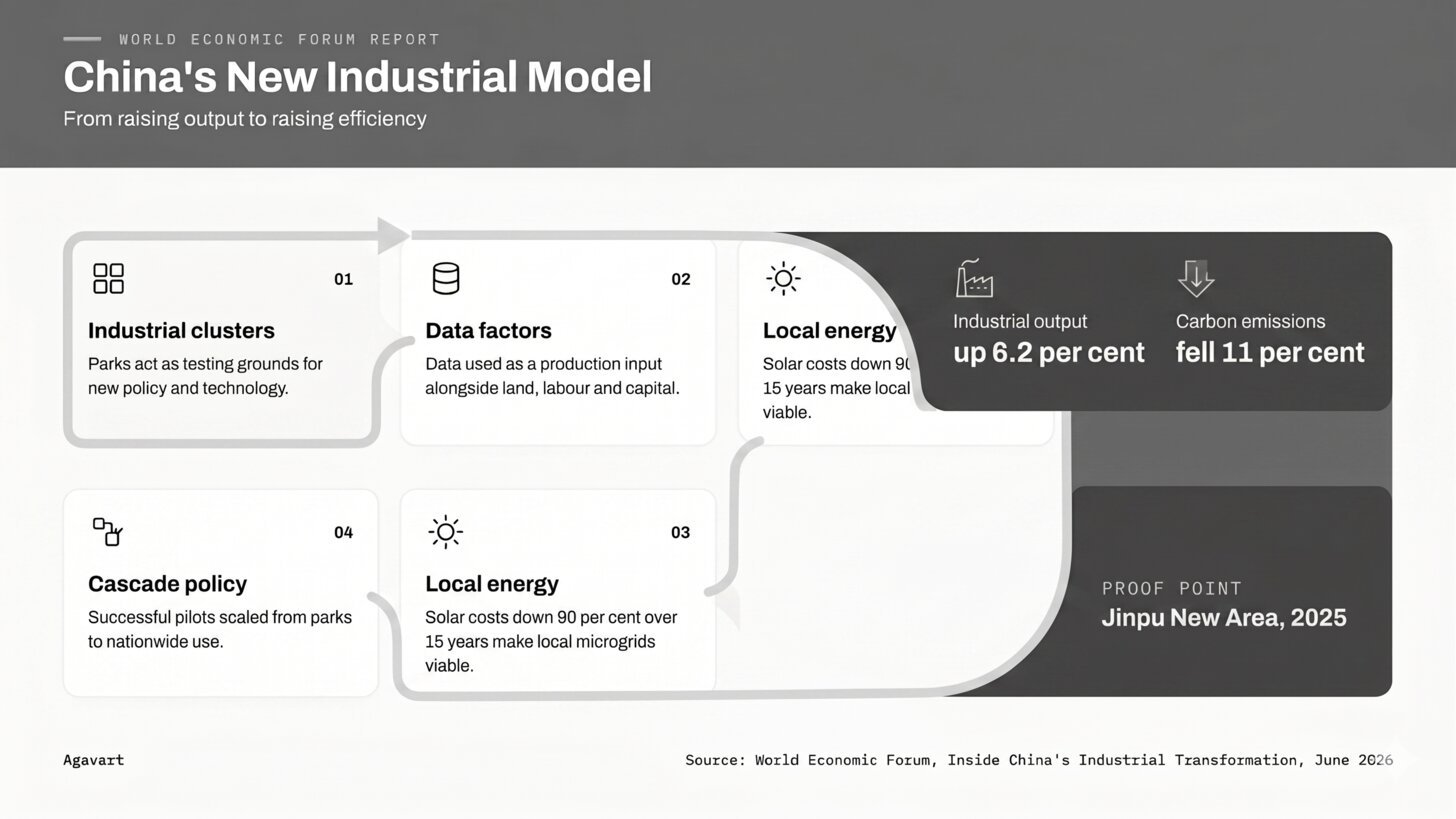
The report suggests that China’s industrial transformation is moving beyond higher production volumes towards a model that focuses on efficiency, resilience and technology-driven growth. It identifies industrial parks as testing grounds where new policies, digital technologies and clean energy solutions are developed before being expanded across the country.
China Industrial Transformation 2026: Clusters Improve Output While Cutting Emissions
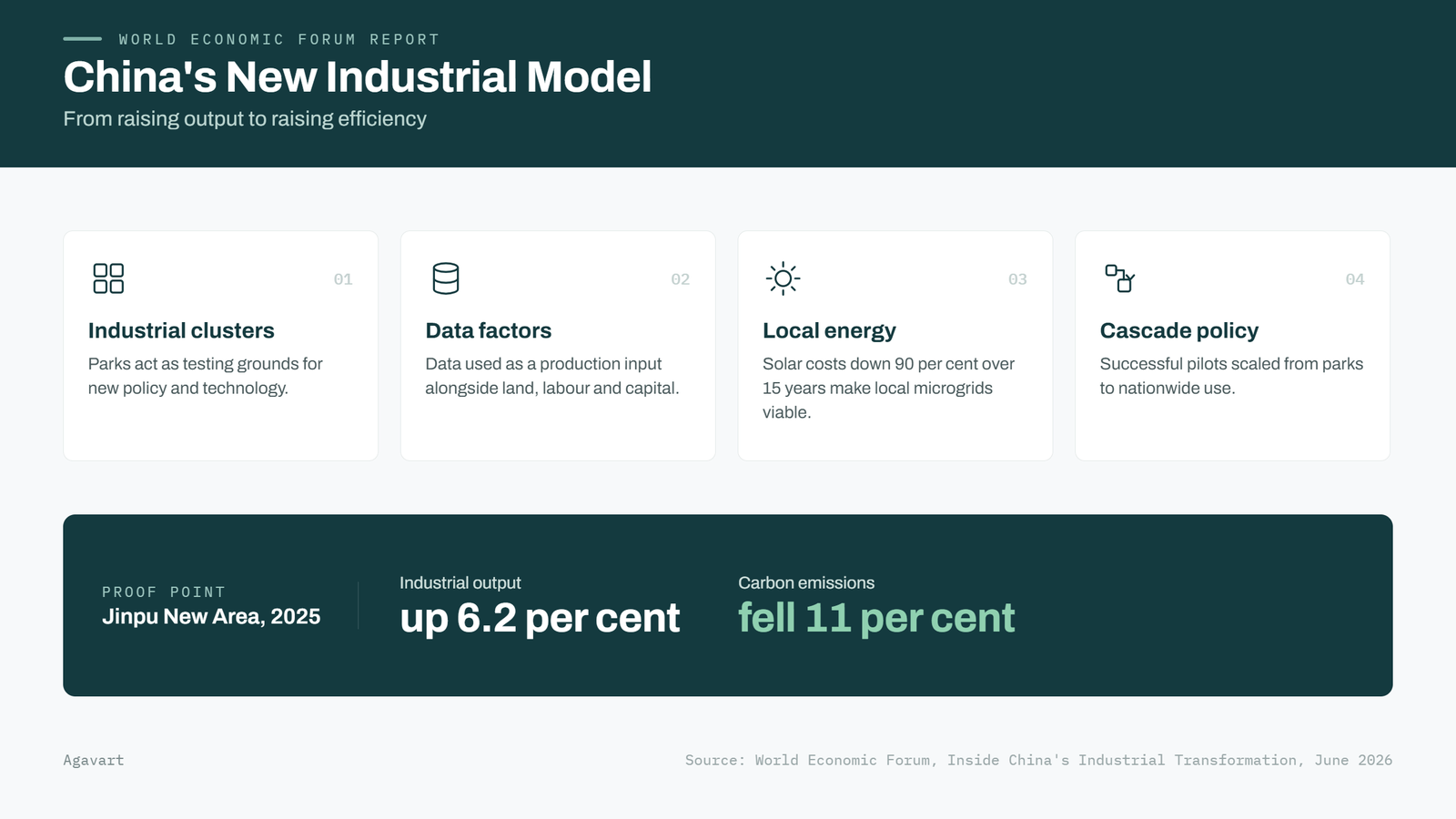
One of the report’s most notable findings comes from Jinpu New Area, where industrial output grew by 6.2 per cent in 2025 while carbon emissions fell by 11 per cent.
According to the report, this demonstrates that industrial growth and lower emissions can increasingly be achieved together through shared infrastructure, digital technologies and more efficient resource management.
Data becomes a production factor
The report also highlights China’s growing use of “Data Factors” as a formal production input alongside land, labour and capital.
Instead of relying only on investment in factories and equipment, companies are increasingly using digital platforms and real-time data to improve production efficiency, manage resources and support business expansion.
According to the report, this approach is central to the china industrial transformation 2026 strategy: it allows industrial growth with lower capital requirements and may help offset the long-term impact of China’s shrinking workforce.
Lower solar costs support local energy systems
The report identifies the 90 per cent decline in solar power generation costs over the past 15 years as a key factor supporting China’s industrial strategy.
Lower renewable energy costs are making local industrial microgrids commercially viable, allowing industrial parks to rely more on local power generation and reduce exposure to global energy price volatility.
Industrial innovations move quickly to national scale
The report also describes what it calls a “Cascade Policy”, under which successful innovations developed in selected industrial parks are refined through policy support before being expanded across the country.
This system combines technology, infrastructure and policy, allowing China to move successful industrial models from pilot projects to nationwide implementation more quickly.
Why China Industrial Transformation 2026 Matters for Global Markets
The WEF report frames china industrial transformation 2026 as a shift towards efficiency rather than production volume. This strategy is designed to deliver output growth while using fewer resources and reducing exposure to global energy shocks.
The wider adoption of industrial clusters, digital technologies and local energy systems could strengthen the country’s competitiveness, reduce exposure to global energy shocks and support faster commercial adoption of new industrial technologies.
Source
Source: World Economic Forum, Inside China’s Industrial Transformation: Policy, Practice and the Path to Scale (June 2026). 📥 Download Full Report PDF
Curated and Reviewed by Deepak Chavan | Founder & Market Expert
What is the China industrial transformation 2026 strategy about?
According to the WEF report, the strategy focuses on building industrial growth through data-driven production, industrial cluster development and local clean energy systems, rather than simply expanding manufacturing output.
What is the Cascade Policy mentioned in the WEF report?
The Cascade Policy is China’s approach to scaling industrial innovation. Successful pilot projects in selected industrial parks are refined and then expanded nationally, combining technology, infrastructure support and policy into a replicable model.
How does the Jinpu New Area result relate to global climate goals?
Jinpu New Area recorded a 6.2 per cent rise in industrial output in 2025 alongside an 11 per cent fall in carbon emissions. This supports the argument that economic growth and emissions reduction are not mutually exclusive when industrial policy is redesigned around efficiency.
What is the China industrial transformation 2026 strategy about?
According to the WEF report, the strategy focuses on building industrial growth through data-driven production, industrial cluster development and local clean energy systems, rather than simply expanding manufacturing output.
What is the Cascade Policy mentioned in the WEF report?
The Cascade Policy is China’s approach to scaling industrial innovation. Successful pilot projects in selected industrial parks are refined and then expanded nationally, combining technology, infrastructure support and policy into a replicable model.
How does the Jinpu New Area result relate to global climate goals?
Jinpu New Area recorded a 6.2 per cent rise in industrial output in 2025 alongside an 11 per cent fall in carbon emissions. This supports the argument that economic growth and emissions reduction are not mutually exclusive when industrial policy is redesigned around efficiency.