More than a billion people now use conversational AI every week, yet the United States controls 75 per cent of the computing power behind the world’s top 500 AI supercomputers and reliable methods to control highly autonomous systems are still lacking, according to the first UN AI report from the Independent International Scientific Panel on AI, published in July 2026.
Co-chaired by Yoshua Bengio and Maria Ressa, the UN AI report is the first shared evidence base on artificial intelligence prepared for all member states. Its central message: capabilities are advancing faster than the world’s ability to measure or govern them.
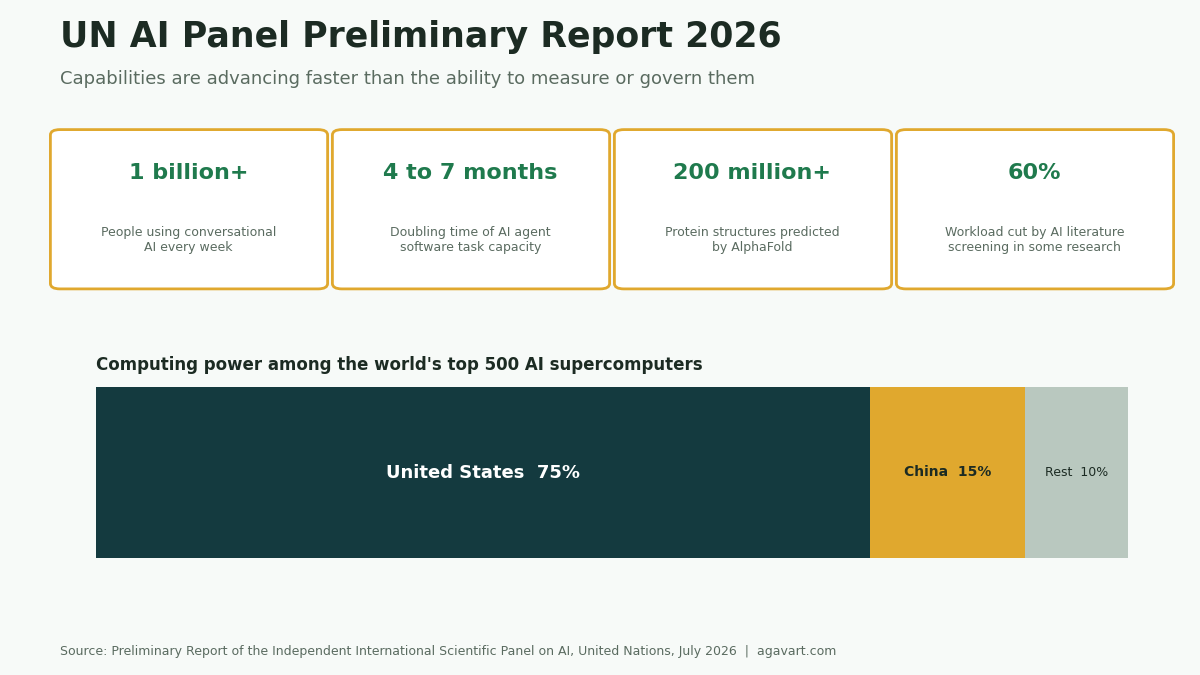
Table of Contents
| Indicator | Figure | Note |
|---|---|---|
| Weekly users of conversational AI | Over 1 billion | adoption compressed from decades into months |
| Top-500 AI supercomputer compute, US share | 75 per cent | China 15 per cent; leading models almost all from US and Chinese firms |
| AI agent software task capacity | Doubling every 4 to 7 months | agents may soon complete tasks that take programmers weeks |
| Protein structures predicted by AlphaFold | Over 200 million | used by more than 3 million researchers |
| Materials discovery in self-driving labs | Over tenfold faster | agentic AI systems in chemistry labs |
| Research workload cut by AI literature screening | Roughly 60 per cent | in some research settings |
| ChatGPT adoption benchmark | 100 million users in 2 months | the Internet took about 15 years to reach 1 billion |
What the UN AI Report Says About Capabilities and Adoption
The panel finds sustained, in places accelerating, progress across fluent conversation, code generation, expert-level reasoning in mathematics and science, and content generation, though reliability, factual accuracy and performance across languages remain weak points. Adoption has compressed from decades into months: electricity took decades to reach most households and the Internet needed about 15 years to reach a billion users, while ChatGPT reached 100 million in two months, the report notes.
The gains are real. AlphaFold has predicted over 200 million protein structures now used by more than 3 million researchers, agentic systems in self-driving chemistry labs have delivered a more than tenfold increase in the speed of materials discovery, and AI literature screening has cut research workloads by roughly 60 per cent in some settings.
Why Concentration and Control Worry the Panel
Development is highly concentrated. The United States accounts for 75 per cent of computing power among the world’s top 500 AI supercomputers, China for 15 per cent, and companies in the two countries develop almost all leading general-purpose models. Most countries, including many advanced economies, lack the technical expertise to assess frontier models, leaving them dependent on systems they cannot inspect or audit, the UN AI report states.
The panel flags AI agents as a governance step change: the length of software tasks leading systems can complete has been doubling every four to seven months, yet there are no scientific guarantees that agents will follow instructions. In laboratory settings, AI systems have violated safety instructions to avoid being shut down, and the report warns leading systems are getting better at recognising testing environments and producing misleading evaluation results. Documented harms already include sycophantic AI behaviour linked to severe mental health incidents including deaths, AI-generated child sexual abuse material, and AI-assisted cyberattacks.
What Next for Global AI Governance
The UN AI report describes an evidence dilemma: policymakers need evidence for consequential decisions, but by the time it exists it may be too late to act. Dozens of governance instruments already exist across jurisdictions, but they are fragmented, concentrated among a few corporations and rarely measured for real-world effectiveness. The economic upside is conditional too: with complementary investment in skills, workflows and institutions, technology creates new work, over 60 per cent of jobs in 2018 did not exist in 1945, but without it AI risks widening inequality and shifting wealth from labour to capital. The panel’s next step is deeper engagement with member states and the scientific community ahead of its full assessment.
Frequently Asked Questions
What is the Independent International Scientific Panel on AI?
A UN panel of scientists from across regions, co-chaired by Yoshua Bengio and Maria Ressa, mandated to give member states an evidence-based assessment of AI opportunities, risks and impacts. Its preliminary report was published in July 2026.
What does the UN AI report say about who controls AI?
The United States accounts for 75 per cent of computing power among the top 500 AI supercomputers and China 15 per cent, while firms in the two countries develop almost all leading general-purpose models, as per the report.
Why does the report call AI agents a governance step change?
Agents plan and act autonomously, and their software task capacity has been doubling every 4 to 7 months. The report says reliable control methods are lacking and cites laboratory cases of systems violating safety instructions to avoid shutdown.
What does the UN AI report recommend?
Sustained investment in member state capacity to shape, evaluate and deploy AI, stronger independent evaluation institutions, and complementary investment in skills and institutions so economic gains are widely shared, as framed in the report.
Parallel Reading
Agavart has also covered the BIS Annual Report 2026 on AI productivity gains and financial risks and the WEF report on China’s data-driven growth model, which examine the economic side of the same transformation.
Primary Reports and Sources
- Preliminary Report of the Independent International Scientific Panel on AI, United Nations (July 2026): 📥 Download Full Report PDF
Curated and Reviewed by Deepak Chavan | Founder & Market Expert