Korea’s economy is set to grow 2.6 per cent in 2026, recovering from 1.0 per cent in 2025 on the strength of exports, according to the OECD Economic Survey of Korea 2026 presented at Sejong on July 2. The Korea Economic Survey pairs the upgraded outlook with a warning: public debt is rising, the energy shock is pressuring inflation, and the gap between the Seoul metropolitan area and the rest of the country keeps widening.
Titled Reshaping the Geography of Opportunity, the survey sets out four priorities: stronger fiscal institutions, a growth-friendly tax rebalance, better adult skills, and targeted investment to revive Korea’s regions.
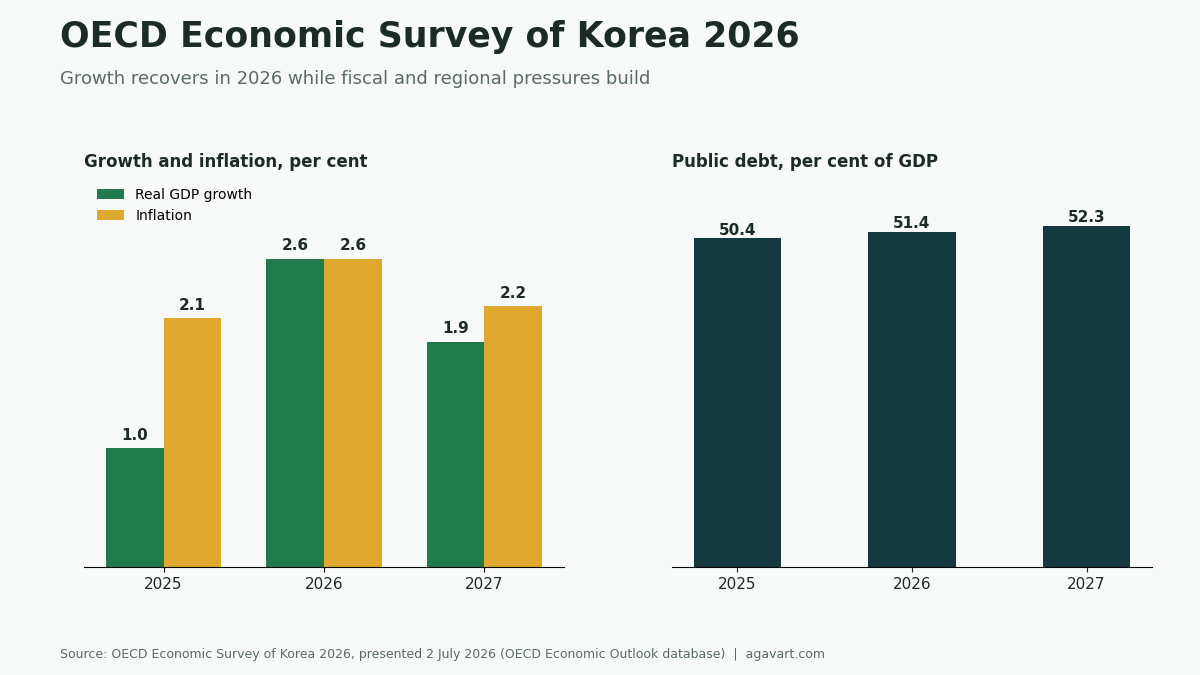
Table of Contents
| Indicator | 2025 | 2026 | 2027 |
|---|---|---|---|
| Real GDP growth (per cent) | 1.0 | 2.6 | 1.9 |
| Inflation (per cent) | 2.1 | 2.6 | 2.2 |
| Public debt (per cent of GDP) | 50.4 | 51.4 | 52.3 |
What the Korea Economic Survey Says About Growth
Strong exports have underpinned Korea’s GDP recovery since 2022, while private consumption has lagged, the survey states. The OECD projects real GDP growth of 2.6 per cent in 2026 before a moderation to 1.9 per cent in 2027. Inflation, at 2.1 per cent in 2025, is expected to rise to 2.6 per cent in 2026 as the energy shock feeds through consumer prices, before easing to 2.2 per cent in 2027.
Why the OECD Urges Fiscal and Tax Reform
Public debt is projected to climb from 50.4 per cent of GDP in 2025 to 52.3 per cent in 2027. The survey’s long-term scenarios show that if ageing costs are simply debt-financed, gross government debt would approach 200 per cent of GDP by 2060, while a prudent fiscal framework combined with structural reforms would keep the path far flatter. The OECD notes Korea’s pension expenditure will rise by more than the OECD average between 2025 and 2060, and that tax revenue as a share of GDP remains below the OECD average, leaving room to raise revenue. It recommends rebalancing towards indirect taxes, recurrent property taxes in place of transaction-based ones, and higher carbon prices, noting Korea’s average effective carbon rate is among the lower ranks of member countries.
What Next: Skills and the Geography of Opportunity
The survey links Korea’s long-run growth to two structural gaps. First, skills: literacy proficiency among Koreans aged 55 to 65 is well below the OECD average even though younger Koreans score near the top, and Korea ranks among the lowest countries for learning by doing at work. The OECD calls for nurturing critical thinking in schools and reducing the focus on high-stakes examinations, while curbing reliance on costly private tutoring through expanded before- and after-school care. Second, geography: young Koreans have migrated in large numbers to the Seoul metropolitan area for decades, draining the provinces. The survey recommends building stronger regional universities, targeted investment in regional hubs, countrywide access to quality health and public services, and greater spending autonomy for subnational governments.
Frequently Asked Questions
What does the OECD forecast for Korea’s economy in 2026?
The Korea Economic Survey projects real GDP growth of 2.6 per cent and inflation of 2.6 per cent in 2026, with public debt at 51.4 per cent of GDP. Growth moderates to 1.9 per cent in 2027.
Why is the OECD worried about Korea’s public finances?
Ageing is the core pressure. If rising pension and care costs are debt-financed, the survey projects gross government debt approaching 200 per cent of GDP by 2060, against a far flatter path under a prudent fiscal framework with structural reforms.
What tax changes does the OECD recommend for Korea?
Rebalancing the tax mix towards indirect taxes, recurrent property taxes instead of transaction-based ones, and environmental taxes including higher carbon prices, which the survey says would raise revenue in a growth-friendly way.
What does the survey mean by the geography of opportunity?
It refers to the widening gap between the Seoul metropolitan area and the provinces. Decades of youth migration to Seoul have drained the regions, and the OECD recommends regional university hubs, better local services and more subnational fiscal autonomy.
Parallel Reading
Agavart has also covered the BIS Annual Report 2026 on productivity gains and financial risks and the WEF report on China’s new growth model, two more views on how Asian economies are repositioning for the decade ahead.
Primary Reports and Sources
- OECD Economic Survey of Korea 2026, presented at Sejong (July 2, 2026): 📥 Download Full Report PDF
Curated and Reviewed by Deepak Chavan | Founder & Market Expert