Data Meter | India Energy
India Oil: Consumption, Production, Imports and Import Dependency (2025-26)
Last updated 15 July 2026 | Fiscal year 2025-26 (April to March), provisional PPAC data | Pune
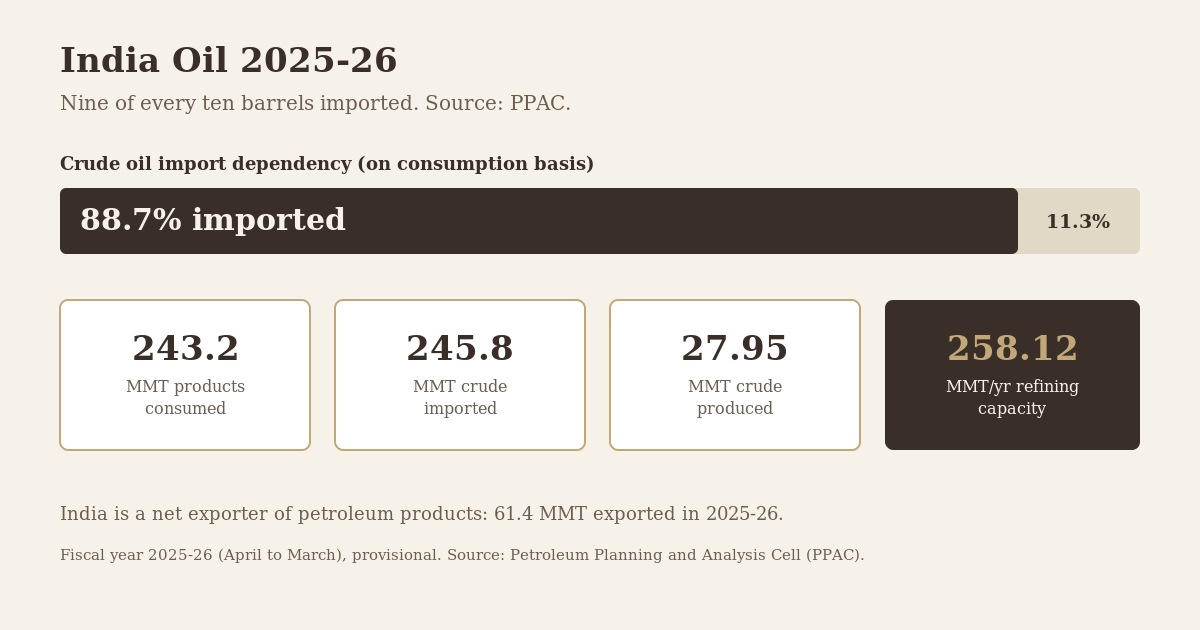
In 2025-26 India consumed 243.2 million tonnes of petroleum products and imported 245.8 million tonnes of crude oil, while producing only 27.95 million tonnes at home, leaving its crude oil import dependency at 88.7 per cent. All figures are from the Petroleum Planning and Analysis Cell.
India Oil at a Glance (2025-26)
| Metric | Value (2025-26) | Global rank | Source |
|---|---|---|---|
| Petroleum products consumption | 243.2 million tonnes | 3rd | PPAC |
| Indigenous crude oil production | 27.95 million tonnes (crude and condensate; crude oil alone 25.98) | 20th | PPAC |
| Crude oil imports | 245.8 million tonnes | 2nd (importer) | PPAC |
| Crude oil import dependency (on consumption basis) | 88.7 per cent | – | PPAC |
| Self-sufficiency in petroleum products | 11.3 per cent | – | PPAC |
| Petroleum product exports | 61.4 million tonnes (net product exporter) | – | PPAC |
| Installed refining capacity | 258.12 million tonnes a year (as on 1 April 2025) | 4th | PPAC |
| Proved crude oil reserves | about 4.5 thousand million barrels (0.6 thousand million tonnes, position at end 2020) | 22nd | PPAC |
Global ranks for consumption, production, imports and refining are from international data (U.S. Energy Information Administration), not PPAC. The reserves figure and its 22nd rank are from PPAC’s Ready Reckoner, which reproduces the Energy Institute Statistical Review (position at end 2020); India’s own balance recoverable reserves are reported separately by the Ministry of Petroleum and Natural Gas. Values are provisional and refer to fiscal year 2025-26 (April to March).
India’s oil story is one of deep import dependency. On PPAC figures, crude oil import dependency was 88.7 per cent in 2025-26 and self-sufficiency in petroleum products just 11.3 per cent. Domestic crude production of 27.95 million tonnes met only about a tenth of the crude the country used; the rest, 245.8 million tonnes, was imported.
Yet India refines more than it consumes. It used 243.2 million tonnes of products at home and exported a further 61.4 million tonnes against product imports of 46.2 million tonnes. So on these PPAC figures India is a large refiner and a net exporter of petroleum products, running mostly on imported crude.
Common Questions
How much oil does India consume?
India consumed 243.2 million tonnes of petroleum products in 2025-26 (provisional), according to the Petroleum Planning and Analysis Cell. By international data it is the world’s third-largest oil consumer.
How much crude oil does India produce?
India produced 27.95 million tonnes of crude oil and condensate at home in 2025-26 (crude oil alone 25.98 million tonnes), per PPAC, only about a tenth of the crude it processes.
What is India’s crude oil import dependency?
Very. PPAC puts India’s crude oil import dependency at 88.7 per cent for 2025-26 on a consumption basis, with crude imports of 245.8 million tonnes against domestic production of 27.95 million tonnes. Self-sufficiency in petroleum products was just 11.3 per cent. For the forward view, see Agavart on India oil demand growth to 2027.
Is India a big oil refiner?
Yes. India has installed refining capacity of 258.12 million tonnes a year (as on 1 April 2025) and is a net exporter of petroleum products, shipping out 61.4 million tonnes in 2025-26 even though it imports most of the crude it refines, per PPAC.
Sources (primary): Petroleum Planning and Analysis Cell (PPAC), Ministry of Petroleum and Natural Gas, Government of India: Snapshot of India’s Oil and Gas Data, May 2026; India’s Oil and Gas Ready Reckoner FY 2025-26; and the PPAC data portals for consumption, production, import and export and refining capacity. Global ranks: U.S. Energy Information Administration. Reserves: Energy Institute Statistical Review, as reproduced in the PPAC Ready Reckoner. All PPAC figures are provisional and updated by PPAC through the year.