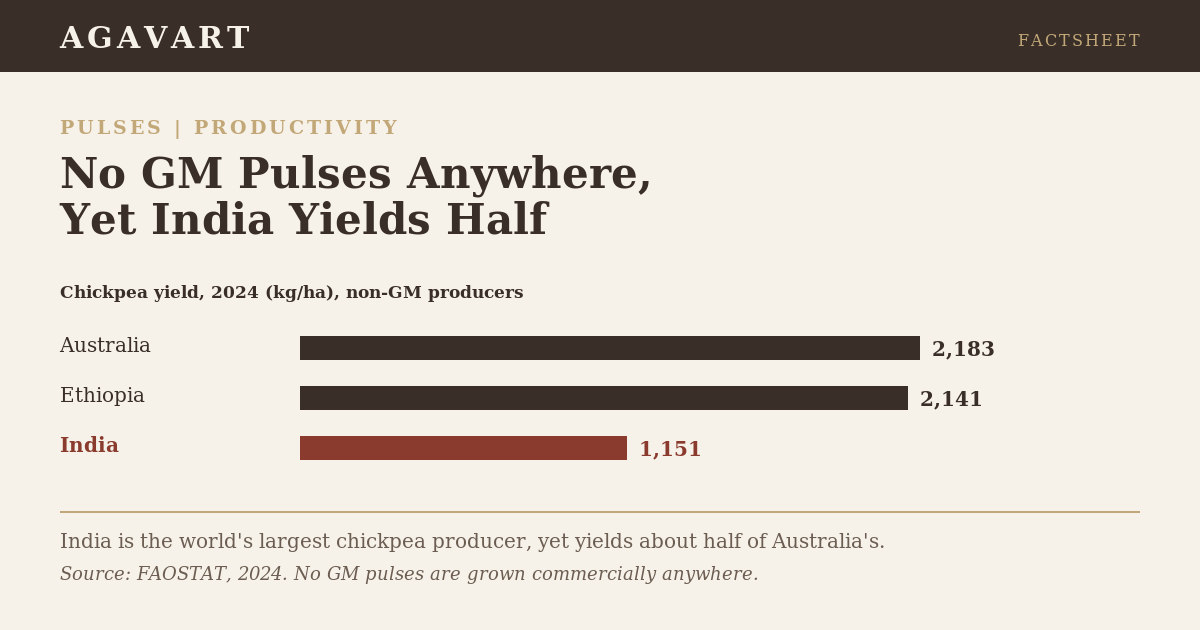
India grows more chickpeas and pigeon peas than any other country, yet its chickpea yield of about 1,151 kg per hectare is barely half of Australia’s 2,183 and Ethiopia’s 2,141. Like India, none of these countries grow genetically modified pulses, so the gap is one of farming practice, not seed technology. India’s agriculture minister, Shivraj Singh Chouhan, flagged the gap at the 98th ICAR Foundation Day in New Delhi on 16 July 2026, calling it a direct challenge to the country’s scientists.
Chickpea Yield, 2024 (kg/ha): India Against Non-GM Peers
Chickpea Yield, 2024 (kg/ha), ranked
| Country (non-GM) | Yield | vs India |
|---|---|---|
| Australia | 2,183 | 1.9x |
| Ethiopia | 2,141 | 1.9x |
| Canada | 1,477 | 1.3x |
| United States | 1,282 | 1.1x |
| Turkiye | 1,252 | 1.1x |
| World average | 1,195 | 1.04x |
| India | 1,151 | 1x |
| Russia | 1,151 | 1.0x |
India is the world’s largest chickpea producer but sits below the world average yield. China’s reported chickpea yield of about 5,592 kg/ha is excluded as an outlier, reflecting a very small, largely irrigated area. Source: FAOSTAT, Crops and livestock products (QCL), 2024.
Lentil Yield, 2024 (kg/ha), ranked
| Country (non-GM) | Yield | vs India |
|---|---|---|
| Turkiye | 1,672 | 1.6x |
| Canada | 1,436 | 1.4x |
| Ethiopia | 1,371 | 1.3x |
| World average | 1,228 | 1.2x |
| Australia | 1,220 | 1.2x |
| United States | 1,123 | 1.1x |
| India | 1,028 | 1x |
| Myanmar | 693 | 0.7x |
Where India holds its own: on pigeon pea (tur), India yields about 836 kg/ha against a world average of 882, and remains the dominant global producer. The productivity gap is concentrated in chickpea and lentil, not across every pulse. Source: FAOSTAT, Crops and livestock products (QCL), 2024.
Summary
India is the largest grower of pulses in the world and its biggest importer, a combination that has long puzzled its own policymakers. The productivity numbers explain why. On chickpea, India’s most important pulse and one where it leads global production, its 2024 yield of about 1,151 kg per hectare trails Australia’s 2,183 and Ethiopia’s 2,141 by close to half, and sits just below the world average of 1,195. On lentil, India’s 1,028 kg per hectare is behind Turkiye, Canada, Ethiopia, Australia and the United States.
The detail that sharpens the point is the one the minister chose to make: none of these higher-yielding countries grow genetically modified pulses. There are no commercial GM chickpeas, lentils or dry peas anywhere in the world; the genetic-modification traits in wide use sit in soya bean, maize, cotton and canola, not in food pulses. So the countries out-yielding India are doing it with conventional, non-GM varieties. The gap, on this evidence, is not a gap in genetic technology but in agronomy: irrigation, quality seed of improved varieties, soil and pest management, and mechanised, well-resourced farming.
India’s own conditions point to the same conclusion. The minister noted that wherever irrigation arrives, farmers move from pulses to paddy and wheat, leaving pulses on rain-fed, marginal land. Agricultural Statistics at a Glance records India’s total pulse yield at 926 kg per hectare in 2024-25, up over the decade but still below the world average. The FAOSTAT series adds a further caution: between 2023 and 2024 India’s total pulse yield fell about 2.9 per cent, even as the world average rose 1.8 per cent, Canada’s yield climbed 9.6 per cent and Australia’s production jumped nearly 34 per cent. India is not only behind, it lost ground in the latest year.
What next follows directly from the diagnosis. The minister asked scientists to focus research on raising pulse and oilseed productivity and to make India self-sufficient in both, rather than continuing to import dal. On the figures, closing even part of the chickpea gap with Australia or Ethiopia, both non-GM, would do more for India’s pulse self-sufficiency than any single new seed technology. The challenge he set is, in his own framing, less about what seed India plants than about how well it grows it.
“जहां भी जीएम सीड्स नहीं है वहां भी दलहन का उत्पादन हमसे अच्छा है। ये चुनौती है हमारे वैज्ञानिकों को। जब दुनिया के बाकी देशों में हो सकता है तो भारत में क्यों नहीं?”“Even where there are no GM seeds, pulse production is better than ours. This is a challenge to our scientists. When it can happen in other countries, why not in India?”Shivraj Singh Chouhan, Union Agriculture Minister, at the 98th ICAR Foundation Day, 16 July 2026, from 2:24:43 in the official video
Does India grow GM pulses?
No. There are no commercially grown genetically modified pulses in India or anywhere else. GM traits in wide use are in soya bean, maize, cotton and canola, not in chickpea, lentil, pigeon pea or dry pea.
Which country has the highest chickpea yield?
Among major producers in 2024, Australia led at about 2,183 kg per hectare, followed by Ethiopia at 2,141, both without GM seed. India, the largest producer by volume, yielded about 1,151.
Why is India’s pulse productivity low?
Most Indian pulses are grown on rain-fed, marginal land, because irrigated land tends to shift to paddy and wheat. Limited irrigation, uneven adoption of improved varieties and quality seed, and pest pressure hold yields below potential.
Is India behind on every pulse?
No. India lags mainly on chickpea and lentil. On pigeon pea (tur) its yield of about 836 kg per hectare is close to the world average and it remains the dominant producer.
Sources: Primary source, the spoken address by Union Agriculture Minister Shivraj Singh Chouhan at the 98th ICAR Foundation Day, New Delhi, 16 July 2026 (official video). Event context: Press Information Bureau, 16 July 2026. Yield data: FAOSTAT, Production: Crops and livestock products (QCL), 2024. India national figures: Agricultural Statistics at a Glance 2024-25, Department of Agriculture and Farmers Welfare, and Directorate of Pulses Development.