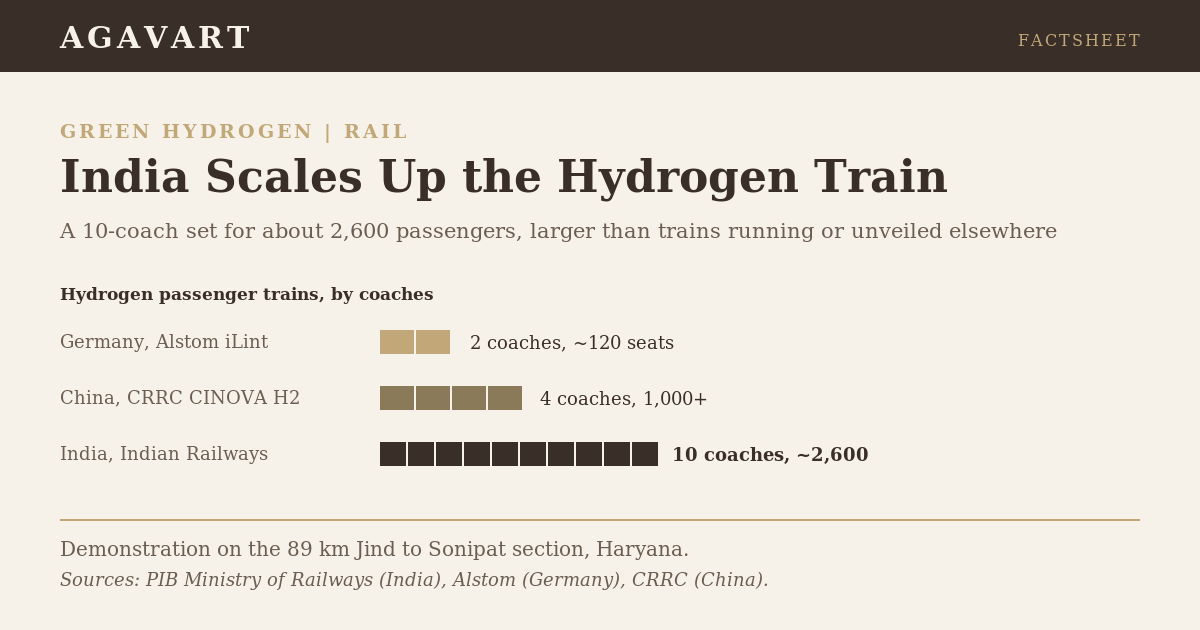
India is set to flag off its first hydrogen fuel cell passenger train, and the notable number is its size: a 10-coach set built for around 2,600 passengers, larger than the two to four coach hydrogen trains running or unveiled elsewhere. The demonstration will run on the 89 km Jind to Sonipat section in Haryana, according to a 16 July 2026 release from the Ministry of Railways.
Hydrogen Passenger Trains: Formation and Capacity
A bigger formation, not a faster one. Germany’s Alstom Coradia iLint, the world’s first hydrogen passenger train in commercial service since 2018, runs as a two-coach unit of about 120 seats, with a 14-train fleet operating in Lower Saxony from 2022. China’s CRRC CINOVA H2, unveiled at InnoTrans 2024, is a four-coach intercity set rated at 200 km/h with capacity for more than 1,000 passengers. India’s trainset carries the scale advantage in coaches and seats rather than speed: its design speed is 110 km/h, with 75 km/h planned on the Jind to Sonipat run.
| Train | Coaches | Capacity | Speed | Status |
|---|---|---|---|---|
| Germany, Alstom Coradia iLint | 2 | ~120 seats | 140 km/h | In service since 2018; 14-train fleet, Lower Saxony |
| China, CRRC CINOVA H2 | 4 | 1,000+ passengers | 200 km/h | Unveiled InnoTrans 2024 |
| India, Indian Railways | 10 | ~2,600 passengers | 110 km/h (design) | Demonstration, Jind to Sonipat, Haryana |
How it moves. The train carries a Proton Exchange Membrane fuel cell that combines stored hydrogen with oxygen from the air to make electricity, leaving water vapour as the only direct by-product. Two Hydrogen Driving Power Cars, one at each end, each produce 1,200 kW, supported by lithium iron phosphate batteries. Hydrogen is produced on site at Jind by electrolysis, compressed to 500 bar and dispensed at 350 bar, with the facility storing close to 3,000 kg at a time.
Certified beyond Indian Railways. The hydrogen system is designed to the NFPA-2 and ISO 19880 standards and cleared by India’s Petroleum and Explosives Safety Organisation. Before commissioning, the full system was independently assessed by TUV SUD of Germany. The train and the Jind plant carry multi-layer detection for hydrogen leaks, heat, flames and smoke, with automatic hydrogen shut-off.
Where it fits. With more than 99 per cent of India’s broad gauge already electrified, a shift the Ministry says has cut its dependence on imported diesel, hydrogen is not aimed at replacing mainline electric traction but at non-electrified and heritage routes; Indian Railways says it is studying the Kalka to Shimla line next. The project is tied to the National Green Hydrogen Mission and the country’s Net Zero goal.
Source: “India’s First Hydrogen Fuel Cell Train Set to Redefine Sustainable Rail Mobility,” Press Information Bureau, Ministry of Railways, 16 July 2026 (Release ID 2285240). Comparison figures: Alstom Coradia iLint and CRRC CINOVA H2.