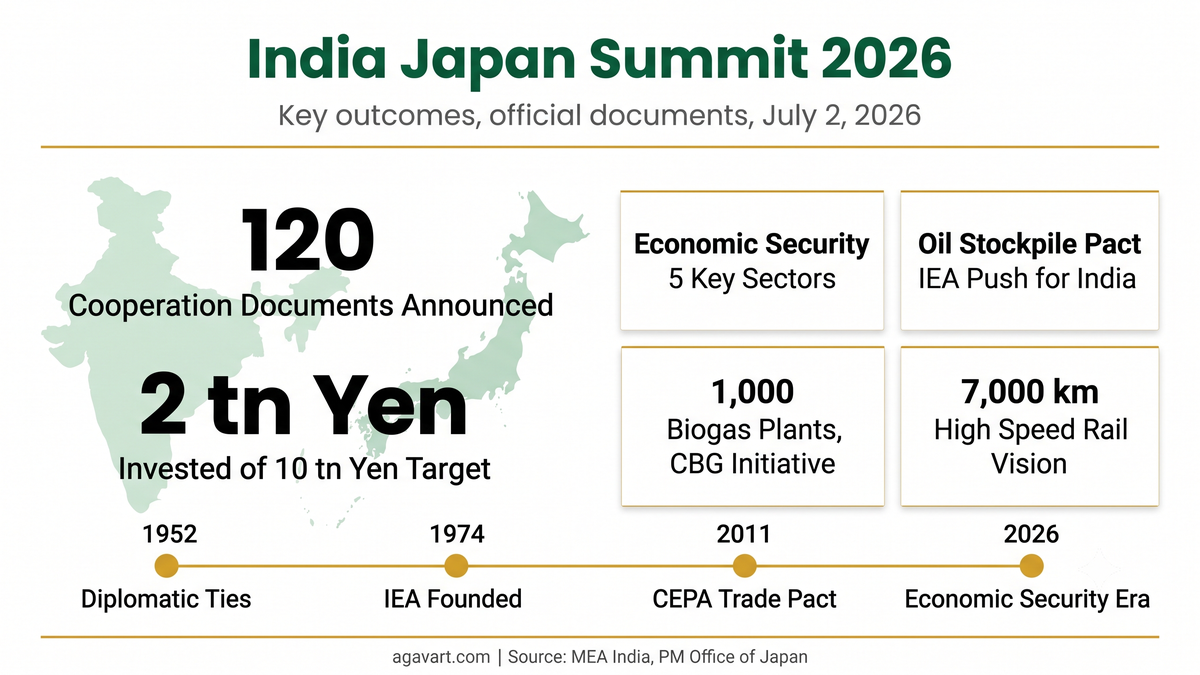
The 16th India Japan Annual Summit in New Delhi on July 2, 2026 produced about 120 cooperation documents, a joint declaration on economic security and Japanese support for India’s membership of the International Energy Agency. Japanese private investment in India has reached 2 trillion yen against the 10 trillion yen target set last year, per the Prime Minister’s Office of Japan.
Most reports led with the Shinkansen and the AI statement. The structural story of the India Japan Summit 2026 sits in oil stockpiles, supply chains and farm-linked energy, spelled out in the outcome documents published by both governments.
Table of Contents
| Outcome | Figure | Note |
|---|---|---|
| Cooperation documents announced | about 120 | per Prime Minister’s Office of Japan |
| Private investment progress | 2 trillion yen | against 10 trillion yen target set in 2025 |
| Japanese business delegation | over 150 companies | accompanied PM Takaichi |
| Economic security sectors | 5 | semiconductors, minerals, ICT, clean energy, pharma |
| Biogas and fertiliser plants target | 1,000 | new CBG Initiative |
| High speed rail vision | 7,000 km | national network with E10 Shinkansen |
| Two-way visitors in 2025 | 540 thousand | 75 years of ties in 2027 |
What the India Japan Summit 2026 Produced
Prime Minister Narendra Modi and Prime Minister Takaichi Sanae met for about 90 minutes in New Delhi on July 2, per the Kantei record. The India Japan Summit 2026 announced three headline documents: the Annual Summit Joint Statement, a Joint Declaration on Economic Security Cooperation, and a Joint Statement on AI cooperation. A fourth, on energy resilience, was signed between Japan’s METI and India’s petroleum ministry. About 120 cooperation documents were announced in total. Over 150 Japanese companies travelled with the Japanese Prime Minister.
The Oil Stockpile Layer Few Noticed
The energy resilience statement commits both countries to cooperate on strategic petroleum stockpiling systems, emergency response and market stabilisation. Japan’s JOGMEC and JBIC will work with Indian Strategic Petroleum Reserves Limited and Indian national oil companies. Both sides agreed to explore joint investments in maritime energy transport and joint engagement with oil producing countries.
Japan also affirmed support for India’s membership of the International Energy Agency. The IEA was created by industrialised oil importing countries in 1974, after the first oil shock. Five decades later, the same logic of a collective consumers’ voice is being rebuilt around India, one of the world’s largest oil importers. The Strait of Hormuz is named in both the joint statement and the Kantei record as a shared concern.
Five Sectors, One Supply Chain Map
The economic security declaration names five sectors for project based collaboration: semiconductors, critical minerals, ICT, clean energy and pharmaceuticals. The detail is specific. An e-waste collection and recycling ecosystem will be built to recover critical minerals. Geological Survey of India will exchange mineral exploration information with JOGMEC. In pharmaceuticals, the two sides will map vulnerabilities in every ingredient and every stage of the supply chain for active pharmaceutical ingredients and key starting materials. Both documents repeat one idea: avoid reliance on any one country.
The Farm, Fertiliser and Biogas Thread
The least reported item connects energy policy to agriculture. The new Cooperative Biogas for Growth Initiative supports India’s target of 1,000 biogas and organic fertiliser plants. The signing parties are unusual: Japan’s METI with India’s Ministry of Cooperation and the Department of Animal Husbandry and Dairying. Japan also extended development cooperation for sustainable horticulture in Punjab, and both sides committed to biofuel value chains connecting India’s North Eastern Region with the Bay of Bengal, per the joint statement.
What Next
The fourth 2+2 ministerial meeting is due in Tokyo by the end of 2026. A review of the 15 year old CEPA trade agreement will be accelerated. The two countries agreed to support each other’s bids for UN Security Council non-permanent seats, India for 2028-29 and Japan for 2033-34, alongside their campaign for permanent seats. 2027 marks 75 years of diplomatic ties, with the 17th summit planned in Japan.
Frequently Asked Questions
What was announced at the India Japan Summit 2026?
A Joint Statement, a Joint Declaration on Economic Security Cooperation, a Joint Statement on AI cooperation and a METI-MoPNG statement on energy resilience, with about 120 cooperation documents in total, per the two governments.
What is the India-Japan economic security declaration?
A commitment to project based collaboration in semiconductors, critical minerals, ICT, clean energy and pharmaceuticals, citing concerns over economic coercion, arbitrary export restrictions and price manipulation.
Why does Japan support India joining the IEA?
The energy resilience statement frames it as strengthening the voice of oil and gas consuming countries, with Japan citing India’s role in stabilising the international energy market.
What is the Cooperative Biogas for Growth Initiative?
A new Japan-India programme supporting India’s target of 1,000 biogas and organic fertiliser plants, signed between Japan’s METI and India’s Ministry of Cooperation and Department of Animal Husbandry and Dairying.
Parallel Reading
Agavart has also covered Brazil’s food import market from the USDA Exporter Guide and the geopolitics of grain in the US-Iran asset dispute, both mapping how trade and security now move together.
Primary Reports and Sources
- MEA India, 16th India-Japan Annual Summit Joint Statement (July 2, 2026): mea.gov.in
- Prime Minister’s Office of Japan, Leaders’ Meeting Summary (July 2, 2026): japan.kantei.go.jp
- Japan-India Joint Declaration on Economic Security Cooperation: 📥 Download Full Document PDF
- METI-MoPNG Joint Statement on Energy Resilience: 📥 Download Full Document PDF
Curated and Reviewed by Deepak Chavan | Founder & Market Expert