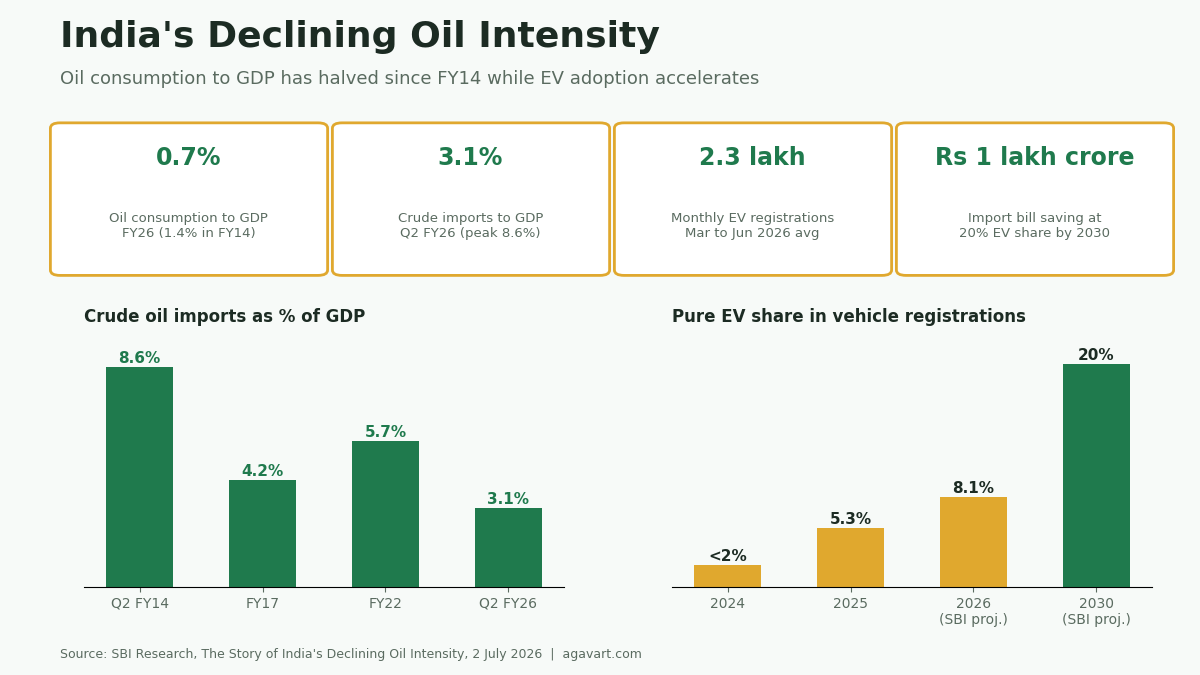
India’s oil intensity, defined as oil consumption as a share of GDP, has halved from 1.4 per cent in FY14 to 0.7 per cent in FY26, according to SBI Research. Crude oil imports have fallen from a peak of 8.6 per cent of GDP in Q2 FY14 to 3.1 per cent in Q2 FY26. The report, released on July 2, 2026, says this structural decline explains India’s economic resilience through the West Asia crisis.
Electric vehicle registrations have averaged 2.3 lakh a month since the conflict began in February 2026, against 1.3 lakh in 2025. SBI Research argues that a comprehensive EV policy could hasten the fall in oil intensity and save Rs 1 lakh crore on the import bill by 2030.
Table of Contents
| Indicator | Latest value | Note |
|---|---|---|
| Oil consumption to GDP | 0.7 per cent (FY26) | down from 1.4 per cent in FY14 |
| Crude oil imports to GDP | 3.1 per cent (Q2 FY26) | peak of 8.6 per cent in Q2 FY14 |
| Oil consumption, May 2026 | down 6.5 per cent yoy | April 2026 down 3.8 per cent |
| Monthly EV registrations, Mar to Jun 2026 | 2.3 lakh average | 1.3 lakh average in 2025 |
| Pure EV share in registrations, 2026 | above 8 per cent | under 2 per cent in 2024 |
| Public charging stations | 29,151 | only 30 per cent are fast chargers |
| Import saving at 20 per cent EV share by 2030 | Rs 1 lakh crore | 8,675 million litres of petrol replaced |
What the SBI Report Says About India’s Oil Intensity
SBI Research finds that oil intensity in the Indian economy has been falling steadily for over two decades, from 5.2 per cent of GDP in FY98 and 1.4 per cent in FY14 to 0.7 per cent in FY26, as per the report. The Bai Perron breakpoint test used in the study identifies four statistically significant structural breaks in crude imports to GDP, with the March 2026 break coinciding with the escalation of the West Asia crisis.
Oil consumption declined 3.8 per cent year on year in April 2026 and 6.5 per cent in May 2026, even as leading indicators such as vehicle sales, GST e-way bills and credit held up. The report reads this divergence as evidence of a structural shift rather than a slowdown.
Why Oil Intensity Is Falling
The report lists four drivers. Diesel pump sets in agriculture are being replaced by solar irrigation pumps, with high speed diesel use in agriculture now at 4.7 per cent of the total in FY25. The metro rail network has grown from 248 km in 2014 to 1,143 km across 29 cities. Renewables account for 212 GW, or roughly 40 per cent of India’s 521 GW installed generation capacity as of January 2026. The fourth driver is the EV push.
Since the West Asia conflict began in February 2026, monthly EV registrations have averaged 2.3 lakh against 1.3 lakh in 2025, and SBI Research projects total registrations may cross 25 lakh in 2026. The pure EV share in total registrations has climbed from under 2 per cent in 2024 to above 8 per cent in 2026 so far, and states such as Odisha, Kerala, Karnataka and Delhi have crossed the 10 per cent mark. Piped natural gas has also gained, with 5.96 lakh PNG connections gasified since March 2026.
What Next for Oil Intensity and EV Adoption
The report argues the gap is now infrastructure and policy, not demand. India has 29,151 charging stations, with Karnataka and Maharashtra alone accounting for 35 per cent of them, and only 30 per cent of chargers are fast chargers. In states such as Odisha and Bihar, more than 220 EVs depend on a single charging station. Battery operated vehicle registrations have fallen from 15.8 lakh in 2023 to 7.9 lakh in 2025, and e-truck adoption lags China, where one in four trucks sold in 2025 was electric. The PM E-DRIVE scheme offers purchase subsidies of up to Rs 9.6 lakh per electric truck but is expected to support only around 5,600 e-trucks.
SBI Research recommends a 10 to 15 year EV roadmap, a credit guarantee fund for EV financing, concessional land for public charging stations, fleet electrification and a dedicated green mobility lending category. If the EV share of registrations reaches 20 per cent by 2030, from 8.1 per cent projected for 2026, the report estimates a saving of 8,675 million litres of petrol and Rs 1 lakh crore on the import bill.
Frequently Asked Questions
What is oil intensity?
Oil intensity is oil consumption measured as a share of GDP. It shows how much oil an economy burns to produce each unit of output. India’s oil intensity fell from 1.4 per cent of GDP in FY14 to 0.7 per cent in FY26, as per SBI Research.
Why did EV registrations in India rise after February 2026?
SBI Research attributes the jump to the West Asia conflict, which pushed fuel prices higher and shifted buyer preference. Monthly EV registrations rose from a 2025 average of 1.3 lakh to 2.3 lakh between March and June 2026.
How much can India save on oil imports through EVs?
The report estimates that a 20 per cent EV share in annual vehicle registrations by 2030 would replace about 8,675 million litres of petrol and save around Rs 1 lakh crore on the import bill.
What is holding back faster EV adoption in India?
Charging infrastructure is the main constraint, as per the report. Only 30 per cent of India’s 29,151 charging stations offer fast charging, and the burden per station exceeds 200 EVs in states such as Odisha, Bihar and Chhattisgarh.
Parallel Reading
Agavart has also covered India’s move to put a monetary value on coal assets under the new accounting framework and the BIS Annual Report 2026 on productivity gains and financial risks, both of which examine the structural forces reshaping energy and the global economy.
Primary Reports and Sources
- SBI Research, The Story of India’s Declining Oil Intensity, Issue 12 FY27 (July 2, 2026): 📥 Download Full Report PDF
Curated and Reviewed by Deepak Chavan | Founder & Market Expert