Reading, 9 July 2026. Last month was the second warmest June ever measured worldwide, and the hottest June on record for western Europe, according to the Copernicus Climate Change Service. A fierce heatwave and the warmest ocean on record for the month underline that the planet’s long warming trend is still very much intact.
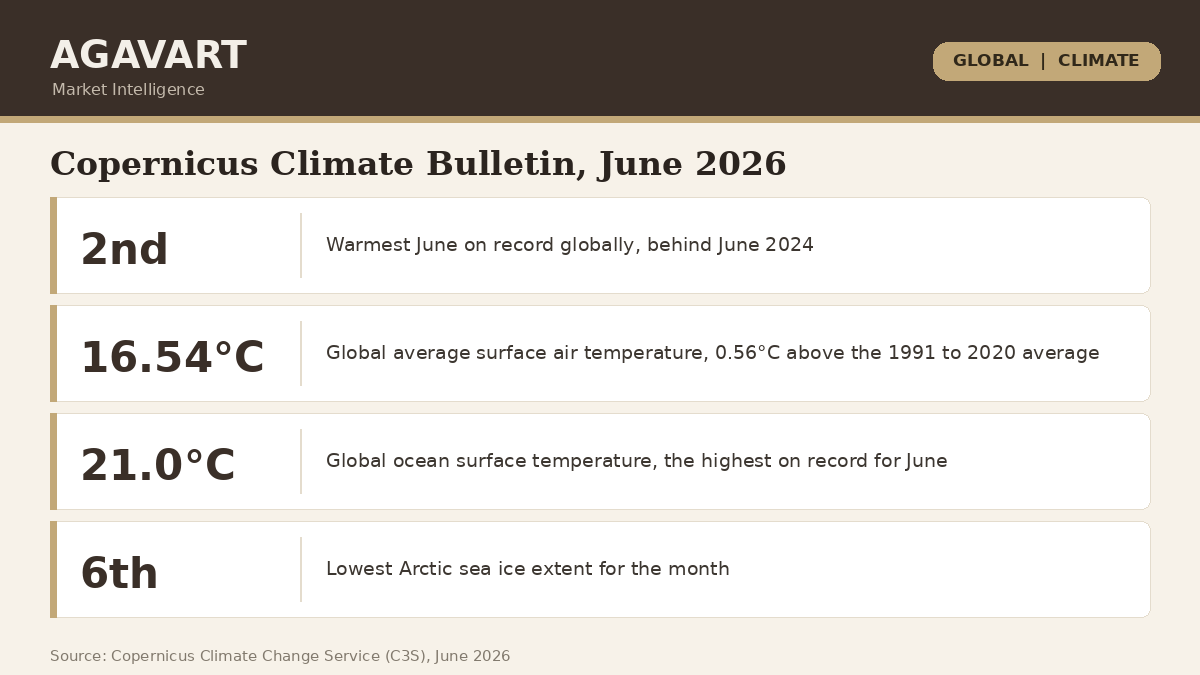
The headline number. The global average surface air temperature in June 2026 was 16.54 degrees Celsius, 0.56 degrees above the 1991 to 2020 average for the month. That places it as the June 2026 second warmest on record, just behind June 2024. The run of near-records that began in 2023 has not broken, and each new month keeps the long-term warming line pointing the same way.
Europe took the brunt. Western Europe recorded its hottest June ever, and the continent as a whole its second warmest, as an intense heatwave gripped much of the region in the second half of the month. The heat arrived with dry ground. Much of western, central and eastern Europe saw below-average rainfall, and river flows ran low across many of those areas, a warning sign for water supplies and summer power generation. For a region already braced for hotter summers, another record shows how quickly the exceptional is becoming the ordinary.
The ocean is the engine. The clearest signal sat offshore. Sea surface temperatures over the extra-polar ocean were the highest ever recorded for June, at around 21.0 degrees Celsius, while El Nino conditions began to develop in the equatorial Pacific. Warm seas load the dice for hot air over land and feed the marine heatwaves that stress fisheries and coral. Because the ocean releases its heat slowly, a record warm sea in June 2026 tends to keep the atmosphere warm for months afterwards. The USDA’s grain and oilseed outlook highlighted how El Nino warming cycles feed through to food production across Asia and the Americas.
Thinning ice at both poles. The cryosphere told the same story. Arctic sea ice extent was the sixth-lowest on record for June, with unusually open water around Svalbard, while Antarctic sea ice also ranked sixth-lowest for the month. Ice at both ends of the Earth continues to run well below its historical norm.
Why it matters and what to watch. A developing El Nino stacked on top of an already record warm ocean points to more heat, not less, through the second half of 2026. For governments and businesses that means another season of pressure on harvests, water supplies, power grids straining under cooling demand, and insurers pricing a hotter world. The number to watch is the twelve-month global average, and whether this run of warmth keeps it close to the 1.5 degree mark that the Paris Agreement set as a guardrail. Watch too whether El Nino strengthens into the autumn, and how quickly, if at all, the poles claw back their missing ice. The June 2026 second warmest designation is a reminder that the run of record-breaking warmth that began in 2023 has not ended.
Curated and Reviewed by Deepak Chavan | Founder & Market Expert