Europe’s latest research digest carries one blunt message. A fresh energy price shock from the Middle East is pushing the Union to build a deeper Energy Union, to weigh a direct EU-wide digital services tax, and to lock down its own supply of critical minerals. One thread runs through every file: strategic autonomy, the drive to depend less on outside powers for money, fuel and raw materials.
• Report Snapshot
• The finding: As stated in the report, a recent energy price shock linked to the Middle East crisis is prompting the EU to pursue a deeper Energy Union while it also examines a digital levy and critical mineral security to protect its strategic autonomy.
• By the numbers: new own-resource basket proposed for the seven-year budget covering twenty twenty-eight to twenty thirty-four; digital levy workshop held on the twenty-third of June twenty twenty-six; the European Semester Spring Package released on the third of June twenty twenty-six; an upcoming briefing on aviation fuel and kerosene prices on the fifteenth of July twenty twenty-six; three regional sea basins studied for cross-border fisheries cooperation, namely the Baltic, the Mediterranean and the Western Waters.
• Why it matters: As stated in the report, a deeper Energy Union aims to improve security of supply and lower medium-term costs, while a new own resource would give the Union more reliable revenue for its long-term objectives.
• Source: European Parliament, PE 789.225, Research Digest for Committees, July 2026
If you have a moment, read on for the full breakdown and sources
Table of Contents
1. What has changed since the 2022 shock
2. Why Europe is deepening the Energy Union
3. What this means, and what to watch
4. Frequently asked questions
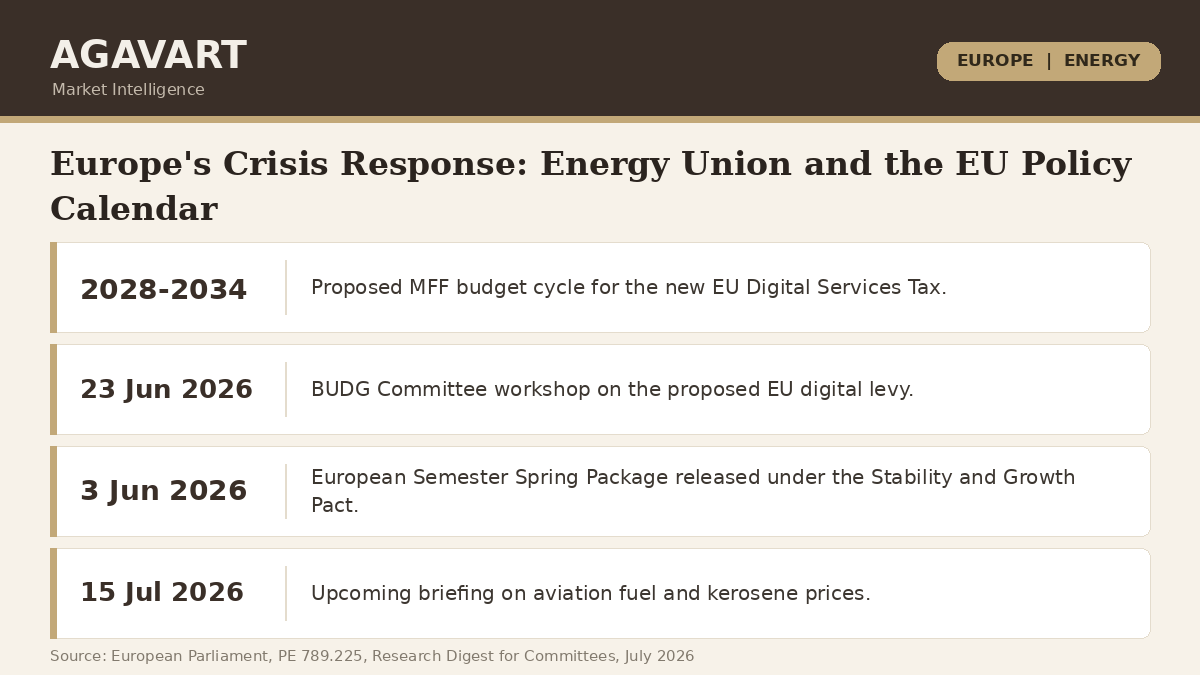
Key dates from the digest
2028 to 2034: proposed MFF budget cycle for introducing the new EU Digital Services Tax as an own resource.
23 June 2026: BUDG Committee workshop on the proposed EU digital levy.
3 June 2026: European Semester Spring Package released, including the Stability and Growth Pact net expenditure check.
15 July 2026: upcoming briefing on aviation fuel and kerosene prices from a competitiveness angle.
What has changed since the 2022 shock
The July 2026 digest opens with a warning from the ECON committee. A fresh energy price shock, this one triggered by conflict in the Middle East, has already worked its way through European wholesale markets. The Parliament’s economists make a point worth pausing on: this shock is not a repeat of 2022. Back then the pain was concentrated in Russian pipeline gas, and the response was emergency storage and rationing.
This time the pressure runs through oil and liquefied natural gas priced on global benchmarks. Europe is therefore exposed to a wider swing in freight, insurance and shipping routes, even though its gas storage now sits at a more comfortable level. The immediate fiscal hit is smaller. The structural lesson is not. The Union is still a price-taker on imported fuel, and that is precisely what a stronger Energy Union is meant to change.
Why Europe is deepening the Energy Union
That reading is driving three connected responses. The first is the Energy Union itself: shared storage, joint gas buying and faster grid links, so that member states stop reacting one by one and start buying and building as a bloc.
The second is money. The budget committee is examining a direct EU-wide digital levy as a new own resource for the 2028 to 2034 budget, and a workshop on 23 June 2026 weighed its revenue potential against the risk of clashing with the OECD Pillar One process and the emerging UN tax framework. The third is materials. A study on United States critical minerals policy warns that Europe’s access to battery metals and rare earths could be squeezed by decisions taken in Washington, which sharpens the case for supply chains built closer to home under the Made in Europe banner.
What this means, and what to watch
Everything above is drawn from PE 789.225. What follows is Agavart’s analysis, drawing on official sources published since the digest. Facts and interpretation are kept separate on purpose.
Energy Union is moving from paper to plumbing. The digest calls for deeper integration to lower medium-term costs. In practice the Commission is already building it: a Grids Package in December 2025 and the AccelerateEU package in April 2026 point to an agenda that is now in delivery rather than debate (European Commission, affordable energy actions). For traders, the takeaway is that Europe’s answer to the next spike is structural, not a one-off subsidy. Watch interconnection milestones and joint gas volumes.
The minerals warning has already become a deal. The report frames US policy as a risk. Since then the risk has turned into a partnership: on 24 April 2026 the EU and the United States signed a critical minerals memorandum of understanding and an action plan (European Commission press release). The read is that Europe is hedging, not decoupling. For battery-metal and rare-earth chains, the transatlantic route now sits alongside Made in Europe. The open question is whether the plan yields offtake contracts or stays a statement.
The real contest is over who taxes, not whether. The digest weighs a digital levy. The Commission’s own budget package leans instead on a Corporate Resource for Europe, a flat charge on large firms, within a wider set of new own resources for 2028 to 2034 (European Commission, EU budget 2028-2034). So Parliament’s digital tax and the Commission’s corporate levy are rival designs for the same revenue gap. For large companies the question is not if a new EU charge lands, but on which base. Watch the own-resources talks, which need unanimity.
Why the reader should care: the downside sits in fuel. The report says this shock is milder than 2022 but the exposure remains. Independent modelling sharpens the stakes: the Joint Research Centre has mapped a prolonged-crisis scenario for EU energy prices (JRC), and the World Bank has flagged the sharpest commodity move since 2022 (World Bank). For Indian and global readers, Europe’s push for autonomy shapes LNG demand, fertiliser costs and the euro-area growth path. The 15 July aviation fuel briefing is an early read on how far competitiveness worries steer the next steps.
Frequently Asked Questions
What is the Energy Union and why does it matter now?
The Energy Union is the EU’s plan to knit national energy systems into a single, better-connected market. After a second price shock in three years, the report argues that shared storage, joint purchasing and stronger grids would improve security of supply and lower medium-term costs more effectively than each country acting alone.
What would an EU digital services tax do?
A digital levy would tax the revenue that large digital firms earn in Europe and channel it directly to the EU budget as a new own resource. It would reduce reliance on member-state contributions, but its design must fit alongside the OECD Pillar One process and the emerging UN tax framework to avoid double taxation and disputes.
Why do critical minerals affect Europe’s strategic autonomy?
Batteries, clean-energy equipment and defence systems all depend on minerals such as rare earths and battery metals. The report reviews how United States policy could tighten EU access to these inputs, strengthening the case for domestic and allied supply chains under the Made in Europe approach.
Sources and further reading
Primary source: European Parliament, PE 789.225, Research Digest for Committees, July 2026 (PDF).
Supporting context (Agavart analysis):
European Commission, actions supporting affordable energy: energy.ec.europa.eu
European Commission, EU and US strategic partnership on critical minerals: ec.europa.eu
European Commission, EU budget 2028-2034: commission.europa.eu
Joint Research Centre, Middle East crisis and EU energy prices: joint-research-centre.ec.europa.eu
World Bank, Commodity Markets Outlook, April 2026: worldbank.org
Curated and Reviewed by Deepak Chavan | Founder & Market Expert