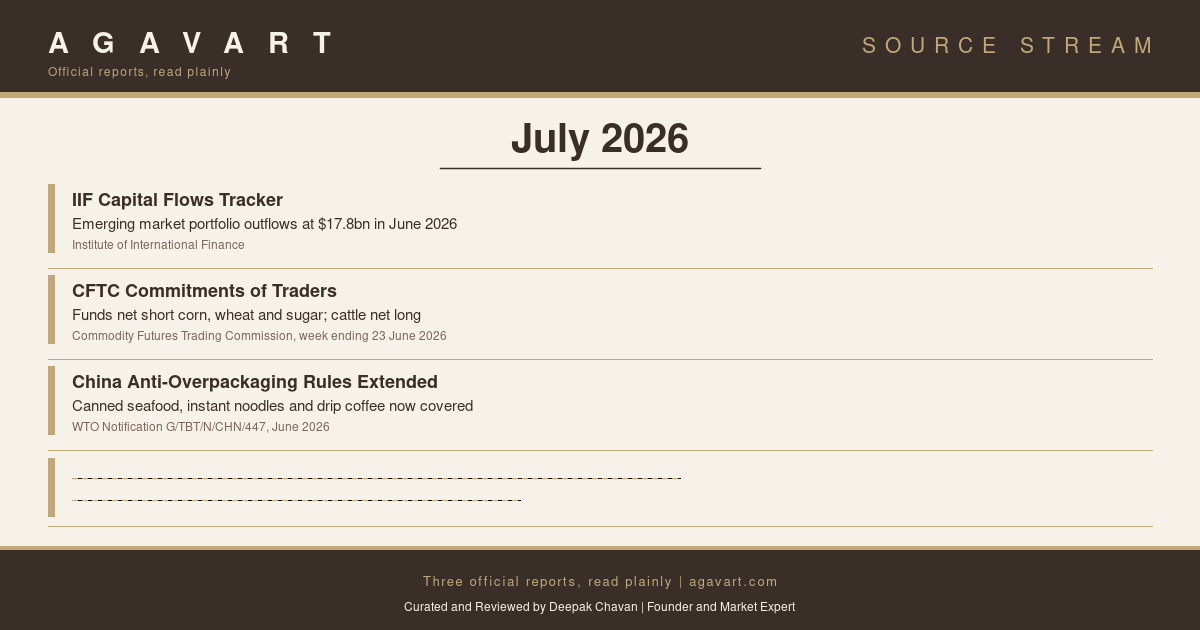
Nonresident portfolio flows to emerging markets registered a second consecutive monthly outflow in June 2026, at -$17.8 billion, according to the IIF Capital Flows Tracker. CFTC Commitments of Traders data as of June 23 shows managed-money funds net short on corn, wheat and sugar, while holding large net long positions in live cattle and coffee. Separately, China filed WTO notification G/TBT/N/CHN/447/Add.3 amending its mandatory food packaging standard GB23350-2021, covering canned seafood, instant noodles and drip bag coffee.
IIF Capital Flows Tracker: July 2026 | Institute of International Finance
The IIF Capital Flows Tracker for July 2026, released July 10, 2026, shows nonresident portfolio flows to emerging markets at -$17.8 billion in June, the second consecutive monthly outflow. May 2026 registered -$25.2 billion; the June figure marks some moderation but keeps the two-month run firmly in negative territory. The year-on-year contrast is sharp: June 2025 saw +$51.1 billion in nonresident EM portfolio inflows, making the swing from year-ago levels approximately $68.9 billion.
The IIF Capital Flows Tracker consolidates portfolio flows data (previously published as the Portfolio Flows Tracker) with broader net capital flow estimates. It is published near the end of each month. The July 2026 edition covers June data. Country-level breakdowns, asset-class splits and the EM Debt Monitor component are available to IIF member institutions; the headline portfolio flow totals cited here are drawn from the public summary on the IIF website.
The back-to-back outflow months follow a sharp April rebound (+$70.6 billion) that had reversed March’s decline, which was the first full month of data after the start of the Iran war, per the IIF’s own framing in earlier editions. The June reading suggests the April recovery has not held.
Read the original: iif.com/Research/Capital-Flows-and-Debt/Capital-Flows-Tracker (full tracker is IIF member access; headline data is public)
CFTC Commitments of Traders: Week Ending June 23, 2026 | Commodity Futures Trading Commission
The CFTC Disaggregated COT report for the week ending June 23, 2026 (published June 26) shows managed-money funds carrying net short positions across the major grain and soft commodity markets, with significant long exposure in livestock and coffee. The managed-money category covers hedge funds and other large speculative traders; their positioning is widely watched as a proxy for directional market sentiment.
In corn, managed money held 308,728 long contracts against 383,547 short, a net short of approximately 74,800 contracts on total open interest of 1.92 million. Short positions added around 40,200 contracts from the prior week. Soft red winter wheat showed a net managed-money short of about 70,400 contracts (open interest 428,305), with the short side representing 32.4 per cent of total open interest. Sugar No.11 carried the largest speculative short in the agricultural complex: 128,209 longs against 314,499 shorts, a net short of roughly 186,300 contracts on open interest of 1.007 million.
Live cattle was the standout long position. Managed money held 135,644 longs against 10,061 shorts, a net long of 125,583 contracts on open interest of 328,903. Coffee C showed a net managed-money long of about 20,900 contracts, with longs adding 3,729 positions from the prior week. Soybeans remained net long at approximately 37,000 contracts but saw longs trimmed by nearly 15,000 in the week. Soybean oil was net long at roughly 103,200 contracts with some position reduction.
Read the original: cftc.gov/MarketReports/CommitmentsofTraders/index.htm (Agricultural Disaggregated Short Format, free public access)
China Extends Anti-Overpackaging Rules to Canned Seafood, Instant Noodles and Drip Coffee | WTO Notification, June 2026
China on June 1, 2026, filed WTO notification G/TBT/N/CHN/447/Add.3, amending its mandatory National Standard for Restricting Excessive Packaging for Foods and Cosmetics (GB23350-2021). The notification, reported by USDA Foreign Agricultural Service on July 9, 2026, carries no comment period. The amendment had not been officially published in China as of the report date; it takes effect on the date of publication.
The amendment revises Table A of Appendix A of the standard, which sets maximum spatial coefficients (k values) for each product category. A k value limits how much packaging volume is permissible relative to product volume; lower values are more restrictive. Three changes are made. The former single “Canned Foods” entry is divided into “Canned Livestock, Poultry and Aquatic Products” (k=2.5) and “Other Canned Foods” (k=8.0). A new footnote under convenience foods sets k=15.0 for instant rice and noodle products prepared in their own containers. A new footnote under cocoa and roasted coffee products sets k=8.0 for drip bag coffee.
GB23350-2021 entered into force on September 1, 2023. This is the third amendment since publication; the previous two revised packaging rules for grains (2022) and for milk powder, seafoods, soy products and infant foods (2025). USDA FAS advises that exporters of canned seafood, canned meat, instant noodles and drip bag coffee products sold in China should review the regulation to assess any market or regulatory impact.
Read the original: USDA FAS GAIN Report CH2026-0089
Curated and Reviewed by Deepak Chavan | Founder & Market Expert