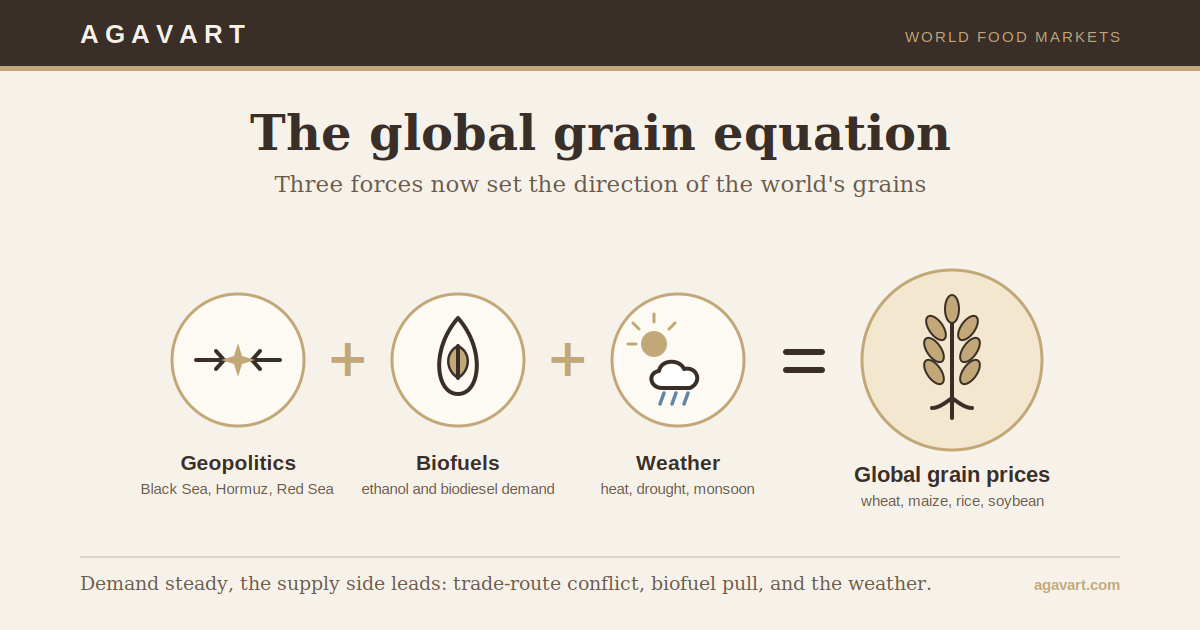
World wheat has climbed to a two-year high as Black Sea shipping disruption and heat damage in the European Union and the United States tighten supply, even as the prospect of a record global soybean crop keeps oilseed prices steady. Rice and urea firmed, and renewed strain on the Black Sea, the Strait of Hormuz and the Red Sea kept maritime risk in focus, according to the AMIS Market News Summary for Week 29 (July 2026).
This week at a glance
| Segment | This week, per AMIS | Direction |
|---|---|---|
| Wheat | Two-year high on Black Sea logistics disruption, heat in the EU and US, and a USDA cut to the US crop. | Firmer |
| Maize | Firmed on heat and dryness across the US and Western Europe and Black Sea tension; IGC cut its 2026/27 global forecast. | Firmer |
| Soybean | Steady on favourable Brazil and US crop prospects; IGC sees a record world crop; China’s June imports hit a record. | Steady |
| Rice | Strengthened on higher Indian minimum reserve prices, monsoon concerns and record Philippine buying. | Firmer |
| Fertilizers | Selected urea references rebounded on renewed disruption to Strait of Hormuz transits. | Firmer |
| Trade logistics | Black Sea, Strait of Hormuz and Red Sea routes under simultaneous strain, keeping freight risk elevated. | Disrupted |
| Vegetable oil and biofuel | Palm futures rose on firmer crude; biofuel mandates in the US and Brazil are pulling vegetable oil toward fuel. | Firmer |
| Policy | Brazil raised its ethanol blend from 30 to 32 percent; China opened Australian canola to private crushers; India advanced sugarcane-maize intercropping for ethanol feedstock. | Active |
Short FAQ
Why did world wheat reach a two-year high this week?
AMIS attributes it to Black Sea shipping disruption, including drone strikes and a halt to Don-Azov canal traffic, combined with heat damage to EU and US crops and a USDA cut to the US harvest. It is a supply and logistics story rather than a demand surge.
What is happening with global soybean prices?
They held steady. The International Grains Council projects a record world crop on larger Brazilian and US harvests, and China’s June imports hit a record on strong Brazilian supply, all of which is keeping oilseed prices contained.
What is AMIS and how often is this published?
AMIS is the Agricultural Market Information System, hosted by FAO and backed by the G20, covering wheat, maize, rice and soybean. It issues this Market News Summary weekly and a deeper Market Monitor monthly.
Where can I read the original AMIS report?
The weekly summary and the monthly Market Monitor are published at amis-outlook.org. Links are in the source line below.
Source
Primary source: AMIS Market News Summary, Week 29, July 2026 (FAO). Deeper monthly analysis: AMIS Market Monitor (FAO). All figures on this page are as reported by AMIS.