Factsheet | India Oil Demand
India, Not China: World’s Largest Single-Country Source of Oil Demand Growth in 2027, Says OPEC
Published 14 July 2026, 16:00 IST | Pune
India will be the largest single country source of world oil demand growth in 2027, adding about 0.36 mb/d, while China remains the world’s largest overall oil consumer, according to OPEC.
OPEC’s July 2026 Monthly Oil Market Report shows India as the single largest source of world oil demand growth in 2027, adding about 0.36 mb/d, ahead of China’s 0.29 mb/d. India’s demand rises from 5.74 mb/d in 2026 to 6.10 mb/d in 2027.
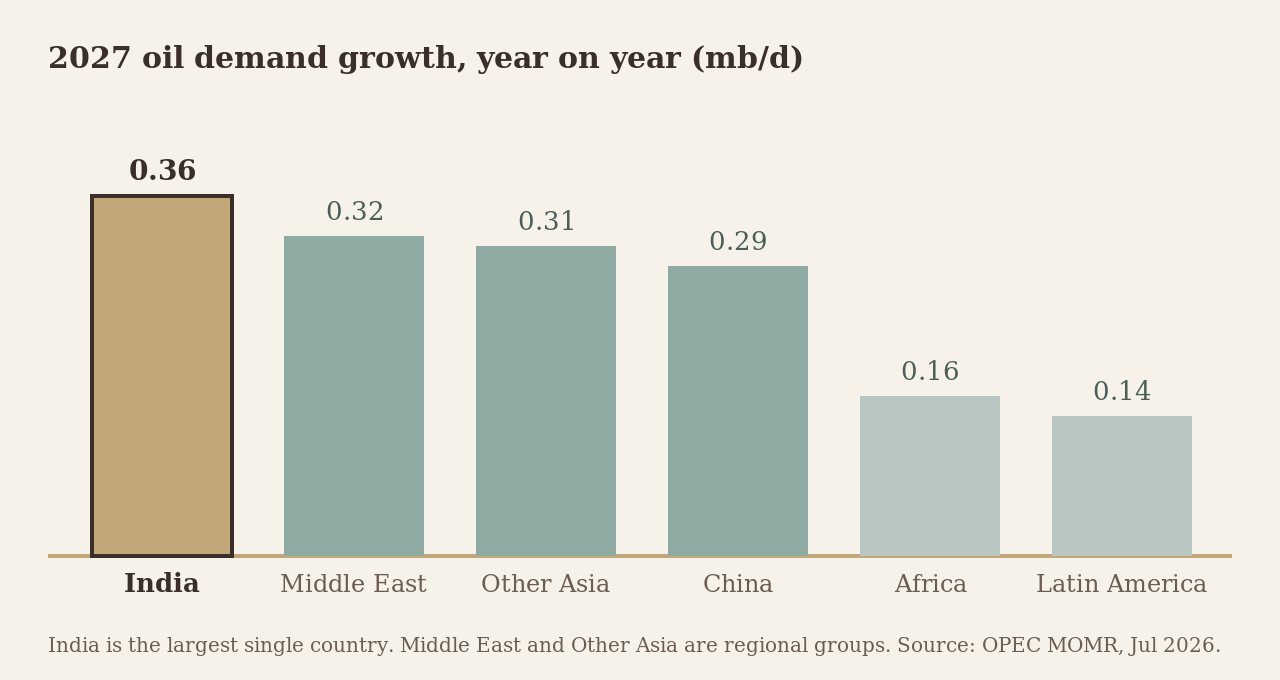
India Out in Front, 2027 Oil Demand Growth
India Oil Demand Trajectory (mb/d)
| 2025 (actual) | 5.65 mb/d |
|---|---|
| 2026 (forecast) | 5.74 mb/dup 0.09 mb/d y-o-y |
| 2027 (forecast) | 6.10 mb/dup 0.36 mb/d y-o-y, the largest single-country gain |
| India share of world demand | 5.4% (2026) to 5.7% (2027)rising |
2027 Demand Growth: India vs Others (mb/d, y-o-y)
| India | +0.36largest single country |
|---|---|
| Middle East (region) | +0.32 |
| Other Asia (group) | +0.31 |
| China | +0.29 |
| Africa | +0.16 |
| Latin America | +0.14 |
| Total world | +1.94non-OECD about 1.68 of it |
India Macro and Trade Snapshot
| India GDP growth (unchanged m-o-m) | 6.6% (2026), 6.5% (2027)fastest of the major economies OPEC tracks |
|---|---|
| India crude imports (May 2026) | 5.1 mb/drose for a second straight month |
| India product imports (May 2026) | 814 tb/drecovered from historically low levels |
| India product exports (May 2026) | 938 tb/dsupported by higher naphtha outflows |
Summary: India Oil Demand Growth 2027 in the OPEC July 2026 Report
OPEC’s July 2026 Monthly Oil Market Report places India at the front of global oil demand growth for 2027. In OPEC’s own tables, India is set to add about 0.36 million barrels a day next year, the largest gain of any single country, ahead of China at 0.29 million barrels a day. This lifts India’s oil demand from 5.74 million barrels a day in 2026 to 6.10 million barrels a day in 2027. It is worth reading this precisely: China remains far larger in absolute terms, at about 17.30 million barrels a day in 2027, so India leads on the increment, not on the total.
The wider shape of the forecast explains why India stands out. OPEC sees world oil demand growing by about 1.94 million barrels a day in 2027, of which roughly 1.68 million barrels a day comes from non-OECD countries, while the OECD adds only about 0.27 million barrels a day. Within the non-OECD group, the largest additions come from India at 0.36, the Middle East at 0.32, Other Asia at 0.31 and China at 0.29 million barrels a day. Of these, India is the single largest individual country, while the Middle East and Other Asia are regional groups.
India’s demand is underpinned by the strongest headline growth among the major economies OPEC tracks. India’s GDP growth forecasts are held unchanged at 6.6 per cent for 2026 and 6.5 per cent for 2027, above the United States, the Eurozone, Japan and China. On the trade side, India’s crude imports recovered to 5.1 million barrels a day in May, rising for a second straight month, while product imports reached 814 thousand barrels a day and product exports 938 thousand barrels a day, the latter supported by higher naphtha outflows.
India’s growth is also import driven, which links this demand story to trade and freight. With crude imports at 5.1 million barrels a day in May against domestic demand near 5.7 million barrels a day, most of the rise in Indian consumption has to be met by higher imports. India is at the same time a refining hub, taking in 814 thousand barrels a day of products while exporting 938 thousand barrels a day, so the country sits on both sides of the product trade even as its underlying demand climbs.
The near-term picture is more modest. For 2026, India adds only about 0.09 million barrels a day as global demand growth stays soft at 0.8 million barrels a day. The step-up arrives in 2027, when the world total accelerates to 1.94 million barrels a day and India’s share of that increase is the largest of any country. In OPEC’s numbers, the centre of gravity for oil demand growth in Asia is broadening beyond China to include India as a leading driver.
Outlook: India, 2026 to 2027 (as projected in the report)
OPEC’s forecasts show India’s oil demand growth accelerating sharply into 2027 and its share of world demand rising. All figures are as projected by OPEC.
| Indicator | 2026 | 2027 | Direction |
|---|---|---|---|
| India oil demand (mb/d) | 5.74 | 6.10 | Rising |
| India demand growth, y-o-y (mb/d) | +0.09 | +0.36 | Accelerating |
| India share of world demand | 5.4% | 5.7% | Rising |
| Rank among single-country adders | – | 1st | Ahead of China |
| India GDP growth (per cent) | 6.6 | 6.5 | Fastest major |
Read it precisely: India leads the world on the increase in oil demand for 2027, not on the total. China stays the larger consumer in absolute terms, at about 17.30 million barrels a day against India’s 6.10 million barrels a day. Within India’s own year, demand peaks in the fourth quarter of 2027 at about 6.38 million barrels a day.
“In India, crude imports continued to recover, increasing for the second month.”OPEC Monthly Oil Market Report, July 2026
Source: OPEC Monthly Oil Market Report, July 2026 (world oil demand tables), OPEC Secretariat. Read the full report: OPEC MOMR PDF download.