Published: 21 July 2026 | Pune, India
China holds the world’s largest strategic petroleum reserve: an estimated 1.1 to 1.4 billion barrels as of May 2026, equal to 110 to 140 days of net imports. That is more than three times the United States government SPR of 413 million barrels. RAND Europe’s new study of China’s strategic petroleum reserve, published on 21 July 2026, asks a pointed question: could Beijing use this reserve as a geoeconomic instrument, and not only as an emergency buffer? The study’s expert panel found the most likely path is caution, with sparing and conservative releases.
Primary source: RAND Europe, RRA5069-1, 21 July 2026 | Report page on rand.org
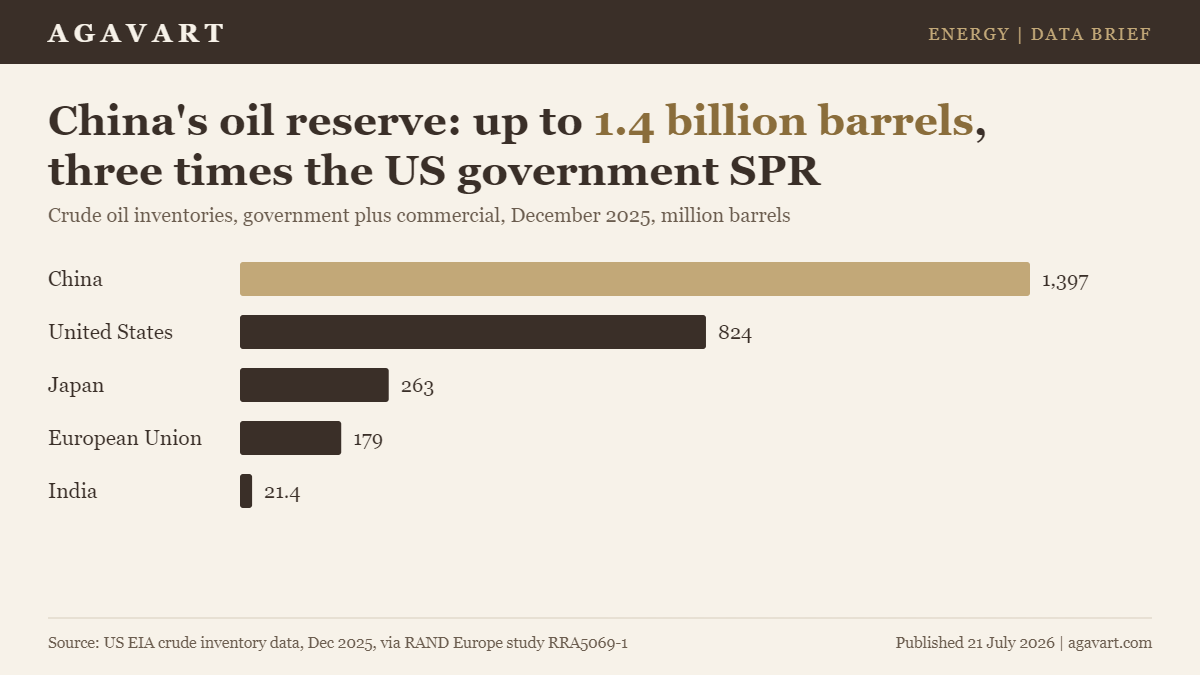
Board 1: Who holds how much crude in reserve
All figures in million barrels, December 2025, as compiled by the US Energy Information Administration and cited in the RAND report. The IEA counts both government and enterprise stocks for China, because Chinese law places enterprise stocks under state direction.
| Country or bloc | Government reserve | Commercial reserve | Total |
|---|---|---|---|
| China | 359 | 1,038 | 1,397 |
| United States | 413 | 411 | 824 |
| Japan | 263 | n.a. | 263 |
| European Union | 179 | n.a. | 179 |
| Saudi Arabia | 82 | n.a. | 82 |
| South Korea | 79 | n.a. | 79 |
| Iran | 71 | n.a. | 71 |
| UAE | 34 | n.a. | 34 |
| India | 21.4 | n.a. | 21.4 |
Import cover: China 110 to 140 days; United States about 125 days, as stated in the report. IEA members carry a 90 day minimum obligation; the report does not give measured day counts for Japan or the EU.
Board 2: Who supplies China’s crude
Share of China’s 2025 crude imports, per the Columbia Center on Energy Policy data cited in the report. Imports rose 4.5 per cent in 2025 to 11.6 million barrels per day.
| Supplier | Share of 2025 imports |
|---|---|
| Russia | 18 per cent |
| Saudi Arabia | 14 per cent |
| Malaysia | 11 per cent |
| Iraq | 11 per cent |
| Brazil | 8 per cent |
| UAE | 7 per cent |
| Oman | 6 per cent |
| Angola | 5 per cent |
| Kuwait | 3 per cent |
| Canada | 3 per cent |
| Others | 14 per cent |
Around 22 per cent of reported 2025 imports are estimated to be sanctioned barrels, mainly Iranian and Venezuelan, often re-exported via Malaysia. This estimate overlaps the country shares above; Malaysia’s 11 per cent largely reflects that transshipped flow.
Board 3: The policy framework behind the strategic petroleum reserve
| Dimension | What the report records |
|---|---|
| Primary purpose | Energy security and supply disruption management |
| Expanded purpose | Market stabilisation and macroeconomic control |
| Legal basis | Energy Law in force since 1 January 2025; Articles 54 and 55 let the state direct enterprise-held stocks during supply shocks or major market fluctuations |
| Structure | Layered: central government stocks plus enterprise reserves that carry a state responsibility mandate |
| Decision making | Centralised, led by the State Council with NDRC and NEA planning |
| Execution | NFSRA management; CNPC, Sinopec and CNOOC infrastructure and logistics |
| Operational tools | Stockpiling, rotation, auctions, emergency drawdown; the September 2021 Dalian auction of about 7.38 million barrels is the clearest documented case |
| Transparency | Limited public disclosure of total inventory and release logic; estimates rely on customs data, tanker tracking and satellite imagery |
Board 4: Three scenarios, with RAND’s expert verdicts
| Scenario | What it involves | Expert verdict |
|---|---|---|
| Strategic caution | Conservative stance; state refiners tap commercial reserves at a modest, monitored pace; central stocks preserved | Most likely baseline |
| Precision relief | Targeted drawdowns for specific provinces and sectors, such as coastal manufacturing or agribusiness, inside China | Highly realistic |
| Strategic energy diplomacy | Refined products, particularly jet fuel, offered to crisis-hit partner countries at below-market rates, tied to alignment or yuan-denominated deals | Plausible policy option |
These are hypothetical vignettes tested with a four-member RAND expert panel, not observed policy. One element is already documented in the report: yuan-denominated, SPR-backed oil deals with smaller or sanctioned trading partners.
What has changed in China’s reserve system?
China planned its strategic petroleum reserve under the Ninth Five-Year Plan in 1996, three years after becoming a net crude importer. Construction of the first base began in March 2004. Two decades later, the network spans at least 22 sites, from coastal ports such as Zhoushan, Zhenhai, Qingdao and Dalian to inland locations such as Shanshan and Daqing. Eleven more commercial sites are planned. The bigger change is legal. The Energy Law, in force since 1 January 2025, lets the state direct enterprise-held commercial stocks during market shocks. In IEA economies, commercial and strategic reserves stay separate. In China, that line has thinned. Beijing can act through commercial stocks first, without declaring an emergency and without touching central reserves.
Why does the reserve’s size matter now?
The report lands in a stressed market. It records that the IEA’s March 2026 coordinated release of 400 million barrels, its largest ever, may not fully calm oil price volatility, citing expert commentary. Before the 2026 Iran War and the disruption around the Strait of Hormuz, China’s reserve alone was comparable to the combined SPRs of all IEA member states. China is not an IEA member, so this capacity sits outside coordinated Western energy security. Opacity adds leverage. China does not regularly publish reserve data. RAND notes this uncertainty amplifies signalling effects: the small Dalian auction of 2021 moved sentiment well beyond its size. Cost matters too. Around 22 per cent of 2025 imports are estimated to be discounted, sanctioned barrels, which lowered the cost of filling the reserve.
What could Beijing do with it next?
The study is explicit that it tests capability, not intent. Its expert panel judged strategic caution the most likely path: rare, careful releases even during volatility. Precision relief, targeted at Chinese provinces and sectors, was judged highly realistic. Energy diplomacy abroad was judged plausible. The panel also expects the reserve to keep its size through the energy transition. Civilian oil demand may plateau as China electrifies, but military platforms remain dependent on liquid fuels. A less oil-intensive economy would make the same 1.40 billion barrels last longer in a prolonged crisis, which widens Beijing’s policy space rather than narrowing it.
Where does India stand?
In the EIA inventory table cited by RAND, India’s strategic petroleum reserve is 21.4 million barrels, the smallest holding among the major importers listed. China’s total is about 65 times larger. India also imports 88.7 per cent of its crude requirement, per PPAC data for 2025-26. For Indian readers, that gap, not the scenarios, may be the most practical number in the study.
Frequently asked questions
How big is China’s strategic petroleum reserve in 2026?
RAND Europe estimates 1.1 to 1.4 billion barrels as of May 2026, equal to 110 to 140 days of China’s net imports, held across at least 22 storage sites.
How does China’s SPR compare with the US SPR?
The US government SPR holds 413 million barrels, about 125 days of net imports. Counting commercial stocks, the US total is 824 million barrels against China’s 1,397 million.
What does China’s 2025 Energy Law change for oil reserves?
Articles 54 and 55 empower the state to direct enterprise-held commercial oil stocks during supply shocks or major market fluctuations, merging commercial inventory into national response capacity.
Could China use its oil reserve as a geoeconomic tool?
The RAND study treats this as a what-if question. Its experts judged cautious, sparing use most likely, targeted domestic relief highly realistic, and conditional energy diplomacy abroad plausible.
Where can I download the RAND China SPR report 2026 PDF?
The full report, China’s strategic petroleum reserve as a geoeconomic tool (RRA5069-1), is free on the official RAND website at rand.org/t/RRA5069-1.
Source: RAND Europe, China’s strategic petroleum reserve as a geoeconomic tool: A ‘what if’ exercise (RRA5069-1) | 📥 View Full Report
Supporting data: US Energy Information Administration, Today in Energy, 20 April 2026 | Columbia Center on Energy Policy, January 2026 | Energy Law of the People’s Republic of China, NEA
Curated and Reviewed by Deepak Chavan | Founder & Market Expert