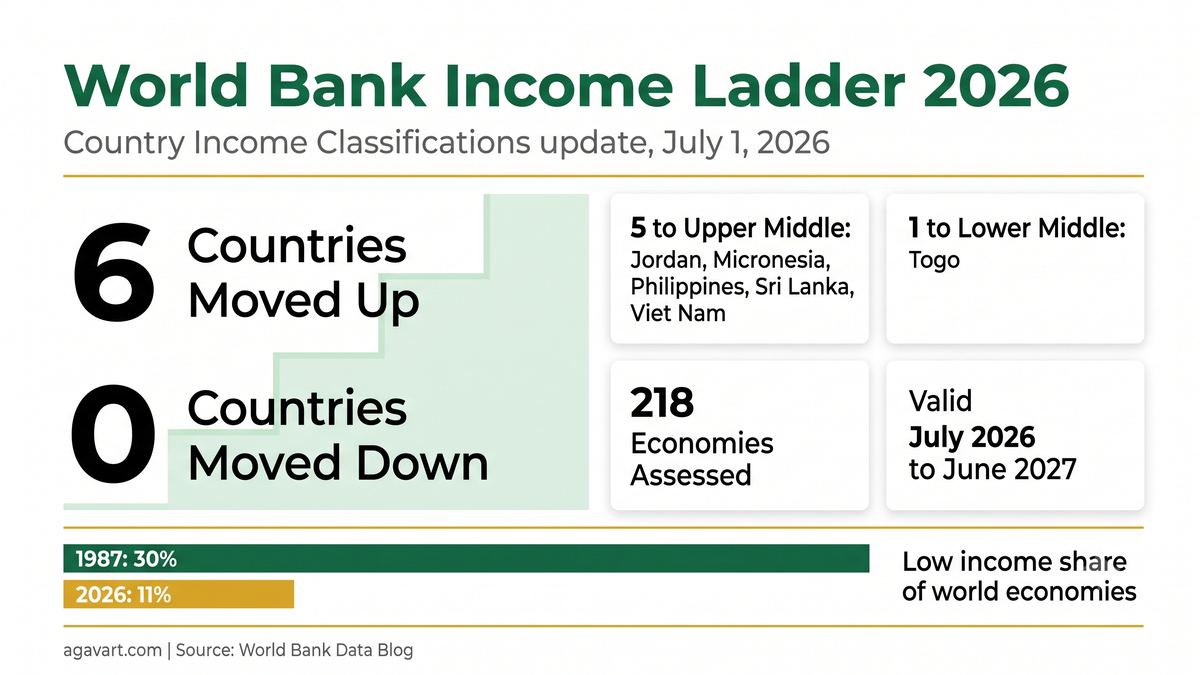
Six countries moved to a higher income group in the World Bank income classification update of July 1, 2026. Jordan, Micronesia, the Philippines, Sri Lanka and Viet Nam rose to upper-middle income, and Togo left the low-income group. None of the 218 economies assessed moved down, per the World Bank data blog.
The classification is more than a statistical exercise. It informs which countries can access concessional loans and development assistance, the funding behind schools, hospitals and jobs. The long trend is the bigger story: low-income economies were 30 per cent of the world list in 1987 and are 11 per cent today.
Table of Contents
| Item | Figure | Note |
|---|---|---|
| Countries moving up | 6 | none moved down |
| New upper-middle income | 5 | Jordan, Micronesia, Philippines, Sri Lanka, Viet Nam |
| New lower-middle income | 1 | Togo, from low income |
| Economies assessed | 218 | 163 in 1987 |
| Low-income share of economies | 11 per cent | 30 per cent in 1987 |
| Viet Nam GNI growth | about 10 per cent a year | 2021 to 2025 |
| Philippines GDP growth | 5.8 per cent a year | five year average |
| Validity | July 2026 to June 2027 | based on 2025 Atlas GNI per capita |
What Changed in the World Bank Income Classification
Every year on July 1, the World Bank’s Development Data Group sorts economies into four income groups: low, lower-middle, upper-middle and high. The sorting uses gross national income per person for the previous year, measured in US dollars under the Atlas method. This year’s World Bank income classification covers 218 economies and stays in force until the end of June 2027. Six countries moved up. None moved down.
Six Countries, Six Different Roads
Viet Nam is the growth story. Exports rose more than 15 per cent in both 2024 and 2025, and GNI expanded about 10 per cent a year between 2021 and 2025, per the blog. The Philippines rose on broad-based expansion, with GDP averaging 5.8 per cent a year across all major industries. Sri Lanka is the recovery story. Three years after its 2022 economic crisis, GDP grew 5 per cent in 2025 on financial services and tourism, and the country crossed the threshold narrowly. Micronesia posted modest, steady growth led by construction and agriculture.
The other two moves carry a lesson in how statistics work. Jordan’s statistics office completed a rebasing of national accounts and found the economy nearly 10 per cent larger than earlier estimates; combined with 2.8 per cent growth in 2025, that pushed it across the line. Togo’s move rests on a population revision. After the 2022 census results, its population estimate fell 11.7 per cent, which lifted income per person even though total income did not jump. Togo’s GDP still grew 5.9 per cent in 2025, per the blog.
What Moving Up Changes on the Ground
The World Bank income classification works like a report card for nations. It informs which countries can access concessional loans and development assistance, the low-cost finance that funds schools, hospitals, roads and clean water. Governments, investors and international organisations use the groups to track progress and set terms of engagement. For families in the six countries, a higher grade signals an economy generating more income per person than before.
The Four Decade Cycle
The longer arc is the real headline. In 1987, the World Bank income classification covered 163 economies and 30 per cent of them were low-income. Today it covers 218 economies and 11 per cent are low-income, per the blog. Country after country has climbed the same ladder over four decades. The pattern repeats, and that is the ground for measured optimism: economies that climbed recently followed paths that others can still take.
What Next
Group thresholds are adjusted every year for inflation using the SDR deflator, a weighted average of the GDP deflators of China, Japan, the UK, the US and the Euro Area. The 2025 income figures behind this update are estimates and may be revised as countries publish final data. Sri Lanka’s narrow crossing makes that caveat matter. The next update arrives on July 1, 2027.
Frequently Asked Questions
Which countries moved up in the World Bank income classification 2026?
Jordan, Micronesia, the Philippines, Sri Lanka and Viet Nam moved from lower-middle to upper-middle income, and Togo moved from low to lower-middle income, per the World Bank data blog of July 1, 2026.
Did any country move down in the 2026 update?
No. None of the 218 economies assessed moved to a lower income group this year, per the World Bank.
How does the World Bank decide income groups?
It uses gross national income per capita for the previous year, in US dollars under the Atlas method, sorted into four groups whose thresholds are adjusted annually for inflation using the SDR deflator.
Why did Togo move up without a jump in total income?
Togo’s population estimate was cut 11.7 per cent after its 2022 census, which raised income per person. GDP also grew 5.9 per cent in 2025, but the population revision was the deciding factor, per the blog.
Parallel Reading
Agavart has also covered the India Japan Summit 2026 and its economic security pacts and Brazil’s rise as a food import market, two more markers of how economic weight is shifting.
Primary Reports and Sources
- World Bank Data Blog, Who moves up and why? (July 1, 2026): blogs.worldbank.org
- World Bank Country and Lending Groups, current classification: datahelpdesk.worldbank.org
- World Bank, FY26 Updated Country Income Classification report (June 2025): 📥 View Report Page
Curated and Reviewed by Deepak Chavan | Founder & Market Expert