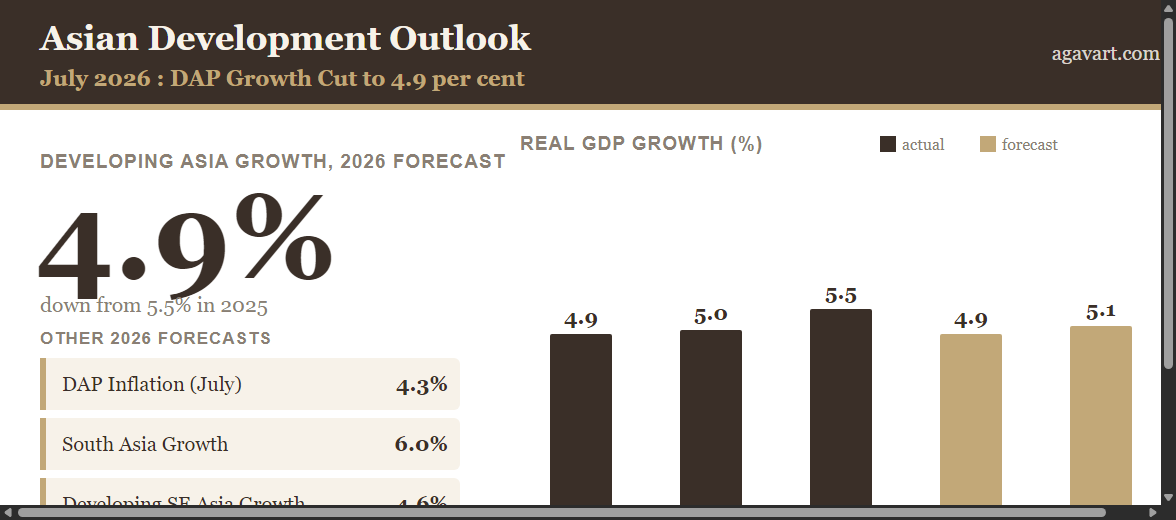
The Asian Development Outlook July 2026 projects economic growth in developing Asia and the Pacific to slow to 4.9 per cent in 2026, down from the 5.1 per cent projected in April. According to the Asian Development Bank, a prolonged has disrupted energy markets and supply chains, raising input costs and dampening regional economic activity. Growth is projected to recover to 5.1 per cent in 2027 as these supply pressures begin to ease.
The Asian Development Bank has lowered its 2026 growth forecast for developing Asia and the Pacific to 4.9 per cent as energy disruptions and supply chain shocks from the Middle East conflict weigh on economic activity.
Developing Asia growth 4.9 per cent in 2026f and 5.1 per cent in 2027f • region-wide inflation raised to 4.3 per cent in 2026f • India growth revised down to 6.6 per cent in 2026f • People’s Republic of China growth forecast maintained at 4.6 per cent in 2026f.
Rising energy costs and freight inflation are squeezing real household incomes and widening fiscal deficits across the region, while the semiconductor upcycle provides a strong export offset for advanced technology hubs.
Asian Development Bank, Asian Development Outlook, July 2026. adb.org
If you have a moment, read on for the full breakdown and sources
What the Asian Development Outlook July 2026 says
The July update of the Asian Development Outlook July 2026 shows that regional growth is projected to slow from the 5.5 per cent recorded in 2025 to 4.9 per cent this year, before recovering to 5.1 per cent in 2027. This downward revision of 0.2 percentage points for 2026 reflects weaker economic activity across most subregions, with East Asia being the sole exception. Higher global oil prices and elevated shipping rates are feeding through to domestic costs, forcing the Asian Development Bank to raise its 2026 regional inflation forecast to 4.3 per cent, up from the 3.6 per cent projected in April. Regional inflation is expected to ease to 3.4 per cent in 2027 as commodity markets normalise. By comparison, the global growth projections from the IMF also highlight sticky inflation and rising trade tensions as persistent downside risks.
Why energy disruptions drag on South Asia
The impact of the Middle East conflict has been particularly severe in South Asia, where growth forecasts have been reduced to 6.0 per cent in 2026 and 6.7 per cent in 2027. Higher fuel import bills, rising transport expenses, and uncertainty over remittances are weighing on household consumption. For India, the fiscal year 2026 growth projection has been cut by 0.3 percentage points to 6.6 per cent, while inflation is revised up to 5.2 per cent. Heatwaves have disrupted local agricultural supply, compounding the pressure on food prices, though growth is expected to rebound to 7.3 per cent in fiscal year 2027. Meanwhile, the assessment of China’s recent growth shows a stable outlook of 4.6 per cent for 2026, supported by resilient export demand and public infrastructure spending, which helps buffer the wider regional slowdown.
What to watch as regional risks persist
A major dividing line in the region is tech exposure. While oil-importing nations face severe terms-of-trade shocks, advanced technology exporters are benefiting from a massive semiconductor boom. Growth projections for South Korea, Singapore, and Taipei,China have been revised upward, driven by global demand for artificial intelligence infrastructure. However, the fiscal outlook is deteriorating. Of the 40 regional economies analysed in the report, 24 are projected to record lower government revenues this year compared to 2025, and 24 will see higher primary expenditures. This fiscal squeeze limits the capacity of governments to protect vulnerable households, especially in lower-income states that have recently shifted between national income categories and have thin financial safety nets. Policymakers must balance the need for growth support with fiscal consolidation to manage rising sovereign debt levels.
Frequently asked questions
What is the Asian Development Outlook?
The Asian Development Outlook is the flagship economic report of the Asian Development Bank. It is published quarterly, with a main report in April, updates in September, and supplements in July and December, reviewing economic developments and projections for developing Asia and the Pacific.
What is the growth forecast for developing Asia in 2026?
The Asian Development Bank projects growth in developing Asia and the Pacific to slow to 4.9 per cent in 2026, down from 5.5 per cent in 2025, before recovering to 5.1 per cent in 2027.
Why did the Asian Development Bank lower the growth forecast?
The downgrade is mainly driven by the prolonged Middle East conflict, which has disrupted global energy markets and supply chains. This has raised import costs, increased transport fees, and weighed on household consumption across most regional economies.
Where can I download the Asian Development Outlook July 2026 PDF?
The official report can be downloaded directly from the Asian Development Bank website.
Parallel reading
- World Bank China Economic Update July 2026
- IMF World Economic Outlook Update July 2026
- World Bank Income Classification 2026: Six Countries Move Up
Source: Asian Development Bank, Asian Development Outlook, July 2026. Download the full PDF.
Curated and Reviewed by Deepak Chavan | Founder & Market Expert