WASHINGTON: The IMF has cut its 2026 global growth forecast to 3.0 per cent as the conflict in the Middle East offsets a technology-driven investment cycle. The International Monetary Fund also warns that global headline inflation will climb to 4.7 per cent this year, stalling the disinflation trend in place since early 2024.
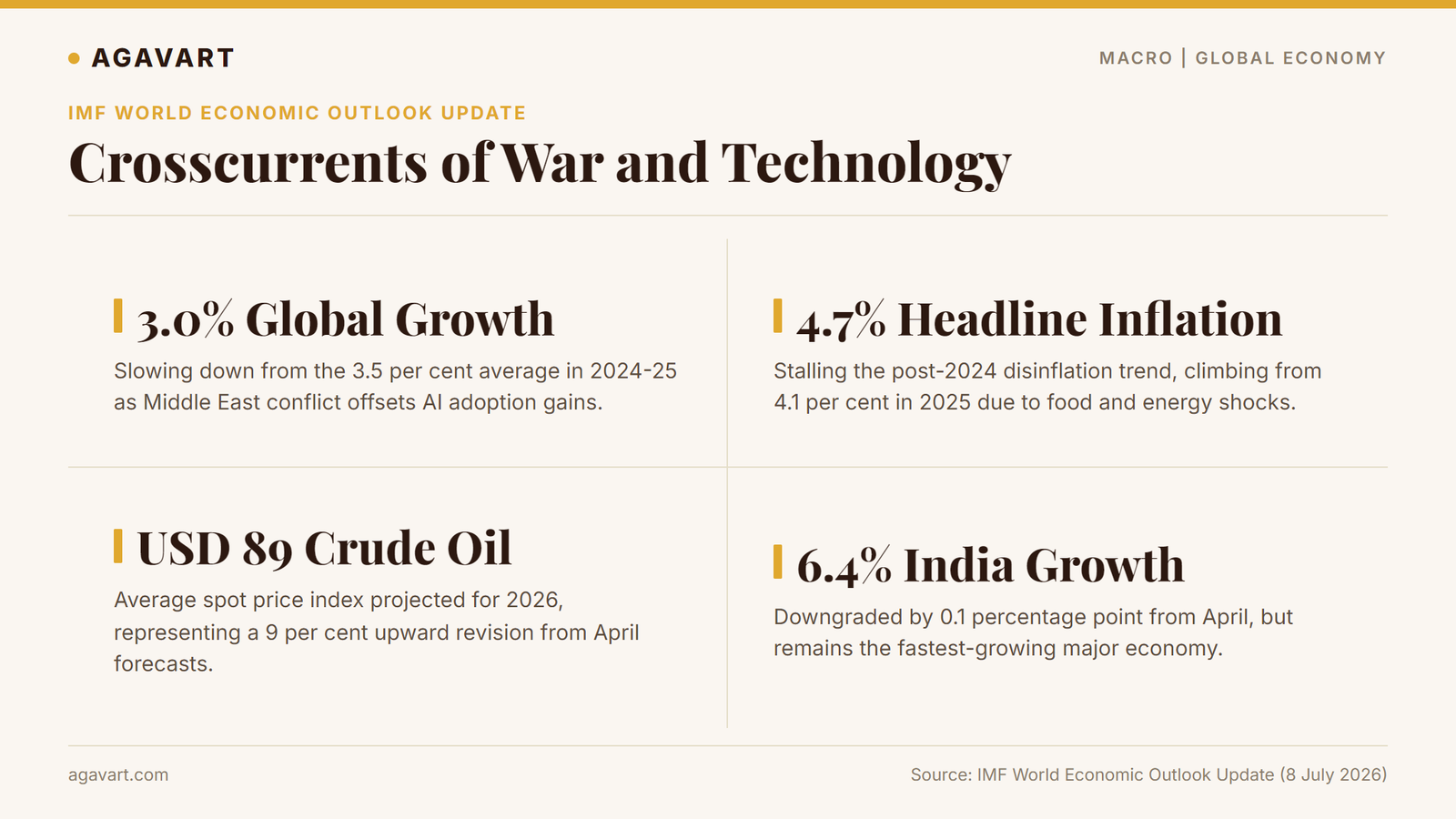
• The finding: Global economic expansion slows to 3.0 per cent in 2026 as Middle East geopolitical shocks counter the AI technology boom.
• By the numbers: Global growth at 3.0 per cent for 2026; global headline inflation rising to 4.7 per cent; crude oil average projected at 89 dollars per barrel; food prices rising by 8 per cent.
• Why it matters: A prolonged closure of the Strait of Hormuz has stoked energy transport costs, stalling the post-pandemic global disinflation trend.
• Source: International Monetary Fund, World Economic Outlook Update, July 2026 (official link: IMF WEO Update)
| Economy | 2025 Growth | 2026 Growth (Update) | 2027 Proj | Revision from April |
|---|---|---|---|---|
| World Output | 3.5% | 3.0% | 3.4% | -0.1% |
| United States | 2.1% | 2.3% | 2.2% | 0.0% |
| Euro Area | 1.4% | 0.9% | 1.2% | -0.2% |
| China | 5.0% | 4.6% | 4.1% | +0.2% |
| India | 7.7% | 6.4% | 6.7% | -0.1% |
| Saudi Arabia | 4.6% | 1.7% | 5.5% | -1.4% |
| Global Inflation | 4.1% | 4.7% | 3.9% | +0.3% |
Uneven Momentum and Opposing Shocks
The global economic outlook is currently being shaped by two major forces pushing in opposite directions. First is the negative supply shock induced by the war in the Middle East and the closure of the Strait of Hormuz. Second is the positive technology shock manifesting in accelerated momentum in the global technology cycle, driven by advances in artificial intelligence tools and adoption. While the technology cycle has provided strong tailwinds, the geopolitical strain has led to a deceleration in global output, which is projected to grow at 3.0 per cent in 2026 before recovering to 3.4 per cent in 2027.
The impact of these opposing forces varies widely across regions. Advanced economies are projected to expand by 1.7 per cent in 2026, with the United States holding steady at 2.3 per cent and the Euro Area slowing to 0.9 per cent. In emerging market and developing economies, growth is expected to slow to 3.8 per cent. India remains among the fastest-growing major economies with a growth projection of 6.4 per cent in 2026, supported by strong private consumption and services activity. China is expected to grow by 4.6 per cent, upgraded by 0.2 percentage points due to high-tech manufacturing exports and public infrastructure investment.
Commodity Shocks and Inflation Rebound
The conflict in the Middle East has disrupted crucial transit routes, causing a significant upward revision in energy and commodity prices. Average crude oil prices are now projected at 89 dollars per barrel for 2026, representing a 9 per cent increase from the April forecast. Natural gas prices have risen by 5 per cent, and fertilizer costs have climbed by 26 per cent. Reflecting these higher energy and transportation costs, global food prices are expected to rise by 8 per cent in 2026. This commodity price shock has pushed global headline inflation up to 4.7 per cent, forcing central banks to maintain tighter monetary settings for longer.
The IMF’s findings on emerging market resilience are consistent with earlier Agavart analysis. In a detailed review of the global growth landscape, Agavart noted how emerging economies were absorbing external shocks more effectively than advanced economies.
Policy Priorities: Restoring Price Stability
The primary task for policymakers is to manage the immediate impact of these supply shocks while preserving economic stability. Central banks must remain focused on restoring price stability, supported by clear communication and operational independence. Given the persistent inflationary pressures, fiscal policy needs to focus on rebuilding depleted buffers. Governments should avoid broad-based subsidies or tax cuts, instead opting for temporary, targeted support for vulnerable households. Structural reforms are also critical to enhance energy security and improve readiness for artificial intelligence deployment.
Sources and Citations
International Monetary Fund, Washington, D.C., World Economic Outlook Update: Global Economy in Crosscurrents of War and Technology, July 2026. (Official Link: https://www.imf.org/en/publications/weo/issues/2026/07/08/world-economic-outlook-update-july-2026)
Frequently Asked Questions
Why is global economic growth slowing down in 2026?
Global growth is slowing down to 3.0 per cent due to the negative supply shock and energy transit disruptions caused by the war in the Middle East, which have offset the positive growth contribution from the global technology cycle.
Why has the global disinflation trend stalled?
The disinflation trend has stalled because of rising energy prices, a 26 per cent increase in fertilizer costs, and an 8 per cent increase in food prices. These increases have driven global headline inflation back up to 4.7 per cent for 2026.
Which economies are performing best in this environment?
Economies that are highly integrated into the global technology value chain and are net exporters of hardware, such as Korea, China, and Malaysia, are performing strongly. India also remains a leading peer with a projected growth rate of 6.4 per cent.
Curated and Reviewed by Deepak Chavan | Founder & Market Expert