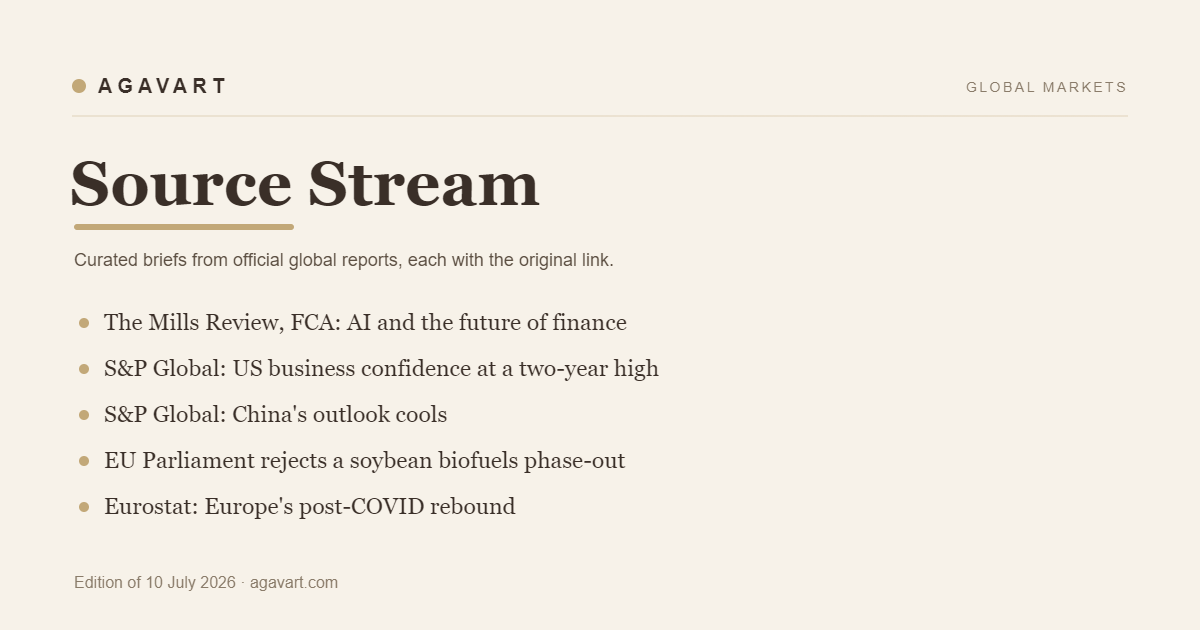
Source Stream brings curated briefs from official global reports, each with a link to the original. This week the reports span the future of AI in finance, the mood of business worldwide, and a major EU vote on biofuels: a UK review on how artificial intelligence could reshape retail financial services, fresh sentiment surveys showing the United States and China pulling in opposite directions, the European Parliament rejecting a plan to phase out soybean-based biofuels, and long-run European accounts charting the rebound in travel and dining after the pandemic.
The Mills Review: AI and the Future of Retail Financial Services | Financial Conduct Authority (UK)
An independent review for Britain’s Financial Conduct Authority, the Mills Review, sets out how artificial intelligence is likely to reshape retail financial services, describing a future that is AI-enabled, continuous and delegated, in which AI agents increasingly act on consumers’ behalf. It argues these tools could help close long-standing gaps: only 9 per cent of consumers use traditional financial advice, and just 30 per cent hold life or income protection. The review finds 1 in 5 UK adults are already open to AI finance agents, though trust, control and access must come first, and about 26 per cent would trust AI for high-stakes choices such as debt advice, pensions and investments. It maps four system shifts, in firms, consumer journeys, competition and financial crime, and makes seven priority recommendations, including an Agentic Supervisory Model to help the regulator oversee a market where software increasingly transacts on its own. Read the original: The Mills Review (Financial Conduct Authority).
S&P Global US Business Outlook | S&P Global Market Intelligence
Business confidence in the United States rose to its highest in two years, the latest S&P Global Business Outlook survey showed. The net balance of US firms expecting higher activity over the next year climbed to plus 37 per cent from plus 32 per cent in February, the most optimistic of the twelve countries surveyed and well above the global average of plus 23 per cent. Firms also reported their strongest capital-spending plans in more than four years, while expected inflation pressures eased. Data were collected in June. Read the original: S&P Global US Business Outlook (S&P Global Market Intelligence).
S&P Global China Business Outlook | S&P Global Market Intelligence
Chinese companies grew more cautious, the same S&P Global survey showed. The net balance expecting higher activity slipped to plus 11 per cent from plus 14 per cent in February, the lowest since June 2025 and among the weakest of the twelve countries, ahead only of Germany and France. There was a brighter note on jobs, with employment expectations turning positive for the first time since late 2024, at plus 1 per cent. Firms expected selling prices to stay flat, the softest pricing outlook in six years. Read the original: S&P Global China Business Outlook (S&P Global Market Intelligence).
Parliament Rejects the Soybean Biofuels Phase-Out | European Parliament
The European Parliament has rejected a European Commission plan to phase out soybean-based biofuels from the European Union’s renewable energy targets. The Commission’s delegated act, adopted on 10 April 2026, would have classified soyabean oil as a high indirect land-use change, or ILUC, risk feedstock and reduced its contribution to renewable targets to zero by 2030, amending the rules under the Renewable Energy Directive. Meeting in plenary in early July, MEPs adopted an objection to the act by 388 votes to 248, with 24 abstentions, blocking it. As a result, the delegated act cannot take effect as drafted, and the Commission would have to bring forward a new proposal to proceed. The decision matters for global oilseed and biodiesel markets, since a phase-out would have shifted demand across vegetable oils. Read the original: Procedure file 2026/2680(DEA), European Parliament Legislative Observatory.
Supply and Use Tables for Individual Countries | Eurostat
Eurostat’s latest supply and use tables, the framework behind national GDP estimates, give a detailed look at how European economies rebounded from the pandemic. Because these accounts carry a three-year delay, the 2022 figures are the most recent validated data. They show consumer demand for accommodation and food services recovering strongly: household spending on these services rose in every EU country in 2022, led by Austria, up 56 per cent, and Germany, up 54 per cent, after the sharp falls of 2020. The tables also map each economy’s structure. Domestic production made up 85 per cent of total supply in Italy, the highest in the EU, while Ireland and Luxembourg were most import-reliant at 66 per cent. For policymakers and researchers, the tables offer a consistent basis for tracking how output, spending and value added fit together across the bloc. Read the original: Supply and Use Tables for Individual Countries (Eurostat).
Curated and Reviewed by Deepak Chavan | Founder and Market Expert