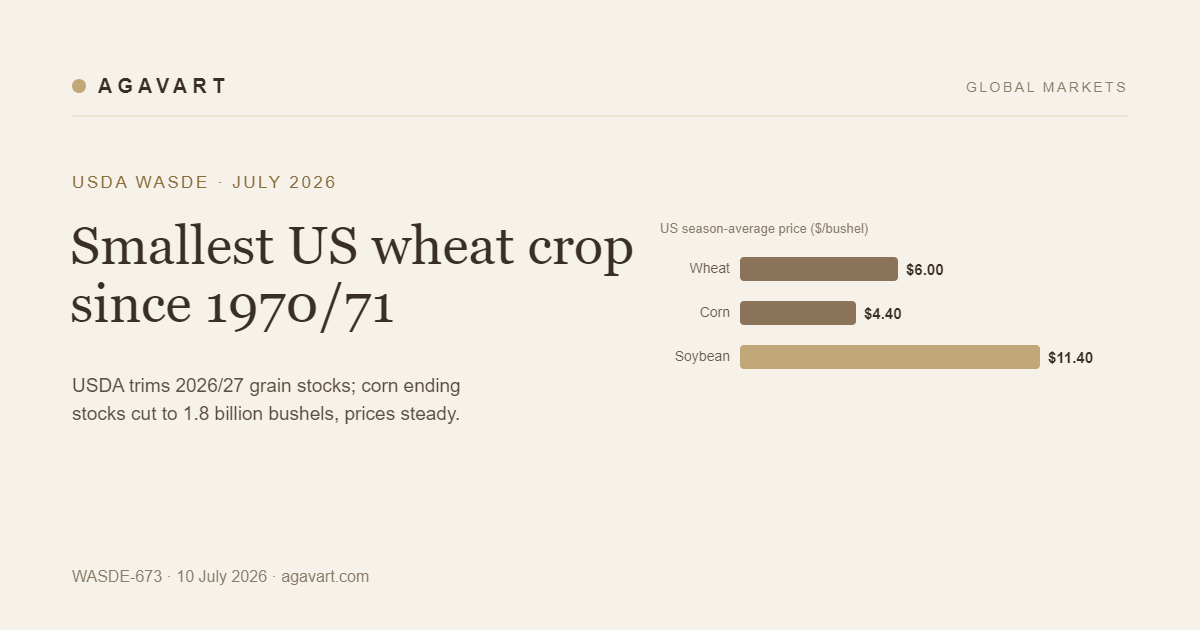
The United States Department of Agriculture’s July World Agricultural Supply and Demand Estimates trimmed its outlook for American grain stocks. It pegged the 2026/27 US wheat crop as the smallest since 1970/71 and cut corn ending stocks, while leaving soybeans and most farm prices little changed. Global stocks of wheat, corn and soybeans were all reduced.
Publisher: USDA, World Agricultural Outlook Board
Released: 10 July 2026, for the 2026/27 marketing year
US wheat: ending stocks 722 million bushels, down 22 per cent on the year; crop smallest since 1970/71; price $6.00 per bushel
US corn: ending stocks 1.8 billion bushels, down 170 million; price $4.40 per bushel
US soybeans: ending stocks 310 million bushels, unchanged; price $11.40 per bushel
Global stocks: wheat 272.8, corn 275.3, soybeans 124.2 million tonnes, all lower
What the July report showed
For wheat, USDA lowered 2026/27 US supplies and put ending stocks at 722 million bushels, down 22 per cent from a year earlier, with production the smallest since 1970/71 even as the all-wheat yield rose to 47.9 bushels per acre. The season-average farm price was held at $6.00 per bushel. For corn, the department cut both beginning and ending stocks, the latter down 170 million bushels to 1.8 billion, as stronger feed and export demand outweighed a small rise in production; the price stayed at $4.40 per bushel. Soybeans were steadier: production was raised to 4.475 billion bushels on more planted area, but ending stocks held at 310 million bushels and the price at $11.40 per bushel, with meal at $310 per short ton and oil at 70 cents per pound.
The global picture
USDA trimmed world stocks across the major crops. Global corn stocks were cut 6.0 million tonnes to 275.3 million, wheat 2.6 million to 272.8 million, and soybeans 0.7 million to 124.2 million, the last mainly on lower stocks in Brazil. In rice, US supplies tightened and the season price rose $1.40 to $14.90 per hundredweight, while global rice consumption was set at a record 542.8 million tonnes. Cotton output was raised in both the United States and globally.
Why it matters
The WASDE is the benchmark monthly read on world crop supply and demand, and traders, millers and policymakers use it to gauge where grain and oilseed prices may head. This month’s report points to tighter United States wheat and corn balances but steady prices, and record global rice use, a backdrop that matters for the grain, oilseed and edible-oil trade that importing countries such as India follow closely.
Frequently asked questions
What is the WASDE? It is the USDA’s monthly World Agricultural Supply and Demand Estimates, a global balance sheet for the major crops.
What was the headline this month? The smallest US wheat crop since 1970/71 and tighter corn stocks, with soybeans and prices broadly steady.
Did farm prices change? US season-average prices were held at $6.00 for wheat, $4.40 for corn and $11.40 for soybeans.
Source: World Agricultural Supply and Demand Estimates (WASDE-673), USDA World Agricultural Outlook Board, 10 July 2026.
Curated and Reviewed by Deepak Chavan | Founder & Market Expert