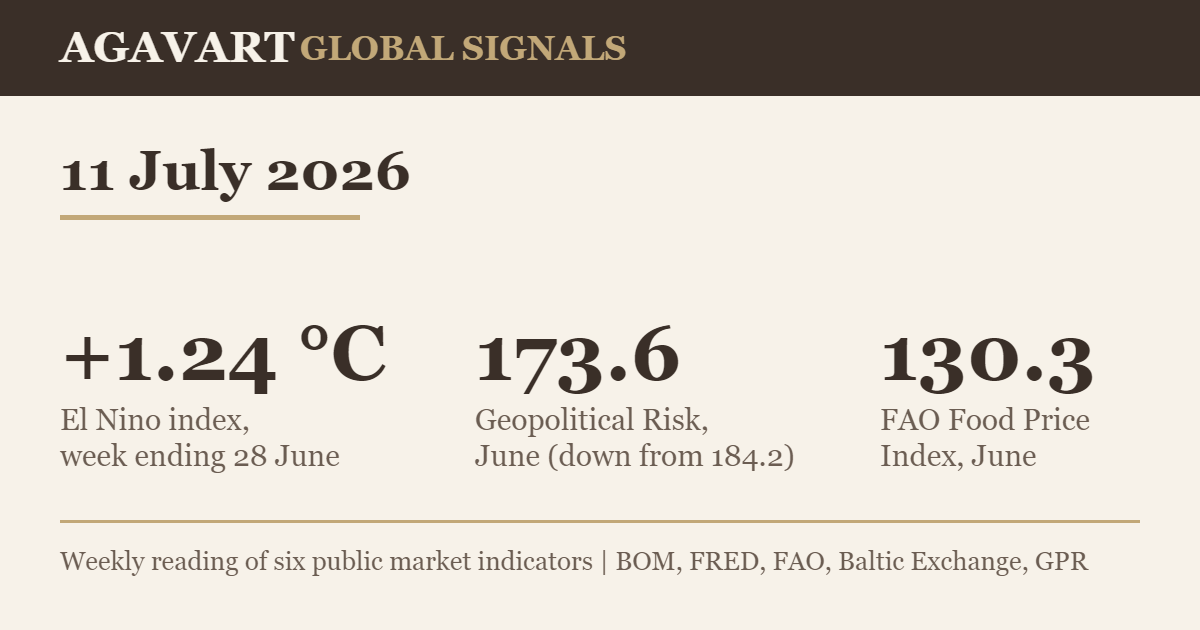
El Nino is holding firm, geopolitical pressure is easing and world food prices are drifting lower. That is the picture from the first Agavart Global Signals reading: the Nino3.4 index stands at +1.24 degrees Celsius for the week ending 28 June, well above the +0.8 threshold that marks El Nino conditions. The Geopolitical Risk Index fell to 173.6 in June from 184.2 in May as the Strait of Hormuz shock faded. The FAO Food Price Index slipped to 130.3 in June, the broad US dollar held near 120.7, and dry bulk freight firmed to 2,944. For agriculture and commodity markets, weather remains the loudest signal in the room.
About this edition: readings were collected on Saturday, 11 July 2026 (IST). Each indicator below carries the official date it refers to, with a link to the primary source. This is the baseline edition of a weekly series; week-on-week tracking begins with the next issue, published every Monday morning IST.
The Six Signals
ENSO Nino3.4 Index: +1.24 °C
Week ending 28 June 2026. Central Pacific sea surface temperatures remain well above the El Nino threshold, keeping monsoon performance and southern hemisphere crop weather at the centre of grain and oilseed risk. Source: Bureau of Meteorology, Australia.
Indian Ocean Dipole Index: −0.02 °C
As of 27 June 2026. The IOD is neutral, neither adding to nor draining moisture from the Indian monsoon system for now. Source: Bureau of Meteorology, Australia.
US Dollar Index, Fed Broad: 120.69
As of 2 July 2026, the latest published observation; the next FRED release is due 13 July. A dollar this firm keeps imported food and farm inputs expensive for emerging market buyers. Source: Federal Reserve via FRED, series DTWEXBGS.
FAO Food Price Index: 130.3
June 2026, down from 130.8 in May. Record meat quotations were offset by softer cereals and sugar; the full breakdown is in our FAO Food Price Index June 2026 analysis. Source: FAO.
Baltic Dry Index: 2,944
As of 10 July 2026, up 1.17% on the day and the highest since 5 June, a manual reading from published Baltic Exchange data. Firmer dry bulk freight feeds directly into landed grain and fertiliser costs; our coverage of freight after the Hormuz reopening explains the mechanism. Source: Baltic Exchange.
Geopolitical Risk Index: 173.6
June 2026, down from 184.2 in May (recent series, base 1985-2019 = 100). De-escalation after the Hormuz reopening pulled the index lower; why tension moves grain even when supplies are ample is covered in The Geopolitics of Grain in the U.S.-Iran Asset Dispute. Source: Matteo Iacoviello, GPR.
Update, 13 July 2026: this June easing has since reversed. Iran declared the Strait of Hormuz closed on 12 July after a third round of US strikes, pushing geopolitical risk back up in July. For the latest, see Strait of Hormuz: Conflict Continues, but the Global Energy Shift Is Already Under Way.
Reading the week together: an active El Nino with easing geopolitical risk shifts the market’s attention from shipping lanes back to the sky. If Nino3.4 stays above +1.0 through July, weather premiums in grains and vegetable oils will do more work than freight or the dollar.
Curated and Reviewed by Deepak Chavan | Founder & Market Expert