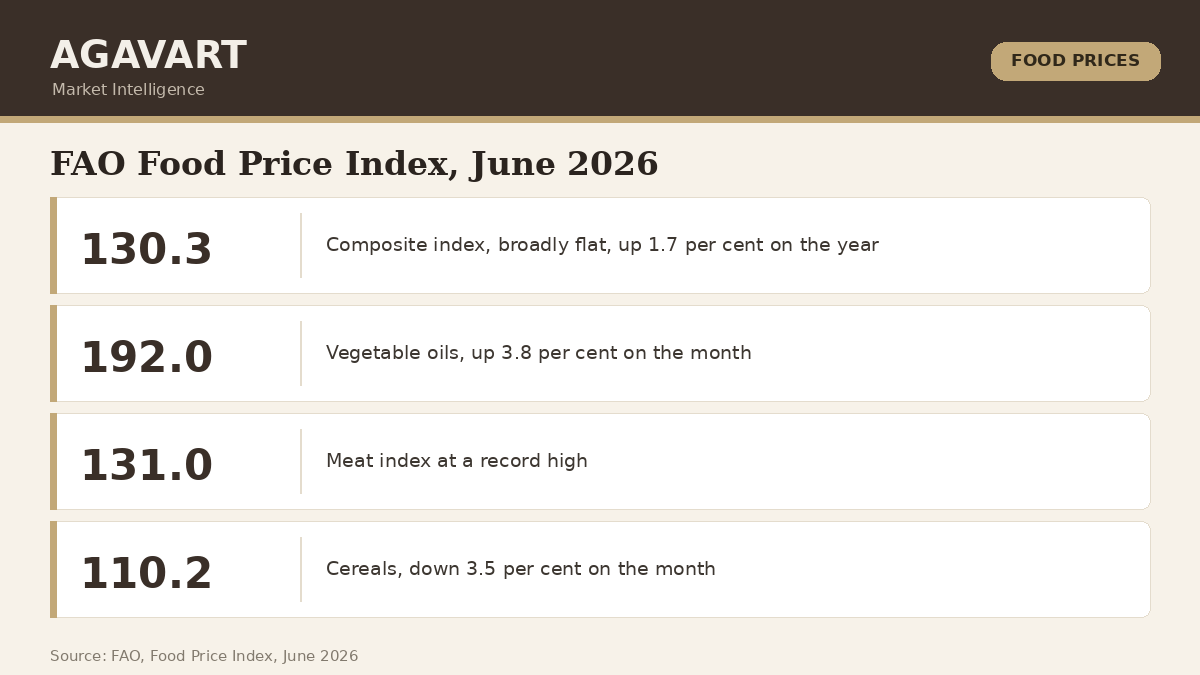
The FAO Food Price Index June 2026 reading came in at 130.3 points, barely moved from May as the world’s food commodity markets pulled in opposite directions. Higher vegetable oil and meat quotations were cancelled out by falling cereals, sugar and dairy. The benchmark now sits 1.7 per cent above a year ago but remains 18.7 per cent below its March 2022 peak.
Table of Contents
What the June 2026 index shows
The FAO Food Price Index tracks the monthly change in international prices of a basket of food commodities across five groups: cereals, vegetable oils, meat, dairy and sugar. In June 2026 the composite reading barely moved, easing 0.3 per cent to 130.3 points. That headline stability hides a wide split beneath the surface. Two of the five groups rose, three fell, and the offsetting moves were unusually large for a month in which the top-line number hardly shifted.
Vegetable oils did most of the lifting. The sub-index climbed 3.8 per cent to 192.0 points, now 23.3 per cent above a year ago, as palm and rapeseed oil quotations firmed on tighter export prospects from Indonesia and steady biofuel demand. Meat added further support, edging up 0.4 per cent to a record 131.0 points, led by higher poultry and ovine prices even as pig and bovine values slipped.
Why the top line stayed flat
Those gains were offset by weakness in the grains and sweetener complex. The cereal sub-index fell 3.5 per cent to 110.2 points, with world wheat down 4.4 per cent and maize off 6.2 per cent on strong Black Sea harvest progress and ample global grain supplies. A stronger United States dollar and softer crude oil prices, helped by easing tension around the Strait of Hormuz, added to the downward pull. Sugar dropped 5.7 per cent to 89.7 points as Brazilian mills shifted more cane to sugar and exported briskly, while dairy slipped 1.5 per cent, its butter and cheese quotations pressured by rising European and United States output.
What to watch next
The FAO Food Price Index June 2026 leaves the global food-price benchmark on the plateau it has held since prices retreated from the 2022 spike. For import-dependent economies, including India, the mix matters as much as the level: cheaper grains ease the cereal import bill, but the renewed climb in vegetable oils feeds directly into domestic edible-oil costs. The wildcard for the second half of 2026 is weather. FAO flagged the risk that El Niño could curb sugar output in India and Thailand and pressure other crops in the 2026/27 season, a factor already lending a floor to sugar prices. Rice, up 3.2 per cent on firm Asian demand, is the other line to track for South Asian food security.
Frequently asked questions
What is the FAO Food Price Index?
The FAO Food Price Index (FFPI) is a benchmark maintained by the Food and Agriculture Organization of the United Nations that measures the monthly change in international prices of a basket of globally traded food commodities. It averages five sub-indices, cereals, vegetable oils, meat, dairy and sugar, weighted by average export shares over 2014 to 2016, with the 2014 to 2016 average set at 100.
What was the FAO Food Price Index in June 2026?
The FAO Food Price Index June 2026 averaged 130.3 points, down 0.4 points or 0.3 per cent from May. It stood 1.7 per cent higher than a year earlier and 18.7 per cent below its March 2022 peak.
Why did global food prices stay flat in June 2026?
Higher vegetable oil and meat prices were offset by lower cereals, sugar and dairy, leaving the composite little changed even though individual markets moved sharply.
Which food commodity changed the most in June 2026?
Sugar fell the most, down 5.7 per cent, while vegetable oils rose the most, up 3.8 per cent. The meat index reached a new record high of 131.0 points.
Where can I download the FAO Food Price Index June 2026 data?
The full dataset and monthly commentary are available free on the FAO Food Price Index page at fao.org.
Parallel reading
- USDA 2026: Supply Cushion Eases El Niño Panic
- Brazil Food Imports Rise to $7.1 Billion in 2025: USDA Exporter Guide
Source: Food and Agriculture Organization of the United Nations, FAO Food Price Index (June 2026). Download the FAO Food Price Index data.
Curated and Reviewed by Deepak Chavan | Founder & Market Expert