Strait of Hormuz: Conflict Continues, but the Global Energy Shift Is Already Under Way

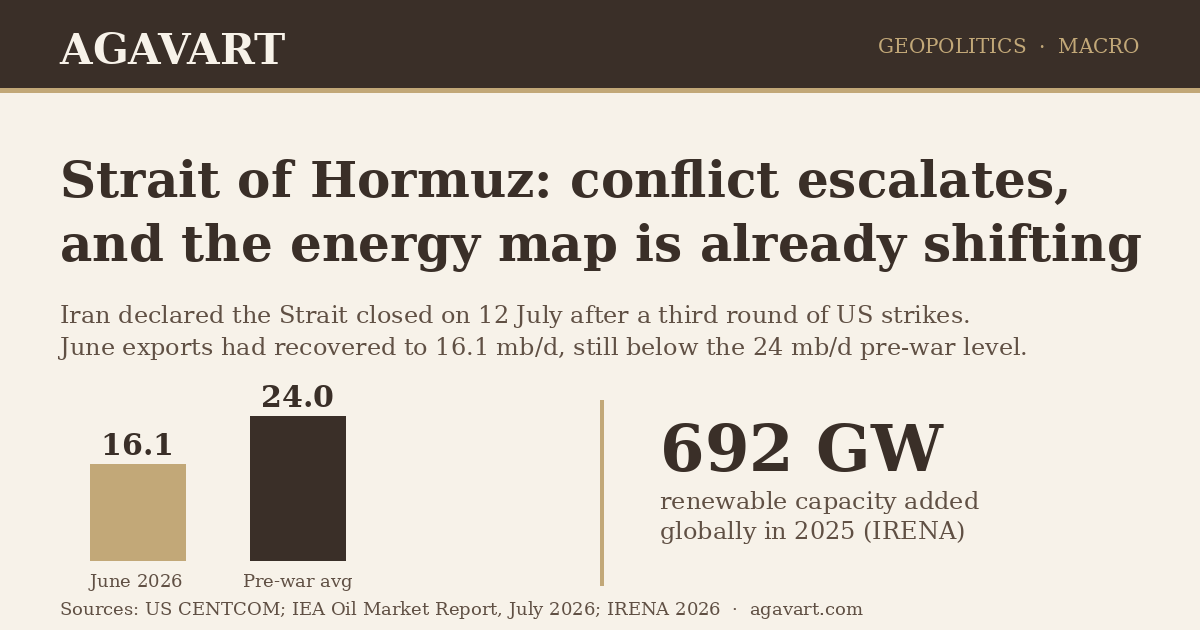
The International Energy Agency’s July 2026 Oil Market Report states that Gulf oil exports rose by 6.5 million barrels a day in June to 16.1 million barrels a day, still below the pre war average of around 24 million barrels a day, while refined product and LPG exports remained well below pre war levels. The same report notes that after the ceasefire was breached on 7 and 8 July, the North Sea Dated benchmark was trading around 77 dollars a barrel. The confrontation has since escalated: US Central Command carried out a third round of strikes on Iran on 11 July, and on 12 July Iran’s Islamic Revolutionary Guard Corps declared the Strait of Hormuz closed until further notice. Alongside this, the World Bank, the IMF, IRENA, and the IEA have each published separate assessments this year arguing that the crisis is pushing several governments to treat renewable energy, storage, and grid investment as part of their energy security planning rather than as a separate climate track.

As of 12 July 2026. Figures reflect what the cited primary sources had reported up to that time.

How much oil passes through the Strait of Hormuz, and what happens if it closes?

Gulf oil exports through the Strait of Hormuz averaged about 24 million barrels a day before the war and had recovered to 16.1 million barrels a day by June 2026, per the IEA, with refined product and LPG flows still well below pre-war levels. If the Strait closes, the IEA says demand cuts alone cannot replace the lost supply, only restored transit can.

IndicatorReadingSource
Gulf oil exports, pre-war averageabout 24 million barrels a dayIEA Oil Market Report, July 2026
Gulf oil exports, June 202616.1 million barrels a day, up 6.5 million barrels a day month on monthIEA Oil Market Report, July 2026
Refined product and LPG exportsstill well below pre-war levelsIEA Oil Market Report, July 2026
Daily vessel transits, 5 to 6 July 202624 to 25 vessels a day, versus a historical average of about 138 a dayJMIC and UKMTO, 7 July 2026
US-facilitated transits since early Maymore than 800 commercial vessels and 400 million barrels of crude oilUS Central Command, 11 July 2026

How much oil normally passes through the Strait of Hormuz?

The IEA puts Gulf oil exports at a pre-war average of about 24 million barrels a day. By June 2026 flows had recovered to 16.1 million barrels a day, still below that level, while refined product and LPG exports remained well below pre-war levels.

What happens to oil prices if the Strait of Hormuz is disrupted?

After the 7 to 8 July ceasefire breach, the IEA reported the North Sea Dated benchmark trading around 77 dollars a barrel. The US EIA noted the oil market adjusted faster than expected, as some Gulf producers rerouted supply, exports from the Americas rose, and strategic reserves were drawn down.

Which countries are most exposed if the Strait of Hormuz closes?

The Kiel Institute finds the burden falls very unevenly. The United States loses just 0.07 percent of welfare, while countries in South Asia and Africa face losses 10 to 20 times larger, because energy disruption cascades into fertiliser and food prices for import-dependent economies.

Can other measures replace the oil lost if the Strait closes?

The IEA’s Sheltering From Oil Shocks report lists ten demand-side measures governments and households can adopt within weeks. It states plainly that even full adoption of all ten across every country would not replace the supply lost to the conflict, and that only the resumption of transit through the Strait can do that.

Why are institutions linking this crisis to renewable energy policy?

Because IRENA, the IEA, and the Energy Transitions Commission have each published reports this year arguing that countries with more renewable capacity, such as Spain, Portugal, and China, were comparatively less exposed to the price shock, and are recommending faster renewables and storage deployment as a security measure, not only a climate measure.

How much has this cost the global economy so far?

The World Bank has cut its 2026 global growth forecast to 2.5 percent and the IMF to 3.1 percent, with both citing the conflict as a key driver of the downgrade from their pre conflict projections.

What happened in the Strait this week?

US Central Command says Iran attacked commercial vessels transiting the Strait and that it carried out three rounds of strikes on Iran, on 7, 8, and 11 July, hitting more than 300 targets in total. On 12 July Iran’s Islamic Revolutionary Guard Corps declared the Strait closed until further notice, while CENTCOM said commercial transits were still moving. Iran rejected the Qatar linked vessel allegation and accused the US of violating the ceasefire and the 18 June memorandum of understanding.

If you have a moment, read on for the full breakdown and sources

What the IEA and IRENA say about the shift toward renewables

The Energy Transitions Commission’s report, Lessons on Energy Security after the Hormuz Crisis, states that a durable crisis response means to accelerate renewables, electrification, cleaner fuels and fertilisers, and energy efficiency, and warns that expanding fossil fuel infrastructure in response to the shock risks locking in the next one. The same report estimates that if elevated fossil fuel prices persist, the world could face an additional 1 to 2 trillion dollars in oil and gas expenditure in 2026.

IRENA’s April 2026 policy advisory describes renewable energy as a strategic necessity for energy security and national resilience rather than a climate policy choice. It reports that global renewable capacity grew by 692 GW in 2025, lifting renewables’ share of total installed power capacity from 46.3 percent in 2024 to 49.4 percent in 2025, and that by 2024 nearly 91 percent of newly commissioned utility scale renewable projects already generated power more cheaply than fossil fuel alternatives. The advisory cites Spain, Portugal, and China as renewables heavy economies that expanded solar, wind, and storage and were left comparatively insulated from the current price shock, and it recommends solar plus storage, mini grids, and electrification as policy priorities.

The IEA’s Southeast Asia Energy Outlook 2026, published on 16 June 2026, examines the region’s exposure to the crisis. It reports that the Middle East accounts for around 60 percent of the region’s crude oil imports, and that almost half of the oil products refined or consumed in Southeast Asia come from Middle Eastern crude. It projects the region’s energy import bill at around 160 billion dollars in 2026, potentially rising to about 400 billion dollars, or 5 percent of the region’s economy, by 2050 under current policy settings. The same report finds renewable power capacity is already set to nearly triple within a decade under today’s policy settings, with early additional momentum visible in solar deployment.

The IEA’s Sheltering From Oil Shocks report lists ten demand side measures governments and households can adopt within weeks, including remote work, lower highway speed limits, car sharing, and prioritising LPG for cooking over transport use, while stating plainly that even full adoption of all ten measures across every country would not replace the supply lost to the conflict, and that only the resumption of transit through the Strait can do that.

What the World Bank, IMF, and Kiel Institute say about the economic cost

The World Bank’s June 2026 Global Economic Prospects report cut its 2026 global growth forecast to 2.5 percent. It states that if Hormuz disruption proves prolonged and is accompanied by financial market stress, growth could fall to 1.3 percent, a downside of 1.2 percentage points from baseline, and to 2.1 percent, a downside of 0.4 percentage points, in a less severe scenario. The same report projects growth in emerging market and developing economies falling from 4.4 percent in 2025 to 3.6 percent in 2026, and, excluding China, from 3.9 percent to 3.2 percent.

The IMF’s April 2026 World Economic Outlook, titled Global Economy in the Shadow of War, cut its 2026 global growth forecast to 3.1 percent, down from a pre conflict trajectory of around 3.4 percent. Its adverse scenario shows growth at 2.5 percent with inflation at 5.4 percent, and its severe scenario, where disruption extends into 2027, shows growth near 2 percent with inflation above 6 percent.

The Kiel Institute’s March 2026 policy brief, The Cost of Closing the Strait of Hormuz, focuses on the fertiliser and food price channel. It states that aggregate global costs are moderate but the burden falls very unevenly, the United States loses just 0.07 percent of welfare, while countries in South Asia and Africa face losses 10 to 20 times larger, because energy disruptions cascade into fertiliser and food prices for import dependent economies.

The US EIA’s July 2026 Short Term Energy Outlook adds that the oil market adjusted faster than expected: some Gulf producers rerouted supply, exports from the Americas rose, strategic reserves were drawn down, and demand eased across Asia, so prices fell in June from May, although rebuilding inventories will take time.

This week in the Strait: official statements, 6 to 12 July 2026

The IEA’s July 2026 Oil Market Report states that Gulf oil exports rose 6.5 million barrels a day in June to 16.1 million barrels a day, still below the 24 million barrel a day pre war average, and that prices rose after the ceasefire was breached on 7 and 8 July, with North Sea Dated trading around 77 dollars a barrel at time of writing.

US Central Command’s official releases state that US forces struck Iran on 7 July, describing the action as a response to Iranian attacks on three commercial vessels transiting the Strait, and hitting over 80 targets including air defence, command and control, coastal radar, anti ship missile capability, and more than 60 IRGC small boats. CENTCOM states that on 8 July US forces struck around 90 additional Iranian military targets, with the stated aim of reducing Iran’s ability to strike commercial shipping in the Strait. On 11 July CENTCOM reported a third round of strikes, hitting approximately 140 Iranian military targets and taking the total to more than 300 targets over three nights, again citing an Iranian attack on a commercial ship. In the same release CENTCOM said that commercial transits were continuing, and that since early May US forces had helped facilitate the passage of more than 800 commercial vessels and 400 million barrels of crude oil through the Strait.

The US Maritime Administration’s advisory 2026-004, active until 9 September 2026, keeps the risk of Iranian attacks on commercial vessels in the Persian Gulf, Strait of Hormuz, and Gulf of Oman at high, citing missile, drone, unmanned surface vessel, and small boat threats.

Iran’s Foreign Ministry, in its 8 July statement, rejected Qatar’s allegation over the reported attack on a Qatar linked vessel, calling it questionable and inconsistent with good neighbourliness, and stated that Iran was implementing its commitments under Clause 5 of the 18 June memorandum of understanding on the future administration of the Strait of Hormuz and provision of maritime services. In its 9 July statement, Iran’s Foreign Ministry described the US strikes as aggressive acts and a violation of the UN Charter, the ceasefire, and the memorandum of understanding, and said the US was using alleged incidents involving non compliant vessels as a pretext for military action. Iran’s President, in an earlier 3 July statement, criticised what it called US and Israeli aggression and warned that instability in Hormuz and energy routes could hit the wider global economy.

The Joint Maritime Information Centre and UKMTO’s advisory note of 7 July raised the regional threat level to Severe, citing deliberate hostile action as likely, continued IRGC hailing and routing pressure, GNSS and AIS interference, and ongoing mine risk reporting. It recorded daily transits of 24 on 5 July and 25 on 6 July, against a historical average of around 138 vessels a day.

The International Maritime Organization’s Secretary General, in a statement on 8 July, condemned the attacks as reckless and urged flag states, shipowners, and operators to avoid exposing seafarers to unnecessary danger while transiting the Strait, noting that around 6,000 seafarers remained stranded in the Persian Gulf since the start of the conflict.

On 12 July, Iran’s Islamic Revolutionary Guard Corps went further and declared the Strait of Hormuz closed until further notice, saying it would stay shut until the United States ended its intervention in the region, and warning of a severe response to any challenge. The declaration followed a warning shot the IRGC said it had fired at a vessel attempting to transit along an unapproved route. It stands in direct contrast to the US Central Command statement, issued the day before, that commercial transits were still moving.

In short, the dispute over the Strait of Hormuz has moved beyond a shipping and pricing question. It has become a contest over whose rules will govern transit through the waterway, even as several institutions report that governments are using this shock to weigh a faster shift away from fossil fuel dependence.

Sources

  • IEA Oil Market Report, July 2026 (link)
  • Energy Transitions Commission, Lessons on Energy Security after the Hormuz Crisis (link)
  • IRENA, From Energy Crisis to Energy Security: Actions for Policy Makers, April 2026 (link)
  • IEA, Southeast Asia Energy Outlook 2026 (link)
  • IEA, Sheltering From Oil Shocks (link)
  • EIA, Short Term Energy Outlook, July 2026 (link)
  • World Bank, Global Economic Prospects, June 2026 (link)
  • IMF, World Economic Outlook, April 2026, Global Economy in the Shadow of War (link)
  • Kiel Institute, The Cost of Closing the Strait of Hormuz: Energy Bottlenecks and Global Food Security (link)
  • US Central Command, 7 July 2026 (link)
  • US Central Command, 8 July 2026 (link)
  • US Central Command, 11 July 2026 (link)
  • Islamic Revolutionary Guard Corps closure statement, via Iran’s official channels, 12 July 2026 (link)
  • US Maritime Administration, Advisory 2026-004 (link)
  • Iran Ministry of Foreign Affairs, 8 July 2026 (link)
  • Iran Ministry of Foreign Affairs, 9 July 2026 (link)
  • Iran President’s Office, 3 July 2026 (link)
  • Joint Maritime Information Centre and UKMTO Advisory Note, Update 068, 7 July 2026 (link)
  • International Maritime Organization, Secretary General statement, 8 July 2026 (link)

Reported and analysed by Deepak Chavan, Founder and Market Expert, Agavart.