From Donbas to the Gulf: How Four Years of One War and the Sudden Second Shock Rewrote the Rules of Alignment
In the age of permanent interests, July 2026 is not a moment for theoretical risk assessments anymore. It is a naked contest for leverage. Four years of war in Ukraine and five months of a brutal escalation in the Middle East have run in parallel. Though both conflicts stayed largely within their own theatres, the shockwaves did not. They travelled through gas pipelines, fertiliser sacks, and computer chips, landing on the desks of leaders who never fired a shot. The real lesson of this period is uncomfortable: staying out of a war does not mean staying out of its cost.
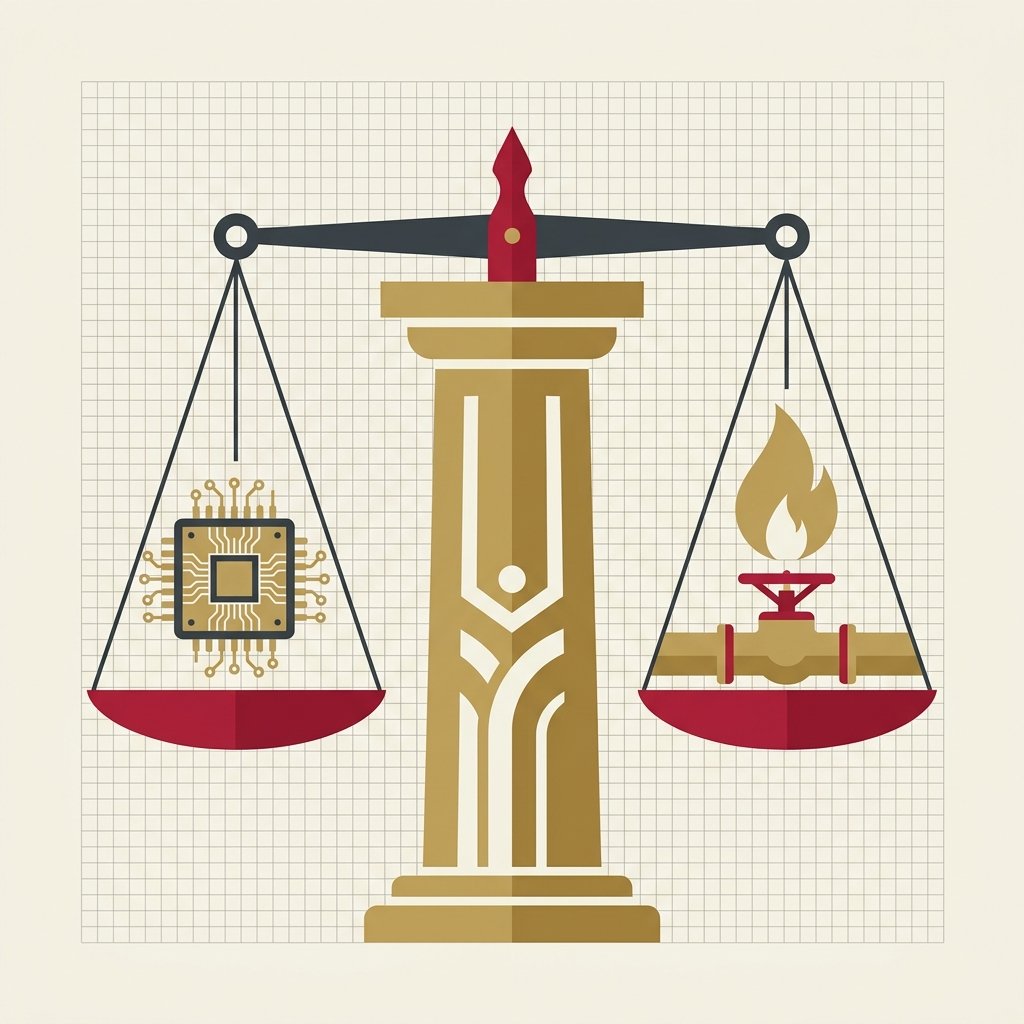
In this kind of world, old-style alliances start looking like liabilities rather than shelters. The superpowers are no longer simply offering protection. They are exporting their own inflation, their own energy anxiety, and their own technology dependence straight down the chain to everybody else. Small and mid-sized nations are learning, the hard way, that loyalty to one camp buys very little safety. What buys safety is an old and slightly disreputable skill: taking what each side offers without paying the full price either side demands.
Table of Contents
If you have a moment, read on for the full breakdown and sources
1. The Energy Squeeze: Chokepoints and the 140 Bcm Ghost
Energy stopped being just a commodity the day the Strait of Hormuz effectively shut down in late February 2026 (IEA Gas Market Report, Q3-2026, p. 6). It became a weapon again, the way it was in the 1970s. That single closure knocked out close to 20 percent of the world’s liquefied natural gas (LNG) supply overnight. The International Energy Agency’s report for the third quarter of 2026 puts a number on the long-term damage: a cumulative loss of 140 billion cubic metres (bcm) of gas supply between now and 2030 (IEA, p. 9).
This “Ghost Supply” is the result of missile strikes that wrecked Qatar’s Ras Laffan plant, the world’s largest LNG facility. Repairing it, the IEA notes, will take three to five years (IEA, p. 56). Between March and June 2026 alone, LNG shipments out of Qatar and the UAE fell by 35 bcm compared with the previous year (IEA, p. 6).
Washington moved fast to fill the gap, authorising an emergency expansion of the Plaquemines LNG terminal to add 4.6 bcm of exports a year (IEA, p. 6). Europe, meanwhile, banned short-term Russian gas purchases and found itself trading one dependency for another, Moscow for Washington, without ever quite becoming independent of anybody. The countries handling this best are the multi-aligners who recognise that in a world of permanent interests, you cannot rely on a single partner. They are buying American gas while keeping diplomatic channels to the Gulf open, ensuring they have the security of a new supplier without losing the leverage of the old guard.
Related Coverage: The 140 Bcm Ghost Supply: Reordering Global Energy Power
2. The Silicon Umbrella: Who Owns the Machines That Think?
There is a second, quieter Cold War running alongside the energy one, and it is fought over computing power rather than tanks. The UN’s Independent International Scientific Panel on AI reports in July 2026 that the United States now controls 75 percent of the computing power inside the world’s top 500 AI supercomputers (UN AI Panel, p. 8). China holds 15 percent. Everybody else on earth is fighting over the remaining 10 percent.
That imbalance matters because of the arrival of “Agentic AI”, systems that plan and execute tasks autonomously. The UN panel notes that the software capability of leading AI agents is doubling every four to seven months (UN AI Panel, pp. 9, 22). A gap that size is not something smaller economies can simply out-invest.
The IMF’s July update captures the economic result: a small cluster of “AI Hardware Exporters”, Taiwan, Korea, Thailand, and Malaysia, posted a growth surprise of 4.4 percentage points (IMF WEO Update, July 2026, p. 4). Korea, despite its energy dependency, had its 2026 growth forecast upgraded to 2.6 percent, a 0.7 percentage point increase from April, driven by a semiconductor boom (IMF, p. 13). Resilient nations navigating these permanent interests are refusing to choose sides in the “Silicon War”. They take American software investment with one hand while keeping their hardware supply chains connected to Asian manufacturing with the other.
3. The Fertiliser Chokepoint: Hunger as Leverage
The Gulf conflict has also turned food into a geopolitical tool. The region supplies 25 percent of the world’s seaborne urea and 50 percent of its seaborne sulphur (IEA, p. 19). When Hormuz closed, urea prices doubled to 800 dollars a tonne, matching the worst levels of the 2022 energy crisis (IEA, pp. 19-20).
This is where the story starts being about dinner tables rather than spreadsheets. The IEA and FAO warn that the fertiliser shortage is putting real pressure on crop yields across Sub-Saharan Africa and South Asia (IEA, p. 8). Global headline inflation is now expected to rise to 4.7 percent in 2026 because the disinflation trend that began in 2024 has effectively stalled (IMF, p. 2). Geopolitics is now the primary driver of the grocery bill. The most resilient nations are those driven by their own permanent interests, treating food security like a military asset and refusing to gamble their survival on any single trade relationship.
Related Coverage: Fertilizer Prices Diverge After Hormuz Reopening: Urea Falls 34 Per Cent, Freight Cools
4. The Geopolitics of Hoarded Minds
The final front is the quietest: the fight for human capital. The OECD Employment Outlook 2026 identifies a critical self-inflicted wound in Western economies. In more than half of OECD countries, employment rates differ by more than 20 percentage points between regions, and one-third of the private-sector workforce is locked into non-compete clauses (OECD, pp. 17-18, 247).
The OECD links these clauses to a 5 percent drag on productivity convergence (OECD, p. 248). In plain language, Western companies are hoarding talent they refuse to let move, creating a landscape of trapped talent, while rivals such as China operate a more mobile, centrally directed scientific workforce. Smaller, agile states are now seeing this as an opportunity. By loosening labour restrictions to serve their permanent interests and welcoming the talent that larger, more rigid economies are repelling, they are attempting to build the “third pole” of the AI race.
Related Coverage: OECD Employment Outlook 2026: The High Cost of Trapped Talent
5. The Strategic Triangle of Survival
Put these four fronts together, energy, computing, food, and talent, and a single shape emerges. National power in July 2026 rests on a triangle: sovereign compute capacity, diversified energy supply, and a workforce that is free to move.
The IMF projects global growth slowing to 3.0 percent this year (IMF, p. 2). Against this backdrop of uneven momentum, the old rulebook, pick a bloc, stay loyal, and wait for protection, is a recipe for bankruptcy.
The countries that will come out ahead by 2030 are the ones currently accused of being “unreliable” by the superpowers. They are the ones building their own chip capacity, keeping multiple energy suppliers on speed dial, and refusing to be permanently owned by either Washington, Moscow, or Beijing. That is not indecision. It is the calculated discipline of the non-aligned.
To get through the double shock of 2026, a nation must master the art of the multi-front deal.
Primary References
- International Monetary Fund (IMF), World Economic Outlook Update: Global Economy in Crosscurrents of War and Technology, July 2026.
- International Energy Agency (IEA), Gas Market Report, Q3-2026 (PDF).
- Organisation for Economic Co-operation and Development (OECD), Employment Outlook 2026: Geographic Disparities in Jobs and Incomes, July 2026.
- United Nations (UN), Preliminary Report of the Independent International Scientific Panel on AI, July 2026.
- Food and Agriculture Organization (FAO), Food Price Index Report, June 2026.
Curated and Reviewed by Deepak Chavan | Founder & Market Expert