Factsheet | Agriculture and Energy
Sugarcane Maize Intercropping: ICAR-IIMR’s Model to Feed India’s Ethanol Push
Published 12 July 2026, IST | Pune
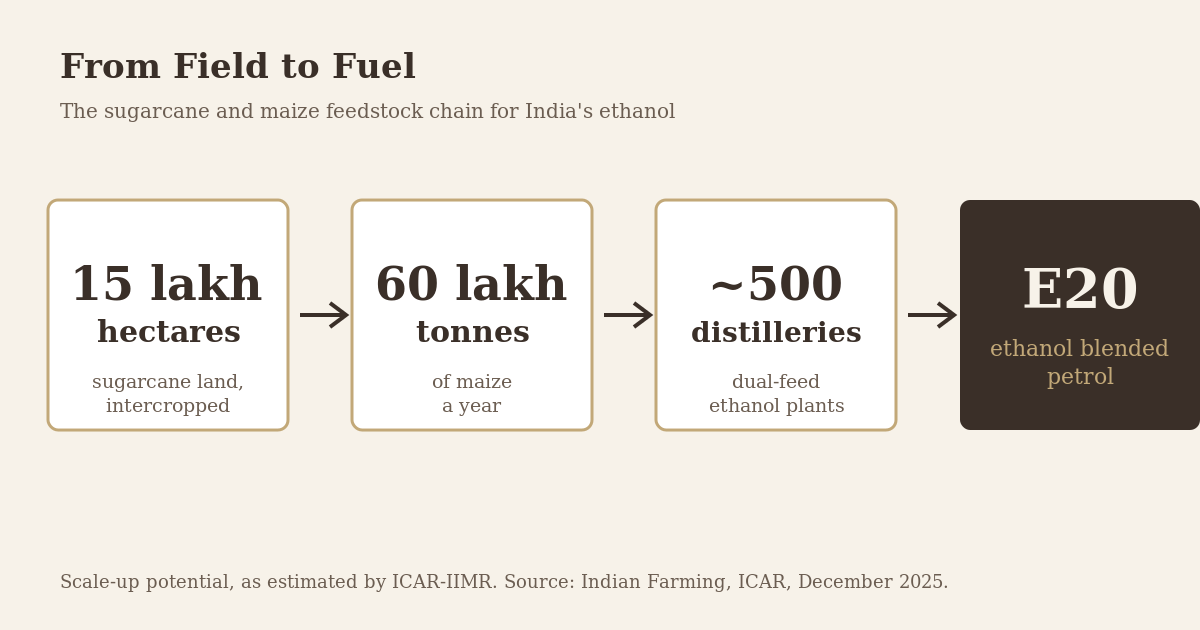
ICAR-IIMR’s sugarcane maize intercropping model can add more than 60 lakh tonnes of maize a year from about 15 lakh hectares, giving India’s dual-feed ethanol distilleries home-grown feedstock while raising farmer net profit by about Rs 1.25 lakh per hectare over sole sugarcane, according to ICAR.
The ICAR-Indian Institute of Maize Research (IIMR) has demonstrated a sugarcane maize (SM) intercropping system that grows a short-duration maize crop inside sugarcane’s slow early phase, on the same land and water. On-farm trials report a 28 per cent rise in sugarcane equivalent yield and about Rs 1.25 lakh per hectare of additional net profit, while creating a year-round maize feedstock for grain-based ethanol.
Net Profit Per Hectare: Sole vs Intercrop
The SM Model at a Glance
| Developed by | ICAR-Indian Institute of Maize Research (IIMR) |
|---|---|
| System | Sugarcane plus short-duration maize hybrid, intercropped |
| Maize duration | 90 to 120 daysgrown in sugarcane’s slow initial phase |
| Demonstrated in | Solapur (Maharashtra), Bulandshahr (Uttar Pradesh)expanding to Haryana, East and West UP |
| Area demonstrated | 50 acres |
| Under the project | Enhancement of Maize Production in the Catchment Area of Ethanol Industries, Ministry of Agriculture and Farmers’ Welfare |
Yield and Profitability (Indian Farming, Dec 2025)
| Sugarcane equivalent yield | about 192 t/ha (SM) vs 150 t/ha (sole)up about 28 per cent |
|---|---|
| Maize yield in the SM system | 4 to 8 t/ha |
| Net profit | Rs 5.75 lakh/ha (SM) vs Rs 4.50 lakh/ha (sole sugarcane) |
| Additional net profit | about Rs 1.25 lakh/haover sole sugarcane |
| Cost saved | Rs 1.01 lakh to Rs 1.48 lakh/ha |
Scale and the Ethanol Link
| Adoptable area | about 15 lakh hectaresroughly one-third of yearly planted sugarcane |
|---|---|
| Potential maize output | more than 60 lakh tonnes a year |
| Target users | dual-feed ethanol distilleriesabout 500 sugarcane-based plants, per ICAR-IIMR |
| Sugarcane in India’s ethanol today | meets 30 to 35 per cent of the requirementper ICAR-IIMR |
| Policy link | supports India’s ethanol blending programme |
Summary
India’s ethanol blending programme, which reached a 20 per cent blend in 2025-26, rests partly on grain feedstock, and the government’s own briefing lists sugarcane, maize and surplus rice as the crops that higher blends draw on. The ICAR-IIMR sugarcane maize intercropping model speaks directly to the maize side of that feedstock question. It uses the fact that sugarcane grows slowly for its first three months and takes 10 to 15 months to mature, while sugar mills and distilleries run for only part of the year. A short-duration maize hybrid, maturing in 90 to 120 days, is sown between the sugarcane rows in that early window, using nearly the same land, water, fertiliser and crop protection.
On-farm demonstrations reported in Indian Farming (December 2025) show the effect. Sugarcane equivalent yield rose by about 28 per cent, from 150 tonnes per hectare under sole sugarcane to about 192 tonnes per hectare in the intercrop. Sugarcane equivalent yield expresses the sugarcane and maize output together in sugarcane terms, so this reflects the combined gain, not a rise in sugarcane’s own yield. Net profit reached about Rs 5.75 lakh per hectare against Rs 4.50 lakh for sole sugarcane, an additional Rs 1.25 lakh per hectare, with a further cost saving of Rs 1.01 lakh to Rs 1.48 lakh per hectare. Maize yields in the system ranged from 4 to 8 tonnes per hectare, and the maize income covered the entire cost of sugarcane cultivation.
The scale is where the ethanol link becomes clear. ICAR-IIMR estimates the model can be adopted on about 15 lakh hectares, roughly a third of India’s yearly planted sugarcane, producing more than 60 lakh tonnes of maize a year. That maize is aimed at dual-feed ethanol distilleries, plants that can run on both sugarcane juice or molasses and on grain, of which ICAR-IIMR counts about 500 sugarcane-based units. Because the maize is grown on land already under sugarcane, the extra feedstock does not require new area, which addresses the food versus fuel land concern that scales with higher blends.
The model also carries broader benefits noted in the study: better use of land and water, improved soil health, lower weed pressure, and green fodder from detopped maize. Read alongside India’s ethanol story, it is a supply-side answer to a demand that is already policy. For maize markets specifically, a steady new source of 60 lakh tonnes would also bear on the competition between ethanol and poultry feed for grain, a balance worth watching as blending rises.
The government’s own procurement prices underline why maize sits at the centre of this feedstock question. Maize commands the highest ethanol procurement price of any feedstock, at about Rs 71.86 per litre.
Ethanol procurement price by feedstock (Rs per litre)
| Maize | 71.86 highest |
|---|---|
| Sugarcane juice or syrup | 65.61 |
| Damaged food grains | 64.00 |
| B-heavy molasses | 60.73 |
| FCI rice | 60.32 |
| C-heavy molasses | 57.97 |
The Government has also allocated 52 lakh tonnes of surplus FCI rice for ethanol across ESY 2024-25 and 2025-26, and diverted 40 lakh tonnes of sugar in 2024-25.
Source: Press Information Bureau, Ministry of Petroleum and Natural Gas, Ethanol Blended Petrol Programme Q and A (Release ID 2283118). View release.
Outlook: What the Study Projects
ICAR-IIMR frames the SM model as a scalable route to feedstock and farm income. The figures below are as reported by ICAR.
| Adoption potential | about 15 lakh hectares |
|---|---|
| Maize that could add | more than 60 lakh tonnes a year |
| Farmer gain | about Rs 1.25 lakh/ha additional profit |
| Ethanol role | year-round grain feedstock for dual-feed distilleries |
Watch: the model is at the demonstration and early expansion stage, moving from Maharashtra into Haryana and Uttar Pradesh. Actual national uptake, and how much of the 60 lakh tonne potential is realised, will depend on farmer adoption and distillery demand. Note also that ICAR’s popular write-up cites a smaller additional-profit range of Rs 50,000 to Rs 1,00,000 per hectare; this factsheet uses the peer-reviewed Indian Farming figures.
“Sugarcane+maize intercropping system optimizes land and water use, boosts farmer income.”Indian Farming, ICAR-IIMR, December 2025
Sources: S. L. Jat and others, “Sugarcane+maize intercropping: A next-generation approach to achieve food-energy-water security and biofuel self-reliance in India,” Indian Farming 75(12): 61-64, December 2025, ICAR. Download the paper. Also: ICAR-IIMR, Farm to Fuel. Related on Agavart: India Puts Evidence Before Speed on Ethanol Blending.