India’s ethanol blending now covers a fifth of the country’s petrol, but the clearer signal from recent weeks is caution, not speed. Through June and early July 2026, the Government, vehicle makers and testing agencies set out evidence on the safety and performance of E20 petrol, framing higher blends as a phased, tested step. India reached the 20 per cent blend in 2025-26, five years ahead of target, and has saved over Rs 1.90 lakh crore in foreign exchange since 2014-15, placing it alongside the United States, Brazil and Japan in the worldwide move to biofuels.
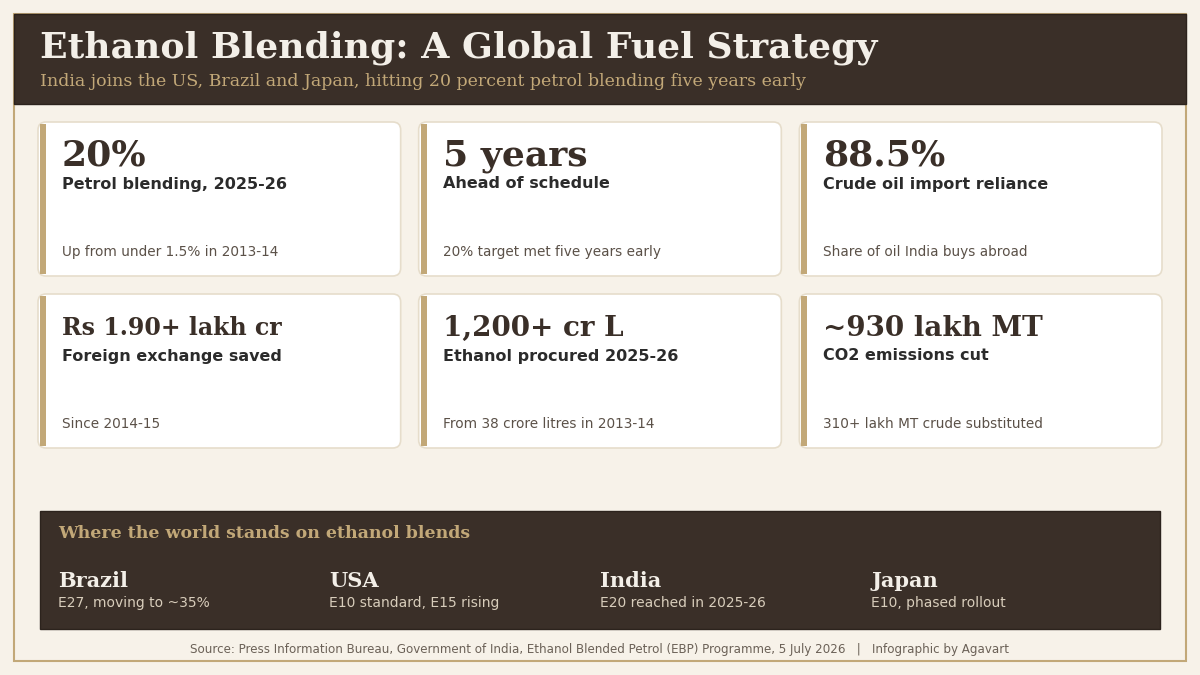
| The finding | India reached 20 per cent ethanol blending in petrol in 2025-26, five years ahead of schedule, according to the Government of India. |
| By the numbers | Blending up from under 1.5 per cent in 2013-14 to 20 per cent in 2025-26; over Rs 1.90 lakh crore of foreign exchange saved since 2014-15; over 310 lakh tonnes of crude oil substituted; about 930 lakh tonnes of carbon dioxide cut; over Rs 1.60 lakh crore in additional farmer earnings. |
| Why it matters | Ethanol blending lowers a country’s exposure to imported oil. India buys close to 88.5 per cent of the crude it consumes, so home-grown fuel reduces price and supply risk. |
| Source | Press Information Bureau, Government of India, Ethanol Blended Petrol (EBP) Programme, 5 July 2026. |
If you have a moment, read on for the full breakdown and sources
- Why ethanol blending sits high on the energy agenda
- Ethanol Blending in India, from under 1.5 per cent to 20 per cent
- Setting the record straight on E20
- How India compares with the US, Brazil and Japan
- What this means, and what to watch
- Frequently asked questions
- Sources and further reading
Why ethanol blending sits high on the energy agenda
Ethanol blending is a way for oil-importing countries to make their transport fuel partly at home. Ethanol, an alcohol produced from crops such as sugarcane, maize and rice, is mixed into petrol, so every litre burned contains less imported oil.
For India the logic is direct. The country imports close to 88.5 per cent of the crude oil it consumes, a dependence on imported oil that exposes it to price swings and supply shocks it cannot control. The Government of India describes ethanol produced from Indian sugarcane, maize and rice as a way to blunt that exposure using resources grown at home. The same reasoning drives biofuel policy in the United States, Brazil, Japan and the European Union, where energy security is reshaping policy.
| Indicator | Baseline | 2025-26 or latest |
|---|---|---|
| Ethanol blend in petrol | Under 1.5% (2013-14) | 20% |
| Ethanol procured | About 38 crore litres (2013-14) | Over 1,200 crore litres (projected) |
| Production capacity | 421 crore litres (2014) | About 2,000 crore litres (2026) |
| Foreign exchange saved | Cumulative since 2014-15 | Over Rs 1.90 lakh crore |
| Crude oil substituted | Cumulative since 2014-15 | Over 310 lakh tonnes |
| Carbon dioxide cut | Cumulative since 2014-15 | About 930 lakh tonnes |
| Additional farmer earnings | Cumulative since 2014-15 | Over Rs 1.60 lakh crore |
Ethanol Blending in India, from under 1.5 per cent to 20 per cent
Under the Ethanol Blended Petrol (EBP) Programme, the blend rose from under 1.5 per cent in 2013-14 to 20 per cent in 2025-26. Ethanol procurement grew from about 38 crore litres in the Ethanol Supply Year 2013-14 to over 1,200 crore litres, projected, in 2025-26. Production capacity expanded nearly fivefold, from 421 crore litres in 2014 to about 2,000 crore litres in 2026.
The Government of India links this expansion to lower crude oil imports, saved foreign exchange, reduced greenhouse gas emissions and higher farm incomes through a new market for crops.
2013-14: blend under 1.5 per cent, procurement about 38 crore litres. 2014: capacity 421 crore litres. 30 June 2026: the Attorney General’s office clarified that the description of E20 as an experiment is incorrect. 2025-26: 20 per cent blend reached, five years ahead of target. 5 July 2026: PIB backgrounder published.
Setting the record straight on E20
The move to E20, petrol with a 20 per cent ethanol blend, has drawn concerns and social media claims about mileage, engine wear and cost. The PIB backgrounder answers the main ones against the record.
| The claim | The record |
|---|---|
| E20 cuts mileage by 30 per cent. | The 30 per cent figure refers only to ethanol’s lower calorific value compared with petrol, not to a real-world drop in mileage. Driving habits, tyre pressure, servicing and air-conditioning load affect mileage far more than fuel type. Maruti Suzuki cites a drop of about 0.6 km for a car giving 20 km per litre. |
| E20 damages engines, especially older ones. | No widespread pattern of engine failure linked to E20 has been reported since rollout. E20 was cleared only after extensive testing by SIAM, ARAI and IOCL together with vehicle makers. |
| Ethanol reduces vehicle performance. | Ethanol is a high-octane fuel, with a research octane number of about 108.5 against 84.4 for petrol. E20 raises the effective octane of Indian petrol to around 95, improving combustion in modern engines. |
| Insurers refuse claims for E20 related damage. | Insurers and vehicle makers have clarified that E20 has no impact on insurance or warranty validity in India. SIAM has confirmed warranties will be honoured for vehicles running specification-compliant E20. |
| One litre of ethanol consumes 10,000 litres of water. | An ethanol plant uses only 3 to 5 litres of processed water per litre of ethanol, and modern distilleries run Zero Liquid Discharge systems. Only surplus rice, permitted by the DFPD after meeting food security needs, is diverted to ethanol. |
| The Government told the Supreme Court that E20 is just an experiment. | The case concerned ethanol procurement contracts, not the merits of E20. The Attorney General’s office clarified on 30 June 2026 that the experiment claim is incorrect. |
How India compares with the US, Brazil and Japan
India is far from alone. The PIB backgrounder notes that ethanol blending is now a widely adopted practice, with several major economies building it into their fuel strategy.
| Country | Standard blend | Direction of travel |
|---|---|---|
| Brazil | E27 | Global leader; being raised toward about 35 per cent; over 80 per cent of new cars are flex-fuel, running on E27, E30 or pure hydrous ethanol. |
| United States | E10 nationwide | E15 expanding rapidly with federal backing; millions of flex-fuel vehicles can run on blends as high as E85. |
| India | E20 in 2025-26 | Reached the 20 per cent blend five years ahead of target. |
| Japan | E10 | Introduced through a phased rollout. |
Countries including Canada, Thailand and several European nations have also adopted ethanol blending as part of their clean fuel strategies.
Ethanol Blending in India met its 20 per cent target five years early, and the economics of the programme have since shifted. The PIB backgrounder notes that ethanol procurement costs have risen above refined petrol costs, so the mandate now rests on energy security, environmental and farm-income grounds rather than on ethanol being the cheaper fuel. For readers in oil-importing economies, that is the wider lesson: biofuel policy is increasingly justified by supply resilience, not price at the pump.
Three things are worth watching. First, Brazil’s move from E27 toward about 35 per cent, which would set the next global benchmark. Second, the feedstock question, since blends at this scale draw on sugarcane, maize and surplus rice, with India’s DFPD acting as the food security guardrail. On the supply side, see Agavart’s factsheet on ICAR-IIMR’s sugarcane maize intercropping model for ethanol feedstock. Third, how the United States handles the expansion of E15, which is the closest large-market parallel to India’s E20 step.
India’s own signalled next step is flex-fuel, not a higher blending mandate. The Government has launched flex-fuel two-wheelers that run on any blend from E20 to E85, along with E85 pumps for such vehicles, which the Ministry of Petroleum and Natural Gas describes as the direction of future policy. That keeps higher blends a market-led choice rather than a compulsory step.
Frequently asked questions
What is E20 petrol?
E20 is petrol blended with 20 per cent ethanol. India reached this blend on average in 2025-26 under the Ethanol Blended Petrol Programme.
Does E20 reduce mileage?
The real-world impact is small. Maruti Suzuki cites a drop of about 0.6 km for a car that gives 20 km per litre, and notes that driving habits and maintenance affect mileage more than fuel type.
Is E20 safe for older vehicles?
The Government of India states that no widespread pattern of engine failure has been reported since rollout, that E20 was cleared after testing by SIAM, ARAI and IOCL, and that warranties are honoured for vehicles running specification-compliant E20.
Which countries use ethanol blending?
Brazil uses E27, the United States uses E10 with E15 expanding, Japan uses E10, and Canada, Thailand and several European nations have also adopted ethanol blends.
How does Ethanol Blending in India compare with other countries?
Ethanol Blending in India reached E20 in 2025-26. Brazil uses E27 and is moving toward about 35 per cent, the United States uses E10 with E15 expanding, and Japan uses E10.
Where can I download the official PIB ethanol blending document?
The Press Information Bureau backgrounder is available as a PDF: download the official PDF here.
Sources and further reading
Primary source: Press Information Bureau, Government of India, Ethanol Blended Petrol (EBP) Programme, Policy Evolution, Key Milestones and Frequently Raised Concerns, 5 July 2026. Read the release or download the PDF.
Supporting references cited by the Ministry of Petroleum and Natural Gas within the release: PIB 2277210, PIB 2281142, PIB 2268671.