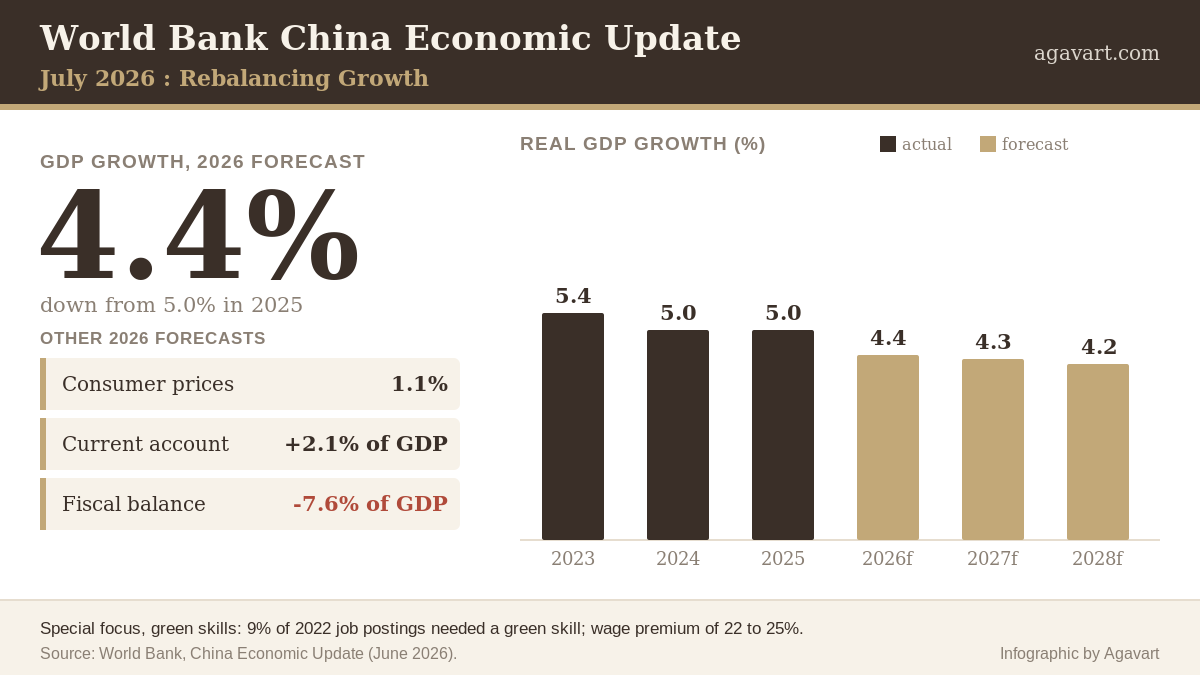
The World Bank China Economic Update July 2026 projects China’s economy to grow 4.4 per cent in 2026, down from 5.0 per cent in 2025, as a prolonged property downturn and cautious consumers weigh on domestic demand. Strong exports and high-tech investment are cushioning the slowdown, but the Bank says the shift towards consumption-driven growth is proceeding only gradually. Growth is seen easing further to 4.3 per cent in 2027 and 4.2 per cent in 2028.
The World Bank projects China’s GDP growth to moderate to 4.4 per cent in 2026 and to keep easing through 2028, as weak domestic demand offsets resilient exports and high-tech investment.
Real GDP growth 5.0 per cent in 2025, 4.4 per cent in 2026f, 4.3 per cent in 2027f, 4.2 per cent in 2028f • first-quarter 2026 growth 5.0 per cent year-on-year • inflation 1.1 per cent in March to May 2026 • current account surplus 2.1 per cent of GDP in 2026f • consolidated fiscal balance minus 7.6 per cent of GDP in 2026f.
China’s rebalancing towards consumption is proceeding only gradually, keeping growth on a slow downward path and putting the spotlight on the social safety net and jobs-skills gaps, as assessed by the World Bank.
World Bank, China Economic Update (June 2026): Rebalancing Growth, released July 2026. worldbank.org
If you have a moment, read on for the full breakdown and sources
What the World Bank China Economic Update July 2026 says
The World Bank’s twice-yearly China Economic Update, subtitled Rebalancing Growth, projects the world’s second-largest economy to expand 4.4 per cent in 2026, down from 5.0 per cent in both 2024 and 2025. Growth started the year solidly, with GDP up 5.0 per cent year-on-year in the first quarter, as high-tech investment and exports offset subdued consumption. Momentum then softened in the second quarter, when disruptions to global energy supply raised costs and uncertainty. Export growth is expected to moderate on slower growth in external demand, and the report expects overall growth to keep easing to 4.3 per cent in 2027 and 4.2 per cent in 2028.
Why domestic demand is the drag
Beneath the headline, the Bank points to a familiar imbalance. The property sector is still adjusting to lower housing demand, and the negative wealth effect from falling home prices, together with a soft labour market, is keeping household spending cautious. Private investment is constrained by the property correction and thin corporate profits in some sectors. A rise in energy prices lifted inflation to 1.1 per cent year-on-year between March and May, but the Bank calls this temporary given weak underlying demand, noting the shock was cushioned by large oil reserves, diversified fuel imports, a high share of renewables and temporary retail fuel price caps. Exports again did much of the heavy lifting, offsetting soft demand at home.
What the World Bank recommends
The report argues that near-term policy should stay supportive while structural reforms are phased in, and that the composition of spending matters as much as its size, since capital spending still accounts for 43 per cent of the budget. Its central recommendation is to strengthen the social safety net. China spends about 11 per cent of GDP on social protection, roughly half the OECD average, and the Bank says raising benefit floors, extending cover to informal workers and delinking access from household registration would let families spend rather than save. The edition’s special focus, on green skills, finds that around 9 per cent of job postings required a green skill in 2022, that such skills carry wage premiums of 22 to 25 per cent, and that about 85 per cent of fossil-fuel workers in coal-dependent provinces lack the qualifications to move into renewable-energy roles.
Frequently asked questions
What is the World Bank China Economic Update?
The China Economic Update is a twice-yearly report from the World Bank that reviews recent economic developments in China and sets out the Bank’s growth outlook, risks and policy recommendations. The July 2026 edition is subtitled Rebalancing Growth.
What is China’s GDP growth forecast for 2026?
The World Bank projects China’s real GDP to grow 4.4 per cent in 2026, down from 5.0 per cent in 2025, followed by 4.3 per cent in 2027 and 4.2 per cent in 2028.
Why is China’s growth slowing in 2026?
Weak domestic demand is the main drag. The property downturn, a soft labour market and cautious consumers are holding back spending and private investment, while export growth is expected to moderate. High-tech investment and public infrastructure spending only partly offset this.
What does the World Bank recommend for China?
It recommends keeping policy supportive in the near term while phasing in structural reforms, and above all strengthening the social safety net so households save less and spend more. China spends about 11 per cent of GDP on social protection, roughly half the OECD average.
Where can I download the World Bank China Economic Update July 2026 PDF?
The full report is available free from the World Bank at the link below.
Parallel reading
- IMF World Economic Outlook Update July 2026
- World Bank Income Classification 2026: Six Countries Move Up
Source: World Bank, China Economic Update (June 2026): Rebalancing Growth. Download the full PDF.
Curated and Reviewed by Deepak Chavan | Founder & Market Expert