Beijing, 9 July 2026. China factory prices rose at their fastest annual pace in almost four years in June, even as consumer prices barely moved. The split sends a clear message to Europe and the United States: the cheap, deflationary China of the past decade is quietly changing shape.
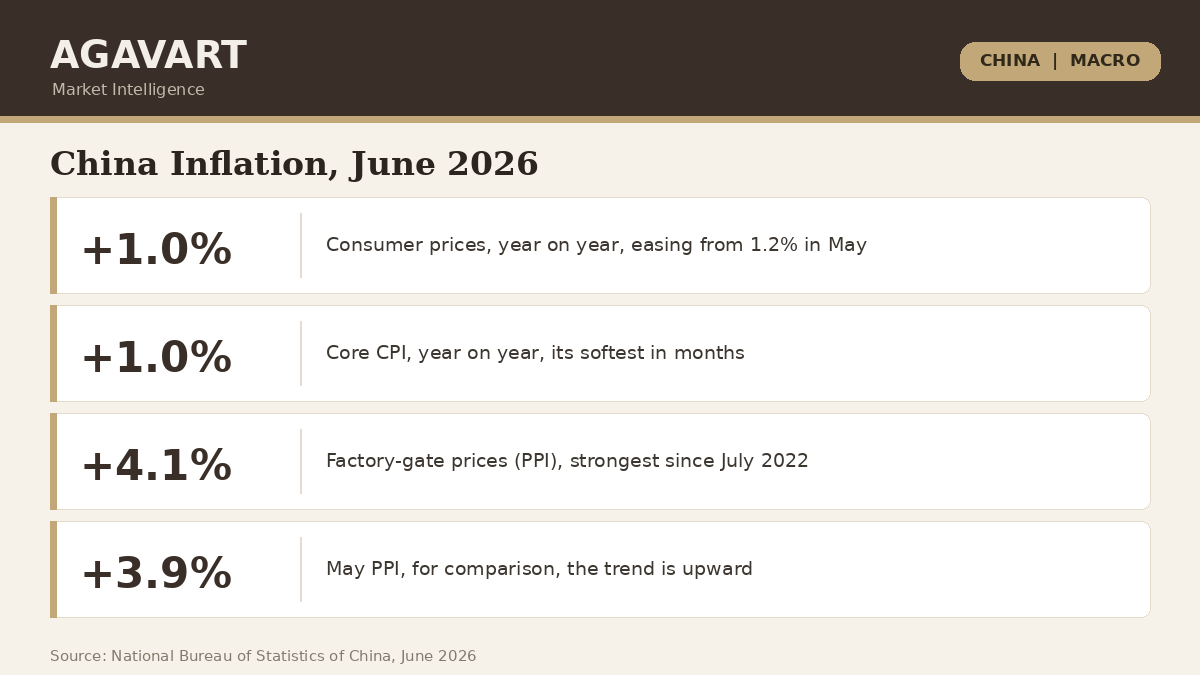
A widening split. The consumer price index rose just 1.0 per cent from a year earlier, down from 1.2 per cent in May and below what forecasters had expected. Core inflation, which strips out food and energy, also slipped to 1.0 per cent. China factory prices told the opposite story. The producer price index jumped 4.1 per cent, up from 3.9 per cent in May and the strongest reading since July 2022. Two price gauges in the same economy are now pulling firmly in opposite directions.
Costs, not demand. The rise in producer prices is largely a cost story, not a sign of a booming factory floor. Higher global energy and commodity prices, driven up by conflict in the Middle East, have lifted the input costs that feed straight into China’s producer index. Domestic demand, by contrast, still looks soft. Weak consumer inflation, a fragile property market and cautious households mean the pressure is coming from raw materials abroad rather than from shoppers at home.
Why China factory prices matter to the West
For most of the past decade, China exported disinflation. A steady flow of competitively priced goods helped hold down inflation in Europe and the United States and gave central banks room to move. Rising factory costs complicate that arithmetic. If Chinese manufacturers can no longer absorb higher inputs and keep cutting export prices, one of the world’s quiet disinflationary anchors begins to loosen, at exactly the moment the European Central Bank and the Federal Reserve are trying to judge how durable falling inflation really is.
The trade angle. There is a sharper edge too. With input costs climbing but consumer prices flat, Chinese producers are caught in a margin squeeze. The likely response is to chase volume abroad and compete even harder on price, adding to the trade friction that already surrounds Chinese electric vehicles, steel and solar panels. For European and American policymakers, cheaper imports and louder calls for trade defence may well arrive together.
What to watch next. The key question is whether June’s rise in China factory prices broadens beyond energy into a genuine recovery, or fades once commodity prices settle. Watch next month’s figures, any move by Beijing to lift household demand, and how quickly the factory-gate story feeds through to the prices Western consumers actually pay.
Curated and Reviewed by Deepak Chavan | Founder & Market Expert