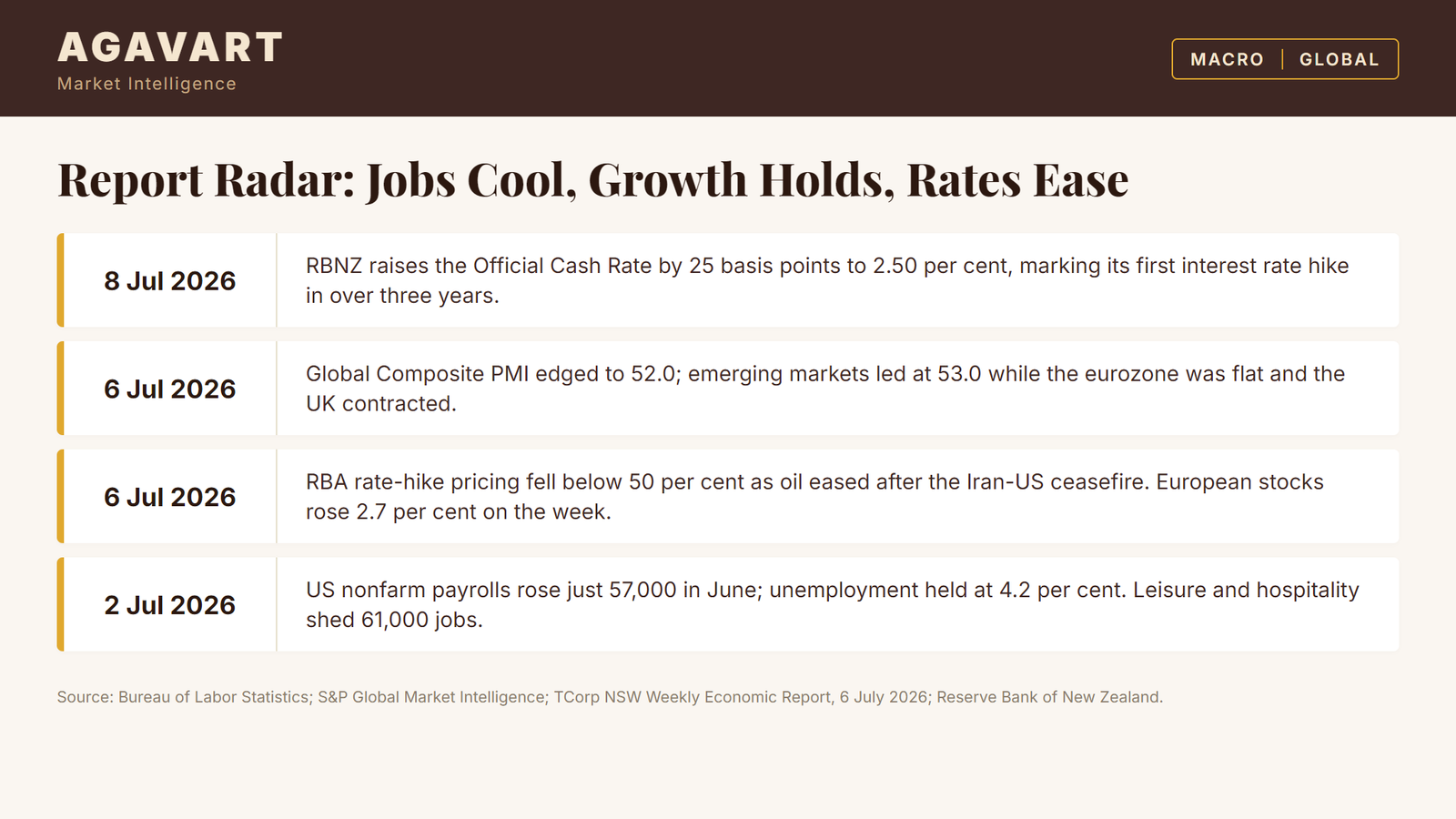
Global economic growth edged higher in June as emerging markets outpaced advanced economies, according to the J.P.Morgan Global Composite PMI. This growth in emerging markets comes as a cooling US jobs market and easing oil prices combine to lower global interest rate expectations.
Global PMI, June 2026: S&P Global
S&P Global’s Purchasing Managers’ Index (PMI) surveys showed world economic activity expanding for the twentieth consecutive month in June. The J.P.Morgan Global Composite PMI Output Index rose to 52.0 from 51.9 in May, driven primarily by services, while manufacturing remained weak. Growth stayed highly uneven across regions. The emerging markets continued to outpace advanced economies, with their aggregate output index rising to 53.0. Mainland China recorded its strongest quarterly growth in three years, supported by solid service sector demand, while India maintained its position as the fastest-growing major economy despite a slight moderation in momentum. In contrast, advanced economies showed divergence, similar to the trends flagged in the OECD’s recent Korea Economic Survey. The United States expanded at an annualised rate of about 1.2 per cent, and Japan recorded solid services growth. However, the eurozone was flat, while the United Kingdom and Canada slipped into contraction. Business optimism about the year ahead remained positive but cautious in these emerging markets, with firms citing concerns over persistent service-sector inflation and elevated shipping costs, which kept global job creation modest.
Read the original: Global PMI Commentary, June 2026 (S&P Global Market Intelligence)
Weekly Economic Report, 6 July 2026: TCorp NSW
TCorp’s weekly economic report noted that the immediate market effects of the West Asia conflict appeared to be fading, lifting global equity markets and sovereign bond yields. Pricing for further Reserve Bank of Australia (RBA) rate hikes slipped below 50 per cent as global crude oil prices eased following the Iran-United States ceasefire. Over the week, European stocks surged 2.7 per cent, US equities rose 1.8 per cent, and Australia’s ASX200 gained 0.9 per cent. Bond markets moved in tandem, reflecting expectations of higher-for-longer policy rates. The US 10-year Treasury yield closed 11 basis points higher at 4.48 per cent, while the German 10-year Bund yield rose 8 basis points to 2.94 per cent. In Australia, the 10-year government bond yield rose 8 basis points to 4.80 per cent, and the RBA cash rate held steady at 4.35 per cent. TCorp highlighted that if the drop in oil prices holds, the inflation risk from shipping and energy chokepoints will recede further. Meanwhile, markets braced for policy updates, with the Reserve Bank of New Zealand raising rates on 8 July and the RBA’s Hunter scheduled to speak.
Read the original: Weekly Economic Report, 6 July 2026 (TCorp NSW)
US Jobs Report, June 2026: Bureau of Labor Statistics
US nonfarm payrolls rose by a modest 57,000 in June, indicating a significant cooling in the labor market, according to the Bureau of Labor Statistics. The unemployment rate held steady at 4.2 per cent, with the number of unemployed individuals little changed at approximately 7.1 million. Job growth was concentrated in professional and business services, social assistance, and health care. Conversely, the leisure and hospitality sector shed 61,000 jobs, driven by weaker-than-normal seasonal hiring patterns. The cooling trend was reinforced by revisions to previous months, as April and May payroll numbers were revised down by a combined 74,000. Under the household survey, the labor force participation rate edged down slightly to 61.5 per cent, and the employment-population ratio was 59.8 per cent. Wage growth remained steady, with average hourly earnings for all employees rising by 0.3 per cent to $37.64. Over the year, hourly earnings have increased by 3.5 per cent. The average workweek for all employees remained unchanged at 34.3 hours, reflecting stable operational capacity despite slower hiring.
Read the original: The Employment Situation, June 2026 (BLS)
Curated and Reviewed by Deepak Chavan | Founder and Market Expert